
 Search Articles


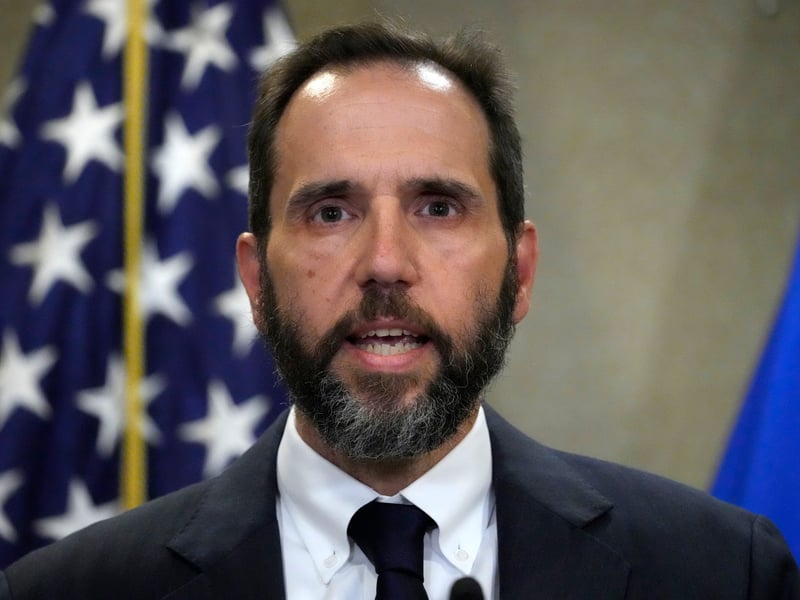
WASHINGTON (CN) — Members of the House Judiciary Committee on Thursday grilled former special counsel Jack Smith during the first public hearing on his ill-fated prosecution of President Donald Trump.
But even as Republican lawmakers sought to frame his probes into the president as politically motivated and cast doubt on his character and prosecutorial record, Smith held firm that he and his team had followed Justice Department protocol and charged Trump based on facts and evidence.
The former special counsel, appointed during the Biden administration to investigate then-former President Trump’s handling of classified documents as well as his efforts to overturn the 2020 presidential election, has become a central target for Republicans during Trump’s second term. Last month, the Judiciary Committee sat for a closed-doors deposition with Smith, who GOP lawmakers have repeatedly argued was a part of a yearslong political operation to put the president behind bars.
Thursday’s public hearing, though novel, was largely a rehashing of the December 2025 deposition, as Smith defended his prosecution from Republican attacks and Democrats accused their colleagues of running interference for Trump.
“It was always about politics,” fumed U.S. Representative Jim Jordan, an Ohio Republican who heads the House Judiciary Committee. “To get President Trump, they were willing to do just about anything.”
Republicans in recent months have been particularly incensed by reports that Smith oversaw the collection of phone toll records of several prominent Republican lawmakers — including former House Speaker Kevin McCarthy — as part of his probe into 2020 election interference. The former special counsel told the Judiciary Committee in December that the records were fair game for an investigation because Trump had ordered allies to call Republicans on Jan. 6, 2021, and pressure them to delay congressional certification of then-President Joe Biden’s victory.
But Jordan on Thursday suggested that Smith and the Biden administration had effectively spied on McCarthy and other Republicans by collecting their toll records.
“The guy is second in line to the president,” said the Ohio congressman. “They know who he called, who called him, when the call took place and how long it lasted. You can pattern an individual’s life.”
Smith, for his part, said in his opening statement that he hoped to correct what he called “false and misleading narratives” about his work as special counsel. He pushed back particularly forcefully on claims that his investigations into Trump were motivated by partisan animus.
“I am not a politician, and I have no partisan loyalties,” said Smith. “Throughout my public service, my approach has always been the same — follow the facts and follow the law without fear or favor.”
The former special counsel argued that he and his team had always followed Justice Department policy and observed legal requirements. He argued that he made the decision to prosecute the president “without regard” to his political party or candidacy.
“President Trump was charged because the evidence established that he willfully broke the law, the very laws he took an oath to uphold,” Smith said.
Responding to questions from Maryland Representative Jamie Raskin, the former special counsel again defended his move to secure toll records from Republican lawmakers, telling the top House Democrat that the effort was part of a “thorough investigation” into Trump’s attempt to overturn the results of the 2020 election.
Smith claimed that the toll records were relevant to understand the scope of the “conspiracy” to flip the election in Trump’s favor, and to determine which members of Congress the president’s allies were seeking to coerce.
Securing “noncontent” toll records, call logs that do not include a transcript, is “common practice” in such criminal investigations, the former special counsel said.
And Smith pointed out to U.S. Representative Kevin Kiley that the Justice Department’s public integrity section had approved the move to secure toll records. “When we secured these toll record subpoenas, it was done consistent with department policy,” he told the California Republican.
U.S. Representative Brandon Gill, meanwhile, accused Smith of violating the Constitution’s “speech and debate” clause, which grants lawmakers broad immunity from prosecution for official duties.
“Collecting months worth of phone data on the Republican speaker of the House, the leader of the opposition, right after he got sworn in as speaker and around the time of a major vote sounds like a flagrant violation of the speech and debate clause to me,” the Texas Republican said.
Gill also pointed to emails from the Justice Department’s public integrity section warning of “litigation risk” surrounding the toll records and legal immunity afforded to members of Congress. But Smith reiterated that the subpoenas were secured with the “concurrence” of the public integrity office.
The former special counsel also faced questions from Republicans about his character and record. Some lawmakers framed him as routinely overstepping prosecutorial bounds, pointing to previous reversals from the Justice Department, federal judges and the Supreme Court.
Kiley argued that Smith had not operated with “humility and restraint” as required of special counsels. “I see a very different mode of operation — one that sought maximum litigation advantage at every turn,” he said. The California Republican claimed the former special counsel had a reputation for “stretching criminal statutes beyond the breaking point.”
Smith, though, disagreed with that characterization.
“I think my career speaks for itself,” he said. “I have conducted my career in a nonpartisan fashion.”
The former special counsel also used Thursday’s public hearing to slam Trump for seeking “revenge” on federal prosecutors, FBI agents and other staff who worked on the prosecutions against him. Smith accused the president of unfairly vilifying the “dedicated public servants” who worked alongside him on the probes.
And Smith also issued a warning about what he saw as the erosion of the rule of law in the U.S. under Trump.
“My fear is that we have seen the rule of law function in our country for so long that many of us have come to take it for granted,” said the former special counsel. “The rule of law is not self-executing. It depends on our collective commitment to apply it. It requires dedicated service on behalf of others, especially when that service is difficult and comes with costs.”
In a post on Truth Social Thursday afternoon, Trump wrote that Smith had been “decimated” by House Republicans during his testimony.
“He destroyed many lives under the guise of legitimacy,” the president wrote. “Jack Smith is a deranged animal, who shouldn’t be allowed to practice law.” He added that Smith and others involved in the cases against him should pay “a big price.”
The Justice Department early last year dropped both the classified documents case and election interference cases against Trump. While Smith’s report on the election interference probe has been published, a court order in Florida has kept his survey of the classified documents investigation under wraps.
The Justice Department has said that it has no plans to publish the report, and has instructed Smith that he cannot discuss the details of his findings with lawmakers.
 Follow @BenjaminSWeiss
Subscribe to our free newsletters
Our weekly newsletter Closing Arguments offers the latest about ongoing trials, major litigation and rulings in courthouses around the U.S. and the world, while the monthly Under the Lights dishes the legal dirt from Hollywood, sports, Big Tech and the arts.