
 Search Articles


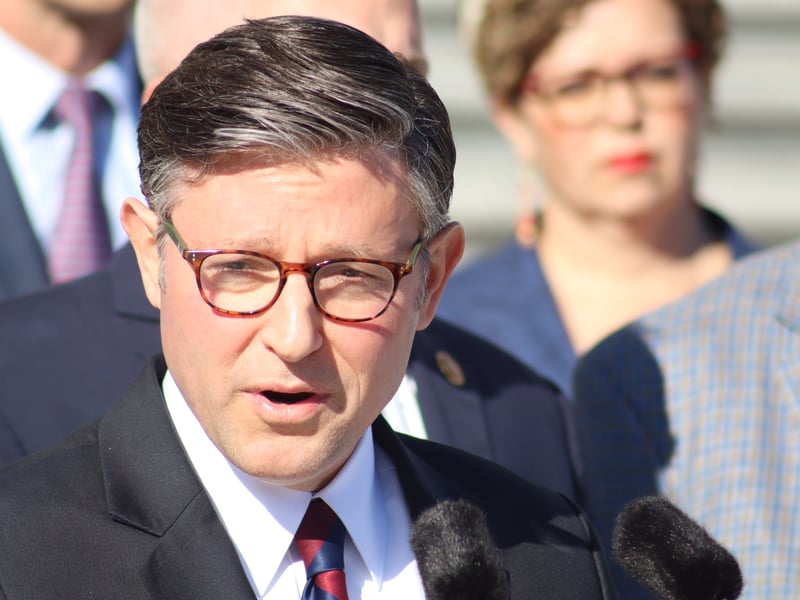
WASHINGTON (CN) — House Speaker Mike Johnson refused to weigh in on Tuesday about whether Trump administration officials had overstepped by branding a Minneapolis woman killed by federal agents as a “domestic terrorist,” even as the government is actively investigating her fatal shooting.
And while the top House Republican said he wanted to reserve judgment, he also claimed Renee Nicole Good — shot dead in her car last week by a U.S. Immigration and Customs Enforcement agent — was “impeding” law enforcement and had attempted to hit the federal agent who ultimately killed her.
Senior Trump administration officials have repeatedly referred to Good, 37, as a domestic terrorist after her shooting, arguing that the ICE agent was acting in self-defense. Homeland Security Secretary Kristi Noem has doubled down on her agency’s determination, telling CNN Sunday that Good had “absolutely” threatened law enforcement.
“We all saw what happened,” she said.
Video clips of the shooting, taken from several angles, show Good’s Honda SUV stopped in front of federal agents who are demanding she get out of the car. Good reversed her vehicle and then drove forward, forcing an agent out of the way who then fired his service weapon multiple times into the car.
Reacting to initial footage of the shooting last week, White House senior adviser Stephen Miller offered a curt observation. “Domestic terrorism,” he wrote on X.
Asked by Courthouse News on Tuesday whether the Homeland Security Department and the White House were using too broad a definition of “domestic terrorism,” and whether he was concerned that such an interpretation could be used to further surveil or prosecute American citizens, Johnson demurred.
“I try to reserve judgment on these things until the investigation is borne out,” the House speaker said during a news conference. “This is a terrible tragedy that occurred here in Minneapolis, and we’ve all seen it. Everybody draws their own conclusions … This is why we have investigations.”
Still, Johnson offered his own interpretation of events, claiming that Good was “taunting” ICE agents.
“She was impeding law enforcement,” he said. “She was violating a number of laws … and they were very patient and asked her multiple times to remove her vehicle and stop impeding their operation.”
In one video clip, the officer who shot Good can be seen switching his cell phone to his non-dominant hand to reach for his holstered sidearm well before her car begins moving forward.
Johnson, though, argued that Good had “revved” her vehicle and attempted to ram the agent. “She hit the accelerator and hit the ICE officer, and he reacted in a split second,” he said. The House speaker did not respond to a follow-up question from Courthouse News about the administration’s decision to classify Good as a domestic terrorist.
The FBI has said it will investigate the circumstances of Good’s shooting without local assistance, cutting Minnesota authorities out of the process in a departure from normal practice in such a probe. And multiple sources reported the Justice Department’s Civil Rights Division has declined to investigate the shooting, prompting the resignation of at least four of the office’s top officials.
Minnesota on Monday sued the Trump administration to block the mass deployment of immigration agents and federal law enforcement to the state, which it called an “organized bombardment” aimed at punishing Democrat-led areas.
Johnson said Tuesday authorities in Minnesota should “definitely cooperate” with federal investigators. “That’s how these things work and we’ll find this out,” he said.
The second Trump administration has taken steps to drastically expand the type of conduct considered domestic terrorism, as the White House seeks to crack down on what it sees as the threat of political violence from left-leaning groups.
President Donald Trump in September issued a directive known as National Security Presidential Memorandum No. 7, or NSPM-7, which directs the National Joint Terrorism Task Force to develop what it calls a “comprehensive national strategy” to investigate and prosecute political violence and entities it says fund such activity.
But Trump casts a wide net of ideologies in NSPM-7 he says are “animating” factors in domestic political extremism, such as “extremism on migration, race and gender.” In the memo he also designates “hostility to those who hold traditional American views on family, religion and morality” as motivating political violence, though without defining “traditional.”
The national security memo has generated little buzz on Capitol Hill, even among Democrats who have warned about what they’ve framed as an effort by Trump to target left-leaning groups. But the White House has already cited NSPM-7 as part of its domestic law enforcement strategy.
After the FBI in December foiled what it said was a terror plot by a “far-left, pro-Palestine, anti-government and anti-capitalist group” in California, Miller credited the national security directive.
“Following the issuance of NSPM-7 vast government resources have been unleashed to find and dismantle the violent fifth column of domestic terrorists clandestinely operating inside the United States,” the White House adviser wrote on X.
 Follow @BenjaminSWeiss
Subscribe to our free newsletters
Our weekly newsletter Closing Arguments offers the latest about ongoing trials, major litigation and rulings in courthouses around the U.S. and the world, while the monthly Under the Lights dishes the legal dirt from Hollywood, sports, Big Tech and the arts.