
 Search Articles


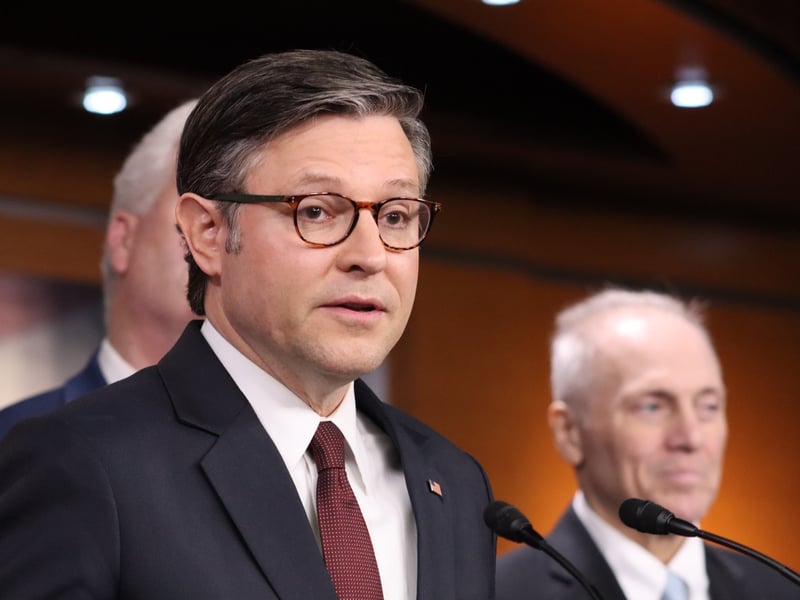
WASHINGTON (CN) — House Speaker Mike Johnson on Thursday publicly rebuked concerns from some conservative Supreme Court justices that the Trump administration’s efforts to wield unilateral tariff power trampled on congressional authority.
The top Republican lawmaker’s critiques came just hours after the high court grilled the administration on its attempt to use emergency authority to set tariff policy — and after Justice Neil Gorsuch worried that the gambit was a “one-way ratchet” snatching power from Congress without any recourse.
“I don’t find myself in disagreement with Justice Gorsuch too often, but I think he’s missed the mark on this one,” Johnson told Courthouse News during a news conference Thursday morning.
Gorsuch expressed reservations during oral arguments Wednesday about whether the Supreme Court should allow President Donald Trump to use the International Emergency Economic Powers Act, or IEEPA, to impose tariffs on a sweeping list of U.S. trading partners. The Trump administration has argued that the president has authority over foreign affairs and should be able to override Congress’ power of the purse to set tariffs unilaterally.
But Gorsuch and some of the other justices worried it would be hard to unroll such executive authority if the court chose to grant it.
“Congress, as a practical matter, can’t get this power back once it’s handed over to the president,” said Gorsuch, a Trump appointee. “It’s a one-way ratchet toward the gradual but continual accretion of power in the executive branch and away from the people’s elected representatives.”
Johnson, however, waved away the justice’s concerns, arguing that while Congress had a “role to play” in setting tariffs, the Trump administration was “well within the bounds” of its authority. He credited the president with addressing the country’s trade deficit, which he said was “truly a crisis.”
And the House speaker contended Trump had made it clear on the campaign trail that he would seek to impose sweeping tariffs if reelected.
“It’s not some surprise,” Johnson said. “He’s fulfilling the promise that he was elected to fulfill, in a literal sense. I think the court has to give deference to that.”
Johnson also pushed back on the idea that the Trump administration had trampled on congressional authority with its unilateral tariffs. The former constitutional lawyer repeated his oft-cited claim that he was a “jealous guardian” of congressional authority and pointed out that he would have gone to Trump himself if he believed the tariffs violated the Constitution’s separation of powers.
“I would have gone to the president privately and said, ‘hey, sir, enough. I think you’ve overstepped the bounds,’” Johnson said. “But that conversation didn’t happen, because I believe what he’s done is within the balance.”
He further argued it’s wrong to “read too much into” the justices’ questioning at oral arguments. He said the tough examination was part of the Supreme Court’s tradition of judicial review.
“This is how the process works,” he said. “I’m sure the court will look at this very carefully and deliberately, and I expect a majority of the court will say this administration is doing what they have the legal authority to do.”
It’s not the first time in recent months that Gorsuch has pushed back on delegating powers away from Congress. The justice over the summer dissented in the high court’s ruling upholding a Federal Communications Commission program that funds a private company to administer phone and internet services in rural areas, reasoning that the Supreme Court had allowed Congress to abandon its authority over tax collection.
“In upholding that arrangement, the court defies the Constitution’s command that Congress ‘may not transfer to another branch powers which are strictly and exclusively legislative,” the justice wrote at the time.
And Gorsuch wasn’t the only conservative justice Wednesday to question the Trump administration’s claims of broad tariff authority.
Chief Justice John Roberts opined that while tariffs concern foreign affairs, the vehicle for such import duties is a tax on Americans, which he said has always been a core power of Congress. “To have the president’s foreign affairs trump that basic power for Congress seems to me to neutralize between the two powers, the executive power and the legislative power,” he said.
Justice Amy Coney Barrett, also a Trump appointee, agreed with Gorsuch that it would be difficult for Congress to regain its authority if the Supreme Court allowed the Trump administration to secure emergency power over tariffs. She pointed out that lawmakers would need a veto-proof majority to legislate such power away from the president.
Trump in April declared a national emergency over U.S. trade deficits and imposed a 10% global tariff on imports, with higher rates on a smaller list of countries. The president slapped additional tariffs on Canada, Mexico and China over what he said were connections to drug trafficking.
 Follow @BenjaminSWeiss
Subscribe to our free newsletters
Our weekly newsletter Closing Arguments offers the latest about ongoing trials, major litigation and rulings in courthouses around the U.S. and the world, while the monthly Under the Lights dishes the legal dirt from Hollywood, sports, Big Tech and the arts.