
 Search Articles


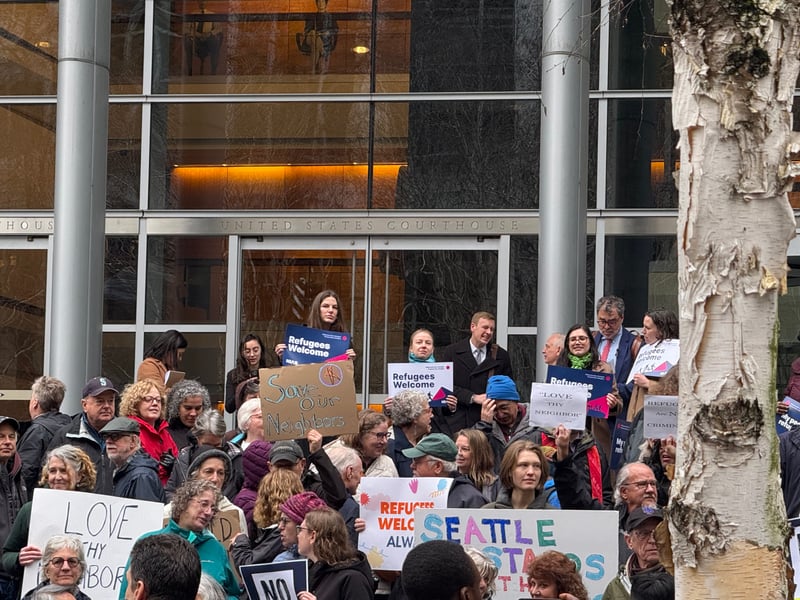
SEATTLE (CN) — The Trump administration’s travel ban does not bar entry for certain refugees despite the government’s attempt to whittle down the number of refugees admitted to the country, a federal judge ruled Monday evening.
U.S. District Judge Jamal Whitehead ordered the government to resume processing the cases of around 80 refugees who were being denied entry based on their nationality due to the Trump administration’s travel ban.
“The court expects all parties to implement this framework in good faith, recognizing that real families remain in limbo while these legal processes unfold,” the Joe Biden appointee wrote in the 23-page compliance framework. “Delays in implementation mean continued separation from safety for some of the world’s most vulnerable people.”
In February, Whitehead issued a preliminary injunction preventing the government from enforcing its Jan. 20 refugee ban and later another ordering it to reinstate the thousands of federal contracts with resettlement agencies it terminated. However, after a series of appeals to the Ninth Circuit, the preliminary injunction was narrowed from covering around 160 refugees to only include about half who met specific circumstances.
The government had argued during an emergency hearing last week that the travel ban closely mirrored that which was issued during President Donald Trump’s first term, but the court found that it contained a carve-out for refugees.
“Finally — and perhaps most decisively — the government’s representations confirm this reading,” Whitehead wrote.
The legal battle between the Trump administration and the refugees and aid groups who sued over the day-one shutdown of the U.S. Refugee Admissions Program has taken several turns, as the court continues to grapple with its authority.
The experience of one plaintiff, identified as Pacito, has been identified by both the appeals court and the district court as defining the reliance interest standard.
Pacito, along with his wife and infant son, were approved for resettlement and had travel booked for Jan. 22. On Jan. 21, after selling their belongings and giving up the lease on their home in Kenya, their travel was canceled and the family spent the night homeless in the parking lot of a transit center.
The injunction protects refugees with similar experiences to Pacito, Whitehead confirmed.
Whitehead also ordered the government to review whether certain refugees whose travel was canceled before Jan. 20 — as early as Dec. 1, 2024 — are protected, if they have an experience similar to Pacito’s. The plaintiffs argued that early implementation of the forthcoming order shuttering the admissions program may have left admitted refugees in the same position as those whose travel was abruptly canceled following the order.
To ensure compliance, the court ordered the government to identify within a week “review-eligible cases” — those that meet the Ninth Circuit’s criteria of having an approved application, having been cleared by customs for travel and having had arranged and confirmable travel plans to the U.S.
Under the framework, all 160 refugees the government identified who had travel plans within two weeks of Trump’s order are protected.
“That entitlement persists, and it applies fully to the 80 individuals to whom the government has denied relief based on [the travel ban],” Whitehead wrote.
In addition, minor children traveling alone to either reunite with family or be placed in foster care are protected by the injunction, Whitehead ruled.
“To place the burden of proving individualized reliance on a population of unaccompanied refugee children — a population of diminished legal capacity, and likely impacted by severe trauma — would be inequitable, impractical, procedurally unsound, and unlikely to produce accurate results,” Whitehead wrote.
Afghan refugees who were required by the U.S. government to relocate to Camp As Sayliyah for their applications to be processed are also protected. The government has two weeks to resume processing their cases.
U.S. Magistrate Judge Michelle Peterson will review the cases should the government object to any that meet the above criteria.
Subscribe to our free newsletters
Our weekly newsletter Closing Arguments offers the latest about ongoing trials, major litigation and rulings in courthouses around the U.S. and the world, while the monthly Under the Lights dishes the legal dirt from Hollywood, sports, Big Tech and the arts.