
 Search Articles


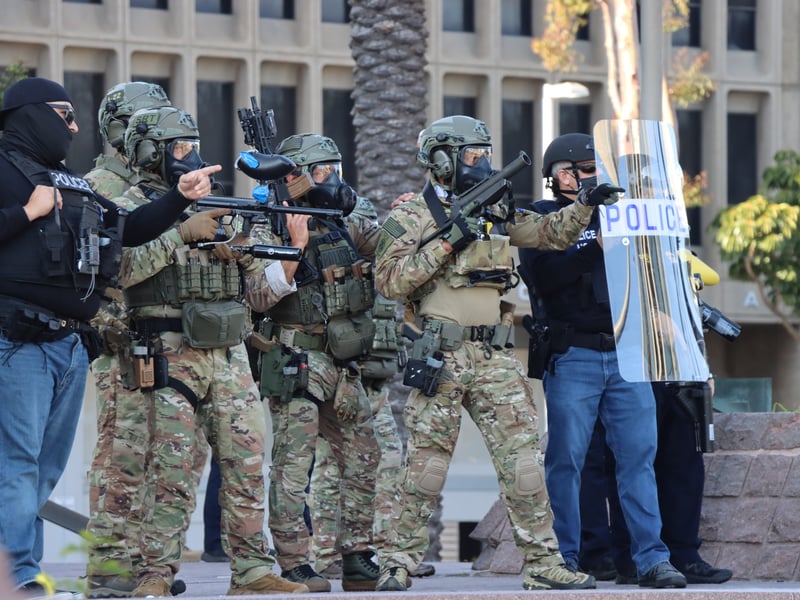
LOS ANGELES (CN) — A federal judge issued a preliminary injunction Monday against California’s No Secret Police Act because it blocks federal law enforcement agents, but not state law enforcement officers, from wearing face masks when performing their duties in public.
Senior U.S. District Judge Christine Snyder rejected the Trump administration’s request to also enjoin California’s No Vigilante Act, which requires U.S. Immigration and Customs Enforcement and other federal agents to wear identification that shows their agency and either their name or badge number.
The judge, a Bill Clinton appointee, already indicated at a hearing last month she was concerned about the potential discriminatory aspect of the ban on masks because it doesn’t apply to, for example, California Highway Patrol officers.
“Even though the United States has failed to demonstrate that the facial covering prohibition of the No Secret Police Act unduly interferes with federal functions, the court acknowledges that it is nonetheless an incidental regulation on law enforcement officers,” Snyder wrote. “The intergovernmental immunity doctrine prohibits imposing such a regulatory burden, albeit minimal and incidental to operations, in a discriminatory manner against the federal government.”
She stayed her ruling on the No Vigilantes Act and on the provisions of the No Secret Police Act that don’t pertain to face masks for 10 days at the government’s request.
“Today’s ruling by the U.S. District Court for the Central District of California denied the Trump administration’s attempt to block California from requiring law enforcement officers, including federal agents, to visually identify themselves by agency and either by name or badge number,” California Attorney General Rob Bonta said. “Safe communities thrive on transparency and trust and California is committed to doing our part to uphold public safety and civil liberties.”
Representatives of the Justice Department did not immediately respond to a request for comment.
Governor Gavin Newsom signed the two statutes in September 2025 as part of a package of legislation that was intended to push back at President Donald Trump’s “secret police” tactics in California.
“For Trump and Miller, the only metric is mass arrests, detentions and removals — even at the expense of Americans’ constitutional rights,” Newsom said at the time, referring to White House Deputy Chief of Staff Stephen Miller. “ICE agents have wrongfully arrested citizens, concealed their identities and undermined transparency.”
Snyder in her ruling largely dismissed the federal government’s arguments that masks were needed to protect ICE agents from “doxing” by activists who post the agents’ names and addresses on the internet, leading to threats.
While she acknowledged that federal agents — like judges, politicians and other public figures — are at risk of getting harassed or threatened, she pointed out there are both state and federal laws protecting people from this kind of criminal behavior.
She also noted the government hadn’t adequately argued why “discretionary” masking and identification policies were essential to safety of its law enforcement agents in the current, tense political climate.
“Security concerns exist for federal law enforcement officers with or without masks,” the judge said. “If anything, the court finds that the presence of masked and unidentifiable individuals, including law enforcement, is more likely to heighten the sense of insecurity for all.”
In addition, Snyder said, the government’s argument that face masks are needed to protect its agents is belied by the fact that there are no requirements for the agents to wear them.
The two laws were initially supposed to go into effect on Jan. 1, but California agreed to stall enforcement until the judge had had an opportunity to review their legality. Homeland Security, which includes ICE, has indicated it doesn’t intend to comply with California’s requirements.
 Follow @edpettersson
Subscribe to our free newsletters
Our weekly newsletter Closing Arguments offers the latest about ongoing trials, major litigation and rulings in courthouses around the U.S. and the world, while the monthly Under the Lights dishes the legal dirt from Hollywood, sports, Big Tech and the arts.