
 Search Articles


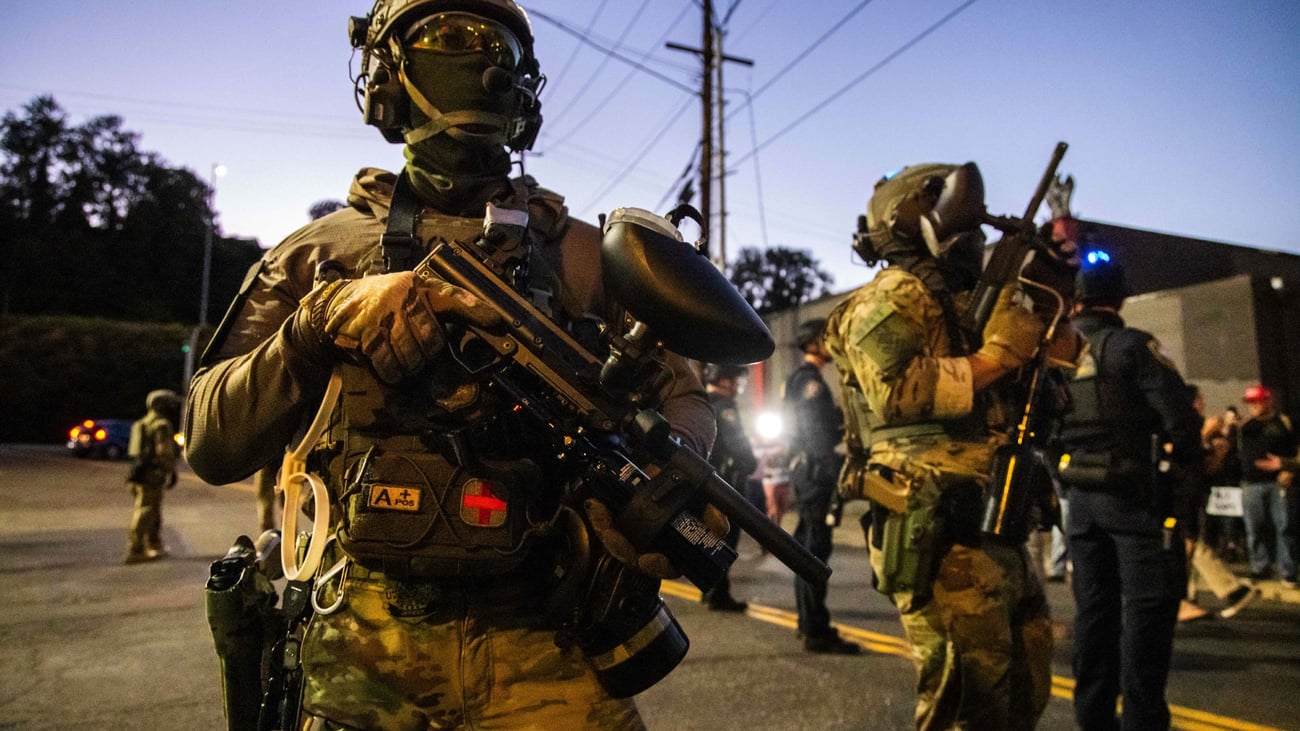
RICHMOND, Va. (CN) — Virginia cannot enforce a newly passed law prohibiting U.S. Immigration and Customs Enforcement from wearing masks, a federal judge ruled less than 12 hours before it would have taken effect.
Senior U.S. District Judge Robert Payne held the Justice Department was likely to succeed in its argument that the intergovernmental immunity doctrine and the supremacy clause of the U.S. Constitution preclude the commonwealth from regulating the conduct of federal officers.
The government “is likely to suffer irreparable injury, absent preliminary injunctive relief, because its valid laws and practices in a domain of federal authority are undermined by impermissible state regulation that is required by the mask/indentity statute,” the George H.W. Bush appointee wrote in a three-page order.
“And because there is evidence that enforcement of the mask/identity statute would expose federal employees to real risk of physical harm in, and in connection with, the discharge of their duties when enforcing federal immigration law and policy,” he added in his brief 3-page order.
The injunction also enjoins a provision of the law requiring federal law enforcement officials to wear a visible badge displaying their name.
The injunction will remain in place until the case is resolved.
“The Attorney General’s Office strongly disagrees with Judge Payne’s order and will continue defending this important law,” Virginia Attorney General Jay Jones said in a statement. “We remain steadfast in our mission to support law enforcement, keep Virginians safe and protect every Virginian’s right to the transparent administration of the law."
Jones, a Democrat, did not immediately state whether he would appeal the injunction or seek a stay.
The law would make it a Class 1 misdemeanor to wear facial coverings and to fail to display identifying information while performing official duties.
The Democratic-controlled General Assembly argued the law prevents those impersonating law enforcement from harming the public. The Justice Department countered that the law will lead to doxing and increased assaults on federal law enforcement.
“With any new law, there is always the possibility of a legal challenge,” state Senator Saddam Salim, who sponsored the bill, said in a statement. “However, we crafted SB352 carefully, including reviewing recent Supreme Court decisions, to ensure it is constitutional. Instead of challenging these reasonable restrictions, the Department of Justice should seek accountability for the actions of poorly trained ICE agents, release the Epstein files and investigate the Trump organization’s unprecedented corruption."
To obtain injunctive relief, a plaintiff must show they are likely to succeed on the merits, they will suffer irreparable harm, the balance of equities tips in their favor, and the injunction is in the public interest.
“The public interest and balance of equities favor an injunction because frustration of, and interference with, federal statutes and prerogatives are not in the public interest and there is no harm from the state’s nonenforcement of invalid legislation,” Payne wrote.
The Justice Department argued to Payne that allowing states to control how federal law enforcement officials conduct their business is a slippery slope, posing, as a hypothetical, a state that requires officials to wear bright pink to make themselves more apparent to the public.
Payne heard the case as courts in New York, New Jersey, Illinois and elsewhere weigh similar efforts from state governments to restrict ICE agents’ conduct.
The Justice Department nudged Payne to give substantial weight to a recent Ninth Circuit ruling prohibiting California from enforcing a law requiring federal law enforcement agents to wear visible identification while on duty.
In granting the federal government a preliminary injunction, a unanimous Ninth Circuit panel also held the California law likely violates the supremacy clause by regulating the performance of federal functions. The panel further held that laws invalid under the doctrine of intergovernmental immunity cause the federal government irreparable harm needed to seek injunctive relief.
The Justice Department sued Fairfax County Commonwealth’s Attorney Steven Descano individually, claiming Descano is an appropriate party because he oversees law enforcement in the commonwealth’s most populous county — and because he is a member of Fight Against Federal Overreach, a coalition of state prosecutors seeking to hold federal officials accountable when they exceed their lawful authority.
The Justice Department, however, agreed to dismiss Descano after he stipulated that an injunction would apply to him.
The Justice Department is also seeking to block a new Virginia law that invalidates cooperation agreements under the Immigration and Nationality Act between state and local law enforcement and ICE. Payne set a hearing on the matter for Aug. 3.
The mask law provides exceptions for health reasons related to protecting officers from diseases, toxins, smoke, gas and severe weather conditions. It also excludes state and local law enforcement officers assigned to undercover, drug, gang, SWAT or surveillance units.
The Justice Department did not immediately respond to a request for comment.
Subscribe to our free newsletters
Our weekly newsletter Closing Arguments offers the latest about ongoing trials, major litigation and rulings in courthouses around the U.S. and the world, while the monthly Under the Lights dishes the legal dirt from Hollywood, sports, Big Tech and the arts.
Additional Reads
 Donor disclosure law upheld June 30, 2026
 Federal judge nukes Pentagon media escort requirement June 30, 2026