
 Search Articles


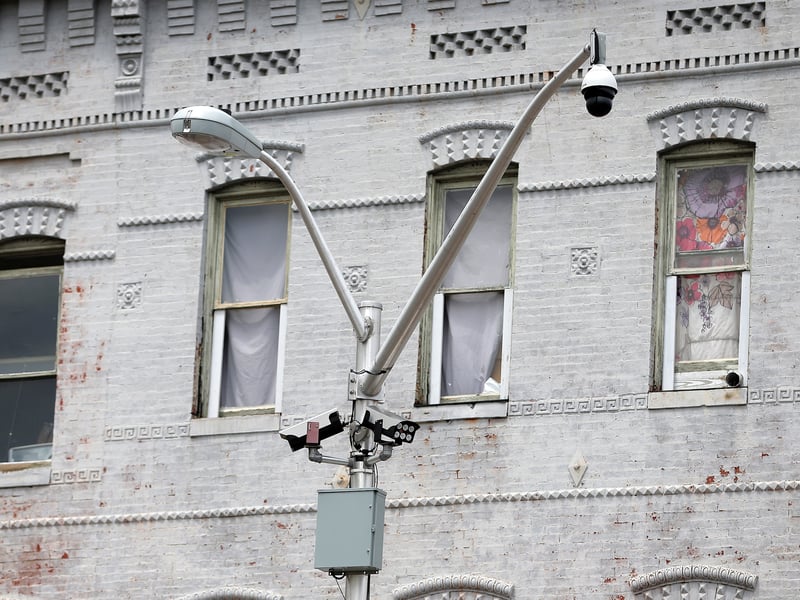
NORFOLK, Va. (CN) — A federal judge sided with the city of Norfolk Tuesday, ruling its use of automated license plate readers doesn’t violate Fourth Amendment privacy rights.
“Today, the federal court decided that Norfolk Police Department’s use of Flock ALPR cameras is fully compliant with the Constitution,” a city spokesperson said in an email. “While the city is pleased with this outcome, it is mindful of the privacy interests raised with the use of law enforcement tools like ALPRs and will benefit from the analysis and guidance provided in the court’s thorough and thoughtful opinion.”
The Fourth Amendment provides the right of the people to be secure against unreasonable searches and seizures in their persons, houses, papers and effects. In determining whether a policy violates the Constitution, the Supreme Court tasks lower courts with deciding whether the plaintiffs have a reasonable expectation of privacy. U.S. District Court Judge Mark Davis ruled that a search doesn’t occur when cameras take discrete pictures at different locations.
“Because rapid technological advances, such as the rise of artificial intelligence, make it impossible to predict how police surveillance will evolve, the Fourth Amendment analysis must remain nimble even as it remains grounded in founding-era traditions,” the George W. Bush appointee wrote in a 51-page opinion. “Plaintiffs are unable to demonstrate that defendants’ ALPR system is capable of tracking the whole of a person’s movements."
Norfolk residents Lee Schmidt and Crystal Arrington, with the help of the Institute for Justice, sued the city after discovering that automated license plate reader cameras from the company Flock Safety captured their vehicles 475 and 325 times, respectively, over four months in 2025. Schmidt and Arrington articulated their plans to appeal the ruling in a press release.
“The city of Norfolk lives under the watch of a flock of unblinking eyes — a growing network of 176 automated license plate reader cameras made by Flock Safety,” Schmidt and Arrington wrote in their motion for summary judgment. “The Flock cameras yield a massive trove of data anyone with access can mine for insights about people’s movements, habits, and routines.”
Those who oppose the use of automated license plate readers argue the practice effectively puts an ankle monitor on a city’s citizens. Those who support the cameras argue they allow police to solve crimes more effectively.
“The government cannot monitor someone’s daily movements without a warrant based on probable cause, which is why we’ll appeal today’s decision,” Institute for Justice attorney Michael Soyfer said in a press release. “As abuses of these ALPR systems are mounting nationwide, it’s more important than ever to vindicate the people’s right to security from mass surveillance guaranteed by the Fourth Amendment."
Flock cameras, mounted on poles next to public roadways, use artificial intelligence to comb through images of nearly every vehicle traveling in one direction and operate 24 hours a day. The cameras upload photos of passing cars to an encrypted server, where they are stored for 21 days.
“This decision aligns with strong national precedent, as over 30 state and federal courts across the country, at both the trial and appellate levels, have concluded that fixed‑location ALPRs do not infringe on an individual’s reasonable expectation of privacy, and therefore do not constitute a search under the Fourth Amendment,” Flock Saftey’s chief legal officer, Dan Haley, said in an email. “This ruling recognizes the difference between fixed LPR — which records an image of a vehicle at a single moment in time — and continuous tracking technologies like mobile phones or GPS trackers.”
The city argued in its motion that the pair hadn’t suffered an injury for purposes of standing. Davis disagreed, finding the pair had standing to bring their Fourth Amendment claim, reasoning that courts have routinely held that individuals subject to government surveillance have standing.
“The database of retained images is not limited to individuals engaged in criminal activity based on probable cause, or even reasonable suspicion, but instead ensnares an immense array of law-abiding citizens guilty of nothing more than driving their cars in Norfolk,” Davis wrote. “While it is undisputed that queries of plaintiffs’ vehicles were never performed, it is likewise undisputed that hundreds of photographs of plaintiffs’ vehicles were captured and stored during the test period, meaning that over time, plaintiffs’ vehicles are being photographed by defendants thousands of times.”
Davis did agree with the city that the pair lacked standing to challenge the warrantless use of the automated license plate reader database because the city had never made them the subject of a query.
Davis drew distinctions from two significant precedents in determining that the pair’s Fourth Amendment challenge lacked merit. In Carpenter v. United States, the Supreme Court held that the government violates the Fourth Amendment when it accesses a suspect’s historical cell site location information without a warrant. The Fourth Circuit ruled in Leaders of a Beautiful Struggle v. Baltimore Police Department that the department’s surveillance program, which captured and stored aerial images of nearly the entire city, violated the Fourth Amendment.
Davis ruled that, unlike in cases where the government tracked people’s movements through cellphone data and aerial photos, the collection of Flock data does not capture enough information to catalogue citizens’ movements in their entirety. Davis reasoned that the 176 cameras, located in 75 clusters across the city, do not constitute a search.
“It is well-established that police pole cameras or security cameras that photograph or record public areas do not violate any objectively reasonable expectation of privacy,” Davis wrote. “An individual scan of a license plate, a vehicle identifier that generally must be displayed under state law, does not invade any privacy interests.”
Delegate Charniele Herring, a Democrat, patroned a bill in 2025 that placed restrictions on the use of automatic license plate readers. The legislation restricts what investigators can use the data for and who they can share it with.
Some localities, such as Staunton, Virginia, are moving away from using Flock cameras despite their purported benefits. City leadership in Staunton canceled its contract with Flock Safety in December after determining that the company doesn’t reflect the city’s values.
“Although I’m of course disappointed by the court’s decision, I remain committed to fighting against this dragnet warrantless surveillance,” Schmidt said.
Subscribe to our free newsletters
Our weekly newsletter Closing Arguments offers the latest about ongoing trials, major litigation and rulings in courthouses around the U.S. and the world, while the monthly Under the Lights dishes the legal dirt from Hollywood, sports, Big Tech and the arts.