
 Search Articles


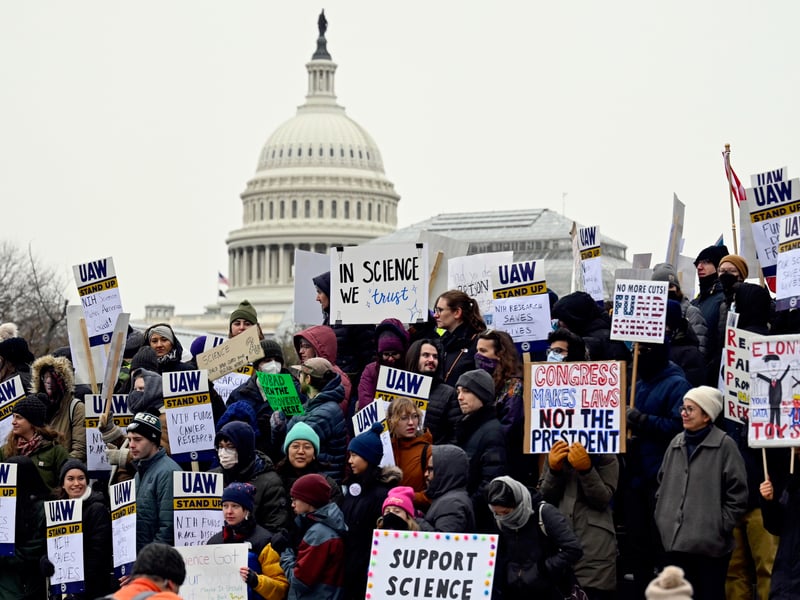
(CN) — A federal judge on Wednesday put the Trump administration’s expected $4 billion slash to National Institutes of Health research funding on ice, granting a scathing preliminary injunction in favor of universities, hospitals, research institutions and 22 states.
U.S. District Judge Angel Kelley, a Joe Biden appointee in the District of Massachusetts, ruled that the administration’s cuts to NIH “indirect cost” grants present “pressing, irreparable harm” to patients, researchers and the medical community as a whole.
“The risk of harm to research institutions and beyond is immediate, devastating and irreparable,” Kelley wrote in a 76-page order.
The NIH announced in February that it would be chopping the rates federal grants pay for indirect research costs — which includes infrastructure and equipment expenses — from an average of 30% to a hard 15% cap.
In effect, the policy change would cut roughly $4 billion allocated for biomedical research, likely ending ongoing clinical trials around the country and leading to the firing of medical researchers.
Michigan Attorney General Dana Nessel said at a press conference last month that the cuts could impact lifesaving research on diseases like cancer, the emerging bird flu and “whatever might be the next Covid.” Nessel was one of 22 state attorneys general who challenged the Trump administration’s rate change with a lawsuit on Feb. 10. Universities and medical associations later followed suit with their own complaints.
Judge Kelley, who is assigned to each of the cases, previously issued temporary blocks to the rate change. Her ruling on Wednesday pauses the policy nationally and indefinitely.
In her order, Kelley noted that “courts have consistently held there is a strong public interest in health and safety.” She ultimately found that the risks of allowing the funding slash to proceed outweighed the risks that came with blocking it.
“The first, and most pressing, irreparable harm is the suspension of ongoing research and risk to patients’ lives,” Kelley wrote. “Institutions across the country described the immediate suspension of research, and more specifically, clinical trials, should the court fail to grant a preliminary injunction in this case.”
Court records alluded to the vast number of ongoing clinical trials that would be at risk if the NIH cuts were to move forward, potentially leaving patients suffering from rare and serious diseases with no other treatment options.
Those arguments moved Kelley, who described those trials as “an incalculable commitment to patients, who by the very nature of their condition have nowhere else to turn.”
“The court is hard pressed to think of a loss more irreparable than the loss of a life, let alone the thousands of people who are counting on clinical trials as their last hope,” the judge wrote.
At risk, too, are the lives of thousands of animals that are essential to research surrounding human health, who would likely have to be euthanized under the new NIH cuts. According to Washington State University executive Leslie Brunelli, who filed a declaration on behalf of the university, “the loss of life would be massive” under the Trump administration’s plan.
She claimed that the school accounted for the use of 90,000 animals in 2023, and without proper funding from the NIH, “the results would be horrific.”
It was another point that moved Kelley toward granting the preliminary injunction.
“It is impossible to accurately measure or compensate humans who lose their lives from a pause in research. It is impossible to measure the value of lost research animals — representing years of study central to medical breakthrough — that will be euthanized,” Kelley said. “It is impossible to measure the value of discovery from scientists who choose to leave, or of the potential students who now never become scientists at all.”
The NIH policy change is one of numerous cuts to federal funding being championed by Republican President Donald Trump, who, alongside billionaire Elon Musk, is prioritizing slashing government spending and agencies in favor of private contracting.
Other Trump administration funding cuts have already left clinical trial participants high and dry. Its dismantling of the U.S. Agency for International Development has left patients overseas with unfinished treatments and, in some cases, experimental devices in their bodies, according to multiple reports.
Trump had proposed similar cuts to NIH research during his first administration in 2017, when he made a budget proposal to cut the indirect research grant rate to 10%. That effort died in Congress, however.
 Follow @Uebey
 Follow @uebey.bsky.social
Subscribe to our free newsletters
Our weekly newsletter Closing Arguments offers the latest about ongoing trials, major litigation and rulings in courthouses around the U.S. and the world, while the monthly Under the Lights dishes the legal dirt from Hollywood, sports, Big Tech and the arts.