
 Search Articles


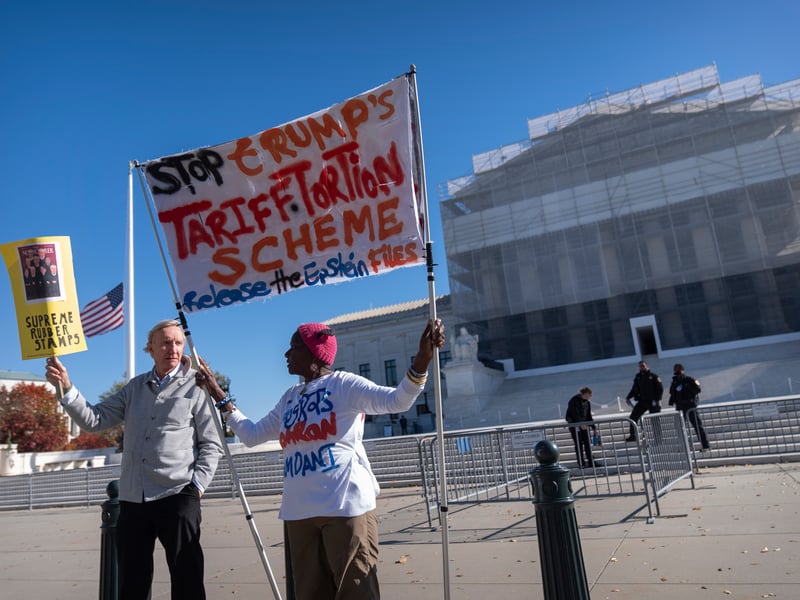
(CN) — A federal judge presiding over a case seeking refunds for President Donald Trump’s tariffs ordered the administration on Wednesday to finalize the paperwork for imported goods without charging companies the rates under the president’s invalidated tariff scheme.
Senior U.S. Judge Richard Eaton of the Court of International Trade instructed the U.S. Customs and Border Protection to liquidate all remaining goods that were imported under the International Emergency Economic Powers Act tariffs following the Supreme Court’s determination that the president misused the statute.
“With respect to any and all unliquidated entries that were subject to the IEEPA duties, U.S. Customs and Border Protection is hereby directed to liquidate those entries without regard to the IEEPA duties,” the Bill Clinton appointee wrote in a three-page order. “Any liquidated entires for which liquidation is not final shall be re-liquidated without regard to IEEPA duties.”
The liquidation process is how the CBP tallies the amount of money an importer must pay based on duty rates and the value of the imported goods — the cost of which companies typically pass off to consumers — before it can then enter the market.
Earlier on Wednesday, a CBP official informed Eaton in a declaration that the importers are entitled to refunds, with interest, after an initial review period.
Brandon Lord, executive director of the CPB’s Trade Policy and Programs directorate, stated the agency was actively liquidating imports with the duties imposed by Trump’s tariff regime and had not issued any refunds since the Supreme Court’s decision on Feb. 20.
Further, Lord said CBP had not instructed CBP officers to liquidate any imports without the IEEPA duties.
According to Lord, imports had increased under the IEEPA regime as compared to the year prior.
From February 2024 to February 2025, a total of 38,134,522 entries were filed with CBP. Over the same period between 2025 and 2026, 71,647,732 entries were filed, Lord said.
In response to Eaton’s question whether the agency would issue refunds with interest, Lord said that decision would partially depend on several factors, including entry type.
“In accordance with applicable law, any validated refund of IEEPA duties would include interest,” Lord said. “Regardless of entry type and liquidation cycle, CBP still requires a review period to ensure no violation of other Customs laws and no other duties, taxes or fees are owed.”
Over 1,000 companies have sued the government seeking refunds, which would return tens of billions of dollars paid since Trump launched his “Liberation Day” tariffs against nearly every country on April 2, 2025.
Eaton wrote in his order that he will preside over all cases regarding IEEPA refunds in order to maintain a consistent legal process for the billions of dollars at play.
“The chief judge has indicated that I am the only judge who will hear cases pertaining to the refund of IEEPA duties,” Eaton said. “So there is no danger that another judge, even one in this court, will reach any contrary conclusions. To find otherwise would be to thwart the efficient administration of justice and to deny those importers who have filed suit the efficient resolution of their claims, and to deny entirely importers who have not filed suit the benefit of the Learning Resourcesdecision.”
The Court of International Trade is one of two courts that heard challenges to Trump’s IEEPA tariffs before the Supreme Court — along with the Court of Federal Claims in Washington — and one of two that determined them illegal.
On Monday, the Court of Federal Claims denied the government’s requested stay and ordered the case, *V.O.S. Selections Inc. v. Trump,*back to the Court of International Trade and allowed for Eaton to begin the refund process in full.
 Follow @Ryan_Knappy
Subscribe to our free newsletters
Our weekly newsletter Closing Arguments offers the latest about ongoing trials, major litigation and rulings in courthouses around the U.S. and the world, while the monthly Under the Lights dishes the legal dirt from Hollywood, sports, Big Tech and the arts.