
 Search Articles


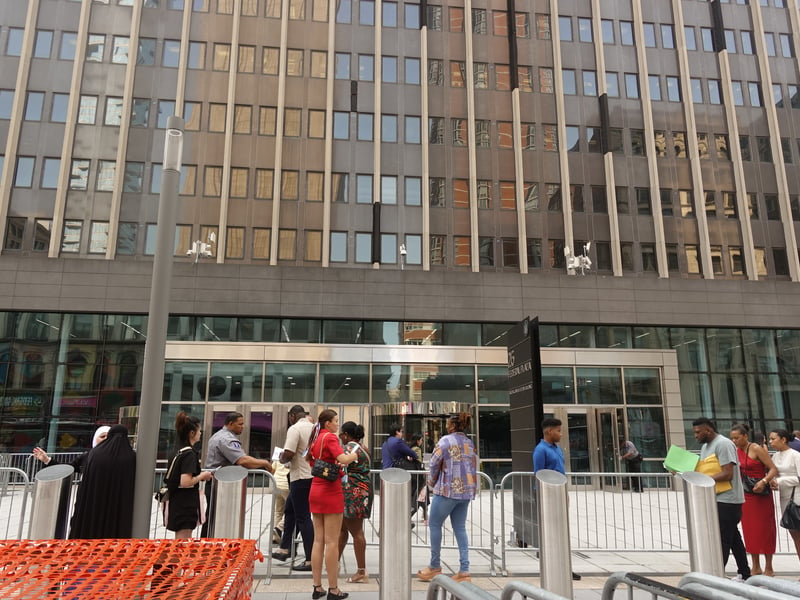
MANHATTAN (CN) — A federal judge on Tuesday ordered immigration authorities to better the living conditions at a processing center in Lower Manhattan amid a slew of complaints about the facility being overcrowded and unsanitary.
U.S. District Judge Lewis Kaplan, a Bill Clinton appointee in the Southern District of New York, made several demands to ensure inmates are being properly housed.
In granting a temporary restraining order, he is requiring that each detainee have 50 square feet of space, receive a clean bedding mat and hygiene supplies and be able to accessibly phone their attorneys within 24 hours of being arrested — conditions the detainees claim are not currently being met, despite being the federal government’s own standard for these detention sites.
The scrutinized facility is nestled on the 10th floor of 26 Federal Plaza, just two floors below the immigration courtrooms, where many immigrants and asylum seekers are being abruptly detained by Immigration and Customs Enforcement following routine court hearings.
That controversial practice is the subject of its own federal lawsuit. But Kaplan’s Tuesday ruling stems from a class action case brought by a detainee of 26 Federal Plaza, Sergio Alberto Barco Mercado, who claims he and others were denied access to soap, clean clothes, toothbrushes and showers at the facility, causing a “horrific stench” of sweat, urine and feces.
Other detainees paint a vivid picture of the center’s conditions in sworn affidavits. A 20-year-old woman claims she was denied feminine hygiene products — guards only gave the women in her holding room two pads to share among them — and was forced to wear blood-soaked clothes throughout her detention when she got her period.
Other inmates complained of malnutrition, only receiving two military-style ready-to-eat meals per day that they described as “inedible” and “slop.” One individual said he was always hungry while in the facility and lost 24 pounds while he was detained.
“Meanwhile, the guards have eaten pizza and hamburgers in front of hungry detained immigrants, which made them feel like they were being taunted,” Mercado claims in the lawsuit against ICE and the Department of Homeland Security.
At arguments Tuesday morning, the government didn’t dispute that many of Mercado’s claims about the conditions at 26 Federal Plaza were accurate.
“There is no factual dispute that there are no beds in these holding rooms and that they are not provided with sleeping mats,” Justice Department attorney Jefferey Oestericher said. “They are only provided with blankets. I think there is no dispute that they are provided two meals instead of three.”
Oestericher also conceded that some detainees have been denied medication, as well as access to their attorneys, which he claimed could be “logistically very difficult” to facilitate, though he argued that, since 26 Federal Plaza was designed to be a short-term facility, this doesn’t violate the inmates’ constitutional rights.
Kaplan wasn’t satisfied with that answer — he hinted that he’d be requiring federal authorities to do “quite a different and better job” of ensuring access to counsel, even if that means removing the detainees from the facility to a private telephone elsewhere.
The detainees claim their stays have been longer than the short-term ones Oestericher implied anyway, with some lasting often for a week or more, and even up to 15 days in one instance, according to court memos. These short-term holding jails are only designed to house detainees for up to 12 hours, per ICE’s internal protocol.
Despite Oestericher’s concessions, Department of Homeland Security spokesperson Tricia McLaughlin said in a statement that the judge’s order was “driven by complete fiction about 26 Federal Plaza.”
“Any claim of subprime conditions at ICE facilities are categorically false,” McLaughlin said. “26 Federal Plaza operates as a processing center, brief intake for illegal aliens, and then transfer to an ICE detention center meeting national standards for care and custody, which are in most cases better than facilities which detain Americans. ICE enforcement operations will continue at full speed to protect American communities from the worst of the worst, and DHS will appeal this order.”
Kaplan’s Tuesday ruling only requires that these minimum conditions be met for the next two weeks, after which he can choose to extend the protections via a preliminary injunction.
The facility has raised alarm bells among civil and immigrant rights groups, particularly as it became more and more crowded this spring when ICE ramped up immigration arrests citywide. Two of those groups — Make the Road New York and the American Civil Liberties Union — are representing Mercado in the class action.
“Today’s order sends a clear message: ICE cannot hold people in abusive conditions and deny them their Constitutional rights to due process and legal representation,” ACLU lawyer Eunice Cho said in a statement. “We’ll continue to fight to ensure that peoples’ rights are upheld at 26 Federal Plaza and beyond.”
 Follow @Uebey
 Follow @uebey.bsky.social
Subscribe to our free newsletters
Our weekly newsletter Closing Arguments offers the latest about ongoing trials, major litigation and rulings in courthouses around the U.S. and the world, while the monthly Under the Lights dishes the legal dirt from Hollywood, sports, Big Tech and the arts.