
 Search Articles


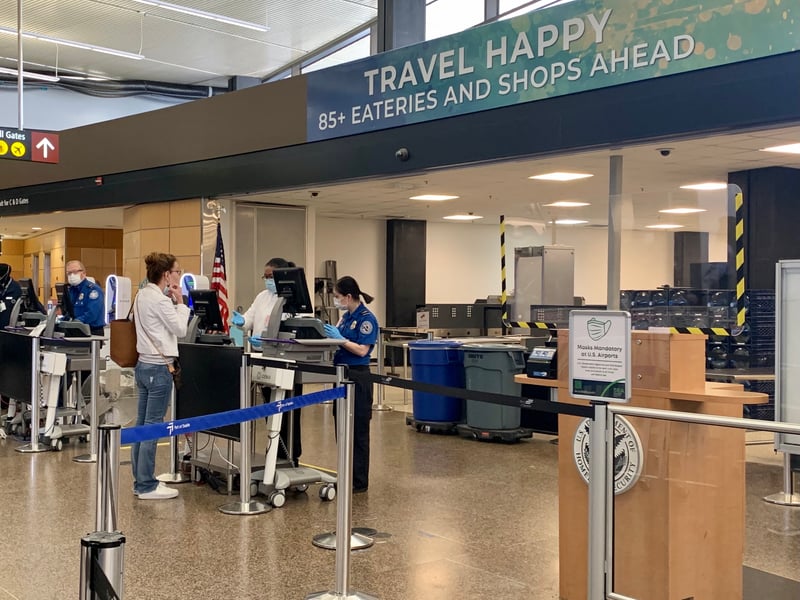
(CN) — A federal judge in Washington on Wednesday grounded the federal government’s attempts to dismiss a lawsuit against it over airport workers’ collective bargaining rights.
U.S. District Judge Marsha Pechman found a series of arguments by the U.S. Department of Homeland Security and Transportation Security Administration had no lift. The suit, filed by labor groups including the American Federation of Government Employees, will continue moving along the runway in the Western District of Washington.
The suit stems from a decision issued in February by U.S. Homeland Security Secretary Kristi Noem, who deemed a collective bargaining agreement no longer binding. Noem said that the American Federation of Government Employees would no longer serve as the employee representative and halted those employees’ ability to voluntarily pay dues from their paychecks.
“Plaintiffs did not receive notice of Noem’s intent to sign the determination and defendants did not follow the bargaining procedures set out in the 2024 [agreement], the Bill Clinton appointee said.
Pechman in June issued a preliminary injunction against Noem for voiding a labor agreement that covers some 47,000 Transportation Security Administration officers across the country. The agreement currently remains in effect.
On Wednesday, the judge upheld the labor groups’ claims against the defendants’ attempts to dismiss the suit, including a First Amendment retaliation claim.
For that claim to proceed, plaintiffs needed to show they participated in constitutionally protected activity, that the defendants’ acts would chill that activity and that the protected actions were a motivating factor in the defendants’ conduct.
“As to animus and causation, there are adequate allegations that the Noem [decision] comes from the Trump administration’s dislike for AFGE as a union pushing back against its federal employment policies and asserting its rights to petition the courts,” Pechman wrote.
Plaintiffs also note that President Trump issued a memorandum for agency heads targeting litigants like AFGE, stating ‘in recent weeks, activist organizations … have obtained sweeping injunctions … undermining the democratic process," the judge added.
The judge also found the plaintiffs properly argued a due process claim.
The defendants have said the collective bargaining agreement voided by Noem provided no protected property interest. However, Pechman ruled the labor groups likely would succeed on the claim, as Noem gave no notice when rescinding the agreement.
The defendants in their motion to dismiss also argued that the judge had no jurisdiction over the claims. Additionally, they have said claims that fall under the Administrative Procedure Act aren’t reviewable.
Concerning jurisdiction, Pechman ruled that Noem’s decision disrupts the labor groups’ ability to perform their duties. They have standing to represent their members, as those employees lost protections like union representation in investigatory interviews, she said.
Pivoting to the Administrative Procedure Act claim, Pechman noted that the defendants have said they have an exemption under the law.
While agencies do have discretion to make certain decisions, the judge found that the collective bargaining agreement created a self-imposed restriction on that discretion.
Once TSA entered into the bargaining agreement, it “set a policy and practice against which to measure Noem’s exercise of discretion and it conferred rights” on officers that they wouldn’t have otherwise enjoyed, the judge said.
Pechman also shot down an argument that the plaintiffs are making breach of contract claims, which must be pursued under a different legal avenue. The judge found that the bargaining agreement isn’t a contract that would require taking that different path, as it has no “money-mandating feature.” Instead, it details agreements about employment, as well as bargaining and union representation rights.
The U.S. Attorney’s Office for the Western District of Washington declined to comment, and the plaintiffs could not be immediately reached for comment.
Subscribe to our free newsletters
Our weekly newsletter Closing Arguments offers the latest about ongoing trials, major litigation and rulings in courthouses around the U.S. and the world, while the monthly Under the Lights dishes the legal dirt from Hollywood, sports, Big Tech and the arts.