
 Search Articles


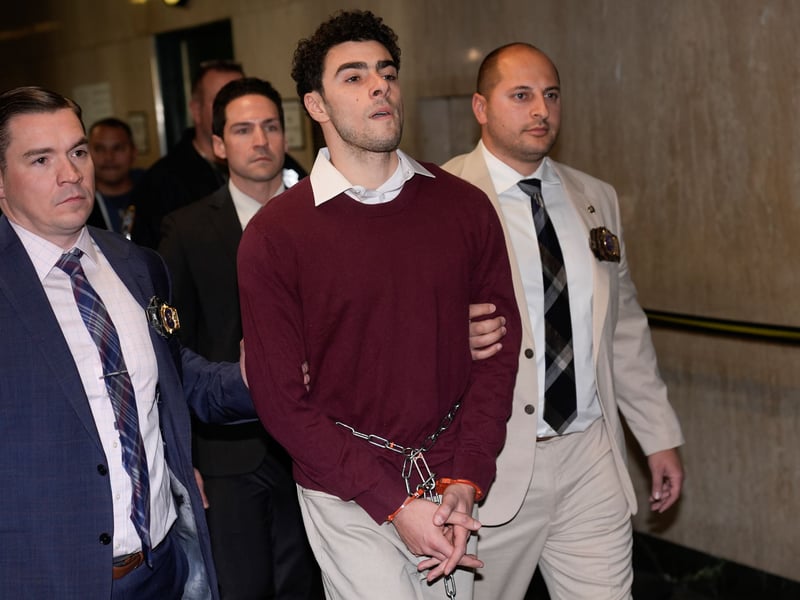
MANHATTAN (CN) — Capital punishment is off the table in Luigi Mangione’s federal murder case, a judge ruled Friday, teeing up the highly anticipated trial to begin in October.
In a bombshell 39-page ruling, U.S. District Judge Margaret Garnett dismissed two charges against Mangione: murder through use of a firearm, which was death penalty-eligible, and a related gun charge.
The Joe Biden appointee sided with the defense’s arguments that these charges were unlawfully predicated on his stalking counts, which were not inherently “crimes of violence” and thus cannot serve as the basis for capital punishment charges.
Garnett acknowledged the Supreme Court precedent on these arguments is murky, citing cases in which crimes like kidnapping and arson were not considered “crime[s] of violence.” She wrote that, while her conclusion “may strike the average person — and indeed many lawyers and judges — as tortured and strange,” it’s the correct one in her mind, according to that precedent.
“Regardless of its own views, a district court is duty-bound to follow binding Supreme Court precedent,” she wrote. “The law must be the court’s only concern.”
It’s a stunning blow for the government, who is accusing Mangione of gunning down UnitedHealthcare CEO Brian Thompson on the streets of Manhattan in the early morning hours of Dec. 4, 2024.
Mangione still faces a maximum sentence of life in prison without parole.
The government can appeal to reinstate the death penalty charges. But at a scheduled court appearance on Friday, which kicked off less than two hours after Garnett’s death penalty ruling, prosecutors weren’t immediately prepared to say whether they’d seek an appeal.
Garnett gave them until Feb. 27 to decide.
“We’re all very relieved,” Mangione’s defense attorney Karen Agnifilo told reporters after the proceedings.
It wasn’t all good news for the defense on Friday. Garnett issued a second order that will make the government’s case vastly easier to try, rejecting Mangione’s bid to suppress evidence from his backpack. Prosecutors say the bag includes the murder weapon and a “manifesto” confessing to Thompson’s killing.
Mangione had argued that law enforcement never had a right to search his backpack without a warrant when he was arrested at a McDonald’s in Altoona, Pennsylvania, five days after the shooting. But Garnett found even if that were true, prosecutors would have inevitably found the contents on discovery — a legal loophole that allows critical trial evidence to skirt some admissibility requirements.
“The entire contents of the backpack fall squarely within several exceptions to the warrant requirement, most notably the inevitable discovery doctrine,” Garnett wrote in a 43-page ruling, finding that the Altoona police followed standard procedure.
Mangione is slated to head to trial on Oct. 13. But the case could get stalled by the Second Circuit if the government decides to appeal the dismissal of the charges there. Had Garnett ruled in favor of the death penalty on Friday, the trial would have begun in January 2027.
U.S. Attorney General Pam Bondi announced last April that she would be seeking the death penalty against Mangione.
“Luigi Mangione’s murder of Brian Thompson — an innocent man and father of two young children — was a premeditated, cold-blooded assassination that shocked America,” Bondi said at the time. “I have directed federal prosecutors to seek the death penalty in this case as we carry out President Trump’s agenda to stop violent crime and make America safe again.”
Bondi made that announcement more than two weeks before the Justice Department secured an indictment against Mangione, drawing criticism from his defense team who claimed the attorney general’s bid was a political move, not a legal one.
Mangione’s lawyers had similarly criticized his cinematic law enforcement “perp walk,” staged when he was extradited from Pennsylvania to New York City, as further proof that the government was unfairly seeking to make an example out of their client.
“In a show of force befitting a captured cartel chief or comic book villain, Mr. Mangione, at the time a 26-year-old who had never been in trouble with the law, was ‘perp walked’ before scores of television cameras and press reporters, surrounded by armed law enforcement officials in tactical SWAT gear and raid jackets,” the defense team wrote in a motion against the death penalty last September.
Prosecutors, meanwhile, underscored their support for capital punishment by claiming Mangione is an “exceptionally dangerous” individual who “hunted Thompson down” to send a message to the for-profit health insurance industry.
They say he meticulously planned the murder by traveling across state lines, using a fake ID to check into a Manhattan hostel and stalking Thompson for days before the shooting — all while wearing a surgical mask to conceal his identity.
“These actions show not only the deliberate planning of this murder but also the defendant’s ability to deceive, to acquire lethal weapons through unlawful means and to evade detection,” prosecutors wrote last August. “Those same characteristics make him exceptionally dangerous in the future.”
Mangione is facing a dueling prosecution in state court, where he previously was charged with terrorism crimes until a judge ruled there was “no evidence” to support them. The top count in his state-level case is now second-degree murder.
The death penalty is barred in New York for state prosecutions.
 Follow @Uebey
 Follow @uebey.bsky.social
Subscribe to our free newsletters
Our weekly newsletter Closing Arguments offers the latest about ongoing trials, major litigation and rulings in courthouses around the U.S. and the world, while the monthly Under the Lights dishes the legal dirt from Hollywood, sports, Big Tech and the arts.