
 Search Articles


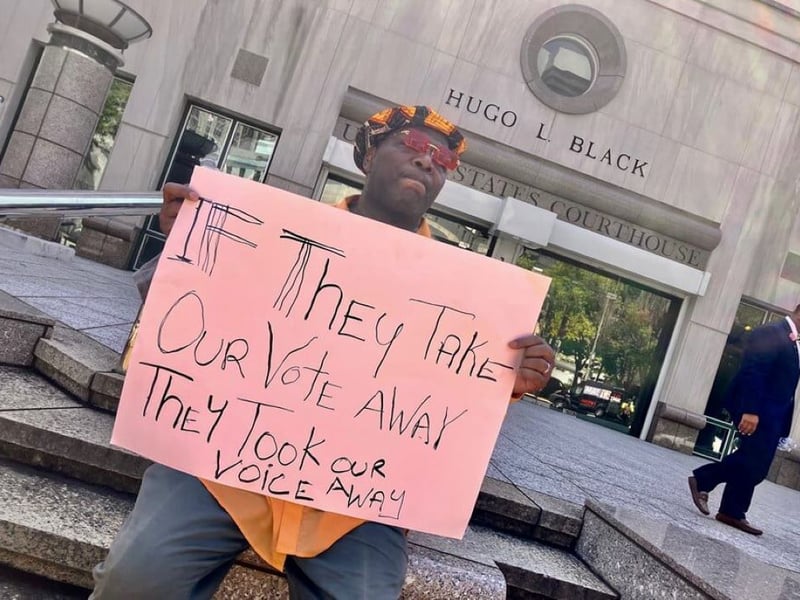
BIRMINGHAM, Ala. (CN) — Distrusting state leaders, the plaintiffs in an Alabama voting rights case asked a federal court Tuesday to require its next congressional maps to be approved by the judiciary.
Although an extraordinary request — since preclearance was effectively ended by the U.S. Supreme Court’s decision in Shelby County v. Holder in 2013 — the plaintiffs told the court state legislators acted with such racially motivated bad faith and malice in approving the 2020 maps they run the risk of “backsliding.”
However, the U.S. Department of Justice has filed a brief indicating it wasn’t interested in monitoring Alabama’s redistricting process.
In May, a federal panel determined the stateintentionally diluted the voting power of Black residents. On Tuesday, U.S. District Judge Terry F. Moorer — a Donald Trump appointee and the panel’s lone Black jurist — emphasized the state has a long, well-documented history of racial discrimination.
“It seems to me that you’re trying to make an argument that Alabama should be completely divorced from its history,” Moorer said in response to assurances from Solicitor General Edmund LaCour that the state needed no further judicial oversight. “If you’re going to predict what someone will do, don’t you usually look at what they have been doing? And unfortunately for the state of Alabama, doesn’t that cut against your argument?”
LaCour argued that evidence shows enforcement of the Voting Rights Act has only resulted in nominal increases in Black voter registration in the South, while he also attempted to minimize the scope of the state’s actions, noting the court only found a single violation. Meanwhile, Section 5 of the act states multiple “violations” must occur to be considered for preclearance.
But Senior U.S. Circuit Judge Stanley Marcus sounded skeptical.
“Words importing the plural include the singular,” said Marcus, an appointee of President Bill Clinton. “Why doesn’t that apply here? Why isn’t a single act enough if it’s willful, if a court finds that the Equal Protection Clause has been violated?”
LaCour pointed to the Dictionary Act of 1871 to establish the plain meaning of the word and explained that preclearance is an equitable consideration where normal equitable relief has proven insufficient, and the state does not have a history of multiple violations.
He further noted that the state has made attempts to comply with the court’s orders and the existing injunction should be sufficient to address any violations.
“One violation alone is not a pattern,” Lacour said. “Preclearance wasn’t deemed appropriate until Congress created it. And why did they create it? It wasn’t for one really bad violation. It was because you had multiple violations again and again, showing that litigation wasn’t enough."
Attorney Deuel Ross of the NAACP Legal Defense and Educational Fund argued that Alabama intentionally defied the Voting Rights Act by drawing a non-compliant map. He urged the court to retain jurisdiction for seven years to preclear congressional redistricting plans.
“After a robust preliminary injunction hearing, this court found that Alabama violated Section 2 of the Voting Rights Act, and the Supreme Court later affirmed that ruling,” Ross said. “Rather than comply with what the Supreme Court and this court ordered, Alabama took the nearly unprecedented step of drawing a map that it openly admitted did not comply with the Section 2 order.”
Ross emphasized that the request was both reasonable and limited in scope: it will only apply to the 2030 congressional redistricting process. He described the state’s actions as “extraordinary,” and involving “intentional efforts to ignore, evade and strategically frustrate” attempts to remedy racial discrimination.
Attorneys Abha Khanna and James S. Christie, representing plaintiffs in consolidated cases, suggested the state could remain blocked under the existing injunction or something similar. While they did not oppose the preclearance restriction, they said it may not be necessary.
“We need to have an injunction that cannot be in some ways worked around,” Christie said. “For example, if in December 2027 there was a new map passed, there would not be time to have the claims brought before the primary.”
Aside from his comments on Alabama history, Moorer suggested he was concerned about judicial overreach.
“We have to tread lightly in as much as the legislature does have a role to play, and only they can play it, and only they can balance out the interests that we as judges can’t consider," he said.
The panel also included U.S. District Judge Anna Manasco, also a Trump appointee. They did not indicate when they would rule.
 Follow @gabetynes
Subscribe to our free newsletters
Our weekly newsletter Closing Arguments offers the latest about ongoing trials, major litigation and rulings in courthouses around the U.S. and the world, while the monthly Under the Lights dishes the legal dirt from Hollywood, sports, Big Tech and the arts.