
 Search Articles


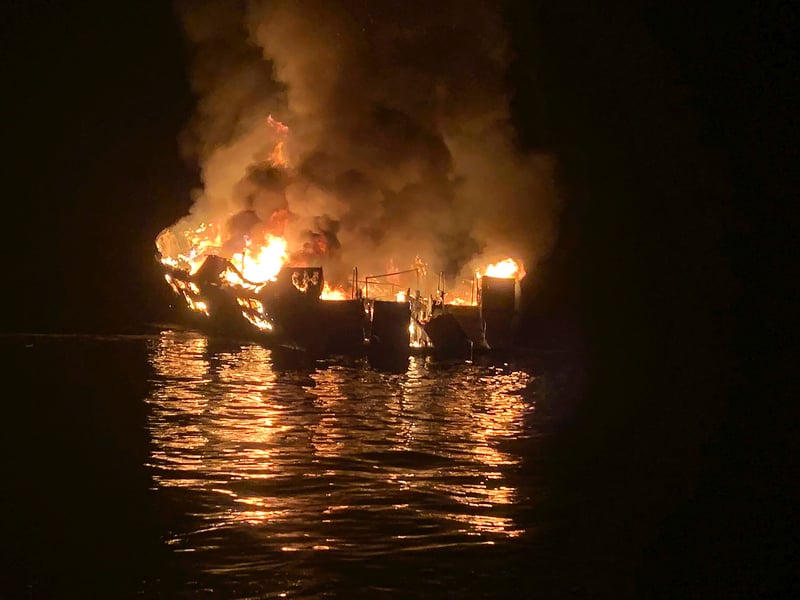
LOS ANGELES (CN) — The captain of the dive boat that was destroyed by fire off the California coast four years ago, killing all 33 passengers and one crew member trapped below deck, “played dice” with the passengers’ lives, the prosecution said as the case went to the jury.
Jerry Boyan’s failure to have a roving patrol at night on the Conception, as he was required to have when passengers were in their bunks, “amounted to a roll of the dice every night passengers went to sleep,” Assistant U.S. Attorney Brian Faerstein said in the government’s closing argument Friday afternoon.
Boylan, 70, stands accused of seaman’s manslaughter. The government claims his failures to train and drill his inexperienced crew in fighting fires at sea, to have a roving patrol at night that would have spotted the fire before it was out of control, and to direct his crew once they discovered the fire amounted to gross negligence that caused the deaths of the people who died on the Labor Day 2019 diving trip.
More than two dozen family members who lost their loved ones in the disaster attended the two-week trial in downtown LA. They saw a harrowing video that one of the passengers shot on her iPhone as the bunk room was filling with smoke while Boylan, the prosecutors said, already had abandoned the boat without trying to rescue them.
They also heard from crew members who were woken up around 3 a.m. by the fire on the boat’s main deck and desperately tried to find a way into the burning galley where both the stairway down to the bunk room as well as the escape hatch from it were located.
And they heard from a marine firefighting expert who testified that Boylan, as the captain of the vessel, was ultimately responsible for the safety of the passengers and crew and who had no doubt that Boylan’s failure to designate a roving patrol or night watch, as federal regulations required him to do, caused the deaths of 34 people.
The tan and bearded Boylan, typically dressed in a long-sleeved shirt without a jacket or tie, sat mostly stoically throughout the witness testimony and didn’t take the stand in his own defense.
His lawyers sought to pin the blame on the boat’s owner, Glen Fritzler, who they said had trained Boylan when he started out as deckhand about 40 years ago and who had never required a roving patrol on any of the three boats his company, Truth Aquatics, operated for overnight dive trips around the Channel Islands across from Santa Barbara.
“Jerry did things the Fitzler way — the way they had been done for decades,” Georgina Wakefield, one of the four federal public defenders representing Boylan at trial told jurors in her closing argument. “There’s no evidence that Jerry Boylan knew that doing things the Fitzler way threatened lives.”
The question the jurors will have to answer is whether Boyan knowingly disregarded the risks he was exposing his passengers and crew to by not having a roving patrol at night and by not training the crew members how to deal with a fire on board the boat.
The defense’s arguments that there was no time to do training or fire drills on the overnight diving trips or that they were too tired to have someone stay up at night didn’t absolve Boylan of his duties as captain to safeguard the passengers’s lives, Faerstein told the jury, nor was his “blaming the boss” defense.
Because the six-member crew, some of whom had very little experience at sea and who were together for the first time on the trip, wasn’t trained or drilled, chaos ensued once they discovered the boat was on fire and none of them knew what to do, the prosecutor said. The second galley hand, the most experienced crew member with two years on the boat, Faerstein said, had never had been through a fire drill and ran straight past one of the fire stations with a hose when it still could have been used.
The Conception, a 75-foot plywood and fiberglass vessel was at anchor near one of the Channel Islands in the early morning of Sept. 2, 2019. The boat was on the last stop of a three-day dive trip over the Labor Day weekend, and all passengers were asleep in the bunk room below deck when a fire broke out on the main deck at around 3 a.m.
Boylan and four crew members were asleep on the upper deck, above the main deck, when the fire started, while a sixth crew member slept in the bunk room with the passengers. The second galley hand, or the “prep cook” on board, was awakened by a sound below and when he looked out, he noticed the fire on the main deck and woke the other crew members sleeping above.
However, the stair from the upper deck to the main deck was already blocked by flames, the galley hand Mikey Kholes testified, and the crew had to climb or jump down to the main deck, with one of them breaking his leg in the process. There they found that the entrance to the salon was engulfed in flames and impossible to enter.
Boylan remained in the wheelhouse to make a distress call, but when the smoke got into the wheelhouse, he jumped overboard while other crew members were still trying to break into the salon and reach the passengers below. One of the crew members, worried that Boylan was in danger, jumped after him only to find that the captain was unharmed.
The captain told the crew to abandon the burning boat even though, the prosecution claims, the passengers were still alive below deck. They were found in the following days by rescue divers with some of them hugging each other in their final moments. A Santa Barbara County coroner determined they had all died from smoke inhalation.
 Follow @edpettersson
Subscribe to our free newsletters
Our weekly newsletter Closing Arguments offers the latest about ongoing trials, major litigation and rulings in courthouses around the U.S. and the world, while the monthly Under the Lights dishes the legal dirt from Hollywood, sports, Big Tech and the arts.