
 Search Articles


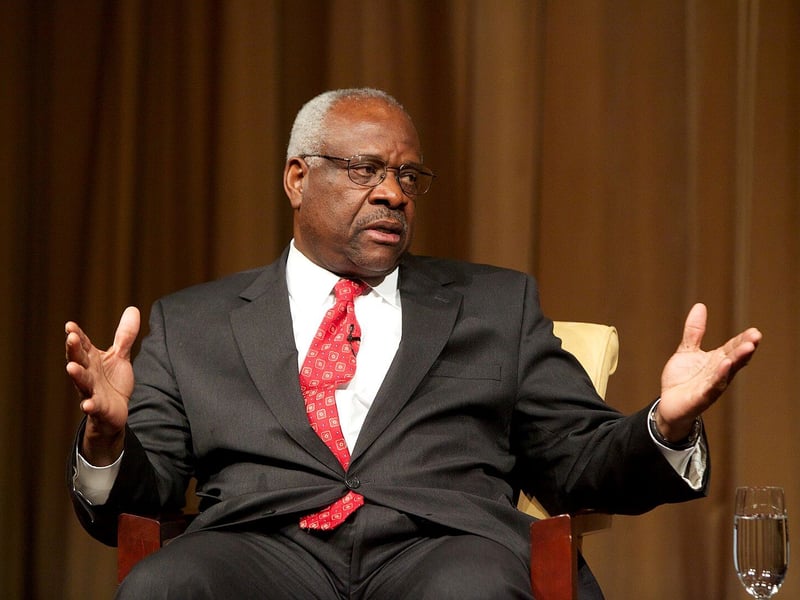
(CN) — The Supreme Court turned down a petition Monday from a teacher who claims she was wrongfully fired, but Justice Clarence Thomas raised serious concerns with how courts are handling such cases regarding controversial political speech.
In a lawsuit from Kari MacRae, the former teacher at Hanover High School in Massachusetts argued her employment was wrongfully terminated in retaliation of her exercising her First Amendment rights.
Prior to her employment, MacRae had “liked, shared, posted, or reposted” six memes or images on her personal TikTok account that are “‘spread widely online’” — expressing her views that immigration laws should be enforced, that an individual’s sex is immutable and that society should be racially color blind.
School officials claimed the posts violated the core values of Bourne Public Schools, of ensuring a “safe learning environment based on respectful relationships” and respecting “human differences,” given the potential to perceive some of her posts as transphobic, homophobic, or racist.”
While the First Circuit sided with the school district, Thomas took issue with its finding that MacRae’s First Amendment interest did not outweigh those of her employers in wanting to minimize disruption.
“This case is the latest in a trend of lower court decisions that have misapplied our First Amendment precedents in cases involving controversial political speech,” Thomas wrote in a statement.
If left unchecked, this number will likely increase, Thomas warned, and in many cases, government employers may find it convenient to attempt to restrict “disfavored or unpopular speech in the name of preventing disruption.”
The George H. W. Bush appointee respected the court’s denial of certiorari because MacRae’s petition did not squarely challenges the First Circuit’s application of the high court’s framework for public employee speech.
But he wrote separately to scorn the federal appeals court for failing to conduct a proper balancing inquiry and discounting the value of MacRae’s speech interest because her posts at times spoke in what the court described as a “mocking, derogatory, and disparaging manner.”
“The First Circuit’s analysis strikes me as deeply flawed,” Thomas wrote.
“To start, I do not see how the tone of MacRae’s posts can bear on the weight of her First Amendment interest. ‘Speech on matters of public concern is at the heart of the First Amendment’s protection,’” he added, quoting the 2011 Supreme Court decision in Snyder v. Phelps .
Supreme Court precedent establishes that “the First Amendment protects a public employee’s right, in certain circumstances, to speak as a citizen addressing matters of public concern."
Under the so-called Pickering-Garcetti framework, whether such speech is protected turns on a balancing test, wherein the employee’s speech interest is weighed against the government’s interest as an employer in avoiding workplace disruption.
But public employers cannot use this framework or unsupported claims of disruption in particular to target employees who express disfavored political views, Thomas wrote.
In the First Circuit’s view, the school district proved a reasonable prediction of disruption based on the potential negative impact of MacRae’s posts on students and staff. It pointed to factors such as public attention and local news coverage MacRae had received in light of her position on a neighboring town’s school board, as well as the fact that at least some Hanover High School’s students and staff were aware of her posts.
“It undermines core First Amendment values to allow a government employer to adopt an institutional viewpoint on the issues of the day and then, when faced with a dissenting employee, portray this disagreement as evidence of disruption,” Thomas wrote.
“And, the problem is exacerbated in the case of an employee such as MacRae, who expressed her views only outside the workplace and before her employment,” he added.
Thomas noted that the justices have granted First Amendment protections even for speech they have deemed as “particularly hurtful,” such as offensive picketing signs reading “God Hates Fags” and “‘Thank God for Dead Soldiers," used by the Westboro Baptist Church at a soldier’s funeral.
“Against this backdrop, I do not see how the First Circuit could discount the First Amendment value of MacRae’s comparatively mild posts, all of which reflected positions that represent ‘by no means an isolated segment of public opinion,’” Thomas wrote.
 Follow @Megwiththenews
Subscribe to our free newsletters
Our weekly newsletter Closing Arguments offers the latest about ongoing trials, major litigation and rulings in courthouses around the U.S. and the world, while the monthly Under the Lights dishes the legal dirt from Hollywood, sports, Big Tech and the arts.