
 Search Articles


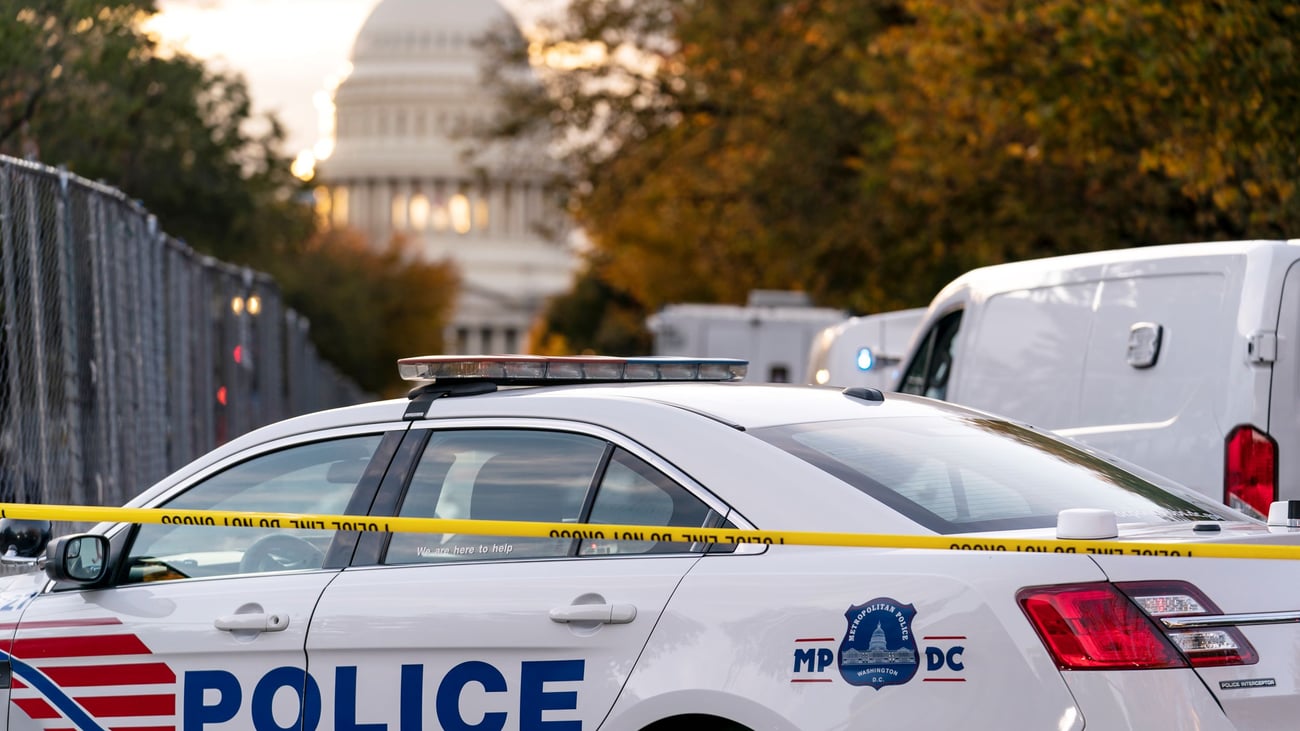
WASHINGTON (CN) — The Supreme Court sided Monday with Washington, D.C., in a case concerning how courts assess Fourth Amendment violations, directing judges to consider the totality of the circumstances when analyzing police officers’ conduct.
In February 2023, Washington, D.C. police officer Clifford Vanterpool responded to a dispatch report around 2 a.m., directing him to check out a suspicious vehicle at an apartment complex. When Vanterpool arrived, he observed two people flee from the vehicle before the driver began backing up with one of the passenger doors still open.
Vanterpool argued police intervention was warranted based on the combination of four factors: the time of night, the dispatch call of a suspicious vehicle, the unprompted flight of the passengers and the driver’s attempt to leave the parking lot.
Vanterpool arrested the driver, a minor using the pseudonym R.W. The trial court adjudicated R.W. delinquent on counts of unauthorized use of a motor vehicle, felony receipt of stolen property, unlawful entry of a motor vehicle and operating a vehicle in the District of Columbia without a permit.
However, a three-judge panel from the top court in the District of Columbia vacated R.W.’s convictions and reversed the trial court’s denial of his motion to suppress the evidence stemming from the arrest. In his analysis, District of Columbia Court of Appeals Associate Judge Vijay Shanker excised the factors related to the dispatch call and the passengers’ flight, finding neither held weight as reasons to suspect R.W. of criminal activity. The city appealed.
“That divide-and-conquer approach is wrong, contravenes this court’s precedents and jeopardizes public safety,” the city wrote in its petition to the Supreme Court. “The decision below is particularly problematic because the D.C. Circuit has adopted the diametrically opposite approach, creating conflicting bodies of Fourth Amendment law governing officers policing the nation’s capital.”
The justices agreed that Shanker’s analysis failed.
“R. W.’s own actions — combined with the panicked flight of his companions — strongly suggested that he was (like them) engaged in unlawful conduct he wished to hide from police,” the justices wrote in a six-page opinion. “Pretending that the most revealing aspect of the encounter did not happen is incompatible with the totality-of-the-circumstances approach required by our precedents.”
In arguing against the Supreme Court review, R.W. claimed the city took the appellate court’s opinion out of context.
“The district accuses the court below of excluding certain categories of information because they are insufficiently incriminating in isolation,” R.W. wrote in his respondent brief. “But the district fails to show that the lower court here, or the law of any other jurisdiction, has categorically cast certain facts aside or considered them only in ‘isolation’ rather than assessing their import against the entire factual context.”
Justice Sonia Sotomayor, a Barack Obama appointee, said she would have denied the petition for a writ of certiorari. Justice Ketanji Brown Jackson wrote a dissenting opinion, arguing the appellate court properly looked at each of the four factors individually before looking at them in totality.
“Any readable analysis will, of necessity, tick through factors, finding some weighty, others less so, and still others not at all, before piling them on a scale and assessing the result,” said Jackson, a Joe Biden appointee. “That is what the court below did here, and it was right to do so.”
Jackson did agree with her fellow justices that the appellate court should not have used the term “excised” when describing its conclusion on two of the factors.
“But I do not think that word choice reflects a methodological error,” Jackson said. “Courts excise facts from their analyses every day. Opinion writing is an exercise in culling the irrelevant; in application, no ’totality-of-the-circumstances’ test really lives up to its name.”
In all, Jackson concluded the appeal didn’t necessitate the Supreme Court’s review.
“Even if I would have assigned more heft to a particular fact in my own first-instance assessment, I would not wordsmith a lower court in this fashion,” Jackson said. “In my view, this is not a worthy accomplishment for the unusual step of summary reversal.”
In seeking the Supreme Court’s review, the city argued that the case presents an opportunity for the justices to weigh in on a split among federal and state courts regarding the assessment of Fourth Amendment violations. The opinion comes as a handful of courts — the Fourth, Fifth, Sixth, and 10th Circuits, along with the supreme courts of Massachusetts, Wyoming and Indiana — permit a reviewing court to excise a fact from the totality-of-the-circumstances analysis.
The National Fraternal Order of Police submitted a brief in support of Washington, D.C., where it argued the appellate court’s ruling imposes a dangerous constraint on officers in the field.
“Real-world policing does not occur in a vacuum,” the group, representing over 375,000 officers, said. “Officers rely on their training and judgment to synthesize multiple sources of information — often within seconds and under life-threatening pressure, in tense and rapidly evolving circumstances where hesitation can have grave consequences.”
Attorneys representing the city and R.W. did not respond to requests for comment.
Subscribe to our free newsletters
Our weekly newsletter Closing Arguments offers the latest about ongoing trials, major litigation and rulings in courthouses around the U.S. and the world, while the monthly Under the Lights dishes the legal dirt from Hollywood, sports, Big Tech and the arts.
Additional Reads


 EU highlights backing for Palestinians amid Mideast War April 20, 2026
 Macron and Tusk meet in Poland to discuss European defense April 20, 2026