
 Search Articles


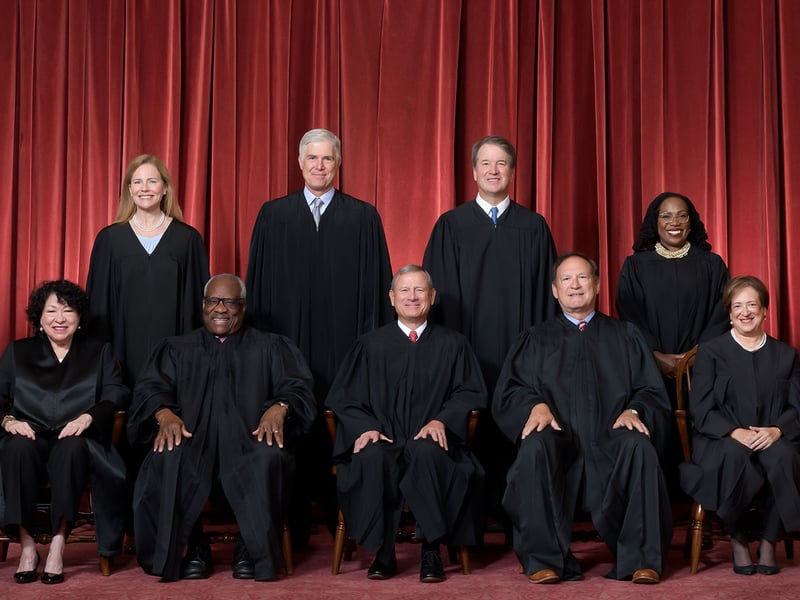
WASHINGTON (CN) — The Supreme Court kicked off its 2025 term Monday by reviewing two technical cases that seemed to draw near unanimity across the bench, marking a stark contrast from the sharp ideological divides over contentious emergency docket disputes this past summer.
The justices searched for a logical solution in an appeal from David Asa Villarreal, a Texas man convicted of murdering his roommate. Villarreal claims his Sixth Amendment rights were violated when a trial court limited his conversations with his lawyer during an overnight recess in the middle of his testimony.
Attorneys cannot give mid-testimony consultations after a witness takes the stand. The Supreme Court previously ruled that a total prohibition on attorney-client communications during long recesses is unlawful, but that shorter no-consultation prohibitions are constitutional.
A judge told Villarreal and his defense counsel to not discuss his testimony during an overnight recess, specifying that this prohibition applied to anything that Villarreal’s counsel could not discuss with him if he was on the stand in front of the jury.
Villarreal argues the qualified conferral order interfered with basic discussions that any competent lawyer would have with a client.
“It’s often impossible to discuss trial strategy without discussing testimony, and responsible defense lawyers, worried about being held in contempt for crossing this invisible line, will be chilled from offering the assistance that the defendant needs and that the Sixth Amendment guarantees,” said Stuart Banner, an attorney with the UCLA School of Law Supreme Court Clinic representing Villarreal.
Justice Brett Kavanaugh, a Donald Trump appointee, said drawing different lines between what witnesses and counsel can discuss during a lunch recess versus an overnight recess isn’t logical.
“The whole thing is treating two classes of defendants very differently, and this might be critical to the outcome of the trial,” Kavanaugh said. “If the trial judge does a recess, you’re golden or at least a long enough recess.”
There seemed to be agreement across the bench that Texas provided a narrow argument in line with the court’s precedents. Texas said that attorneys should not be able to “manage” witness testimony during an overnight recess. The state said this involved coaching, regrouping and strategizing about the testimony itself, but attorneys and witnesses could still discuss the other aspects of the case that might be part of the testimony.
“It’s an empirical predicate of our system of justice that an uncounseled witness is more likely to tell the truth than one who has time to pause and consult with their attorney,” said Andrew Warthen, an assistant criminal district attorney in Bexar County, Texas.
The justices also seemed to find agreement in Monday’s second argument concerning federal court jurisdiction. Harold Berk challenges a Delaware law that required medical negligence claims to include a mandatory affidavit from a medical expert.
Berk said Delaware’s law violates federal procedure rules. Most of the justices appeared to think that the state overstepped by adding new requirements before a plaintiff filed a lawsuit.
“That is exactly what…the entire structure of the federal rules was designed to prevent,” Justice Elena Kagan, a Barack Obama appointee, said. “If there was one thing that the federal rules did, it was to say notice/pleading uniformly throughout the nation in federal courts.”
Throughout the two arguments, the justices expressed the most disagreement with the federal government, which participated as an amicus in Villarreal’s case. The Trump administration urged the court to adopt a rule that barred all discussions involving witnesses’ testimony.
Justice Neil Gorsuch, a Trump appointee, said that position would violate the prohibition on the government conditioning a benefit on a recipient waiving their constitutional rights.
“I would have thought that our unconstitutional conditions doctrine would have something to say about unnecessarily chilling the Sixth Amendment right that’s at stake here,” Gorsuch said.
Justice Sonia Sotomayor, a Barack Obama appointee, called the government’s position dangerous, noting that attorneys need to step in if their client commits perjury.
Despite officially marking the end of their summer break, the Supreme Court’s term opener was overshadowed by the continuous drip of consequential emergency orders over the last few months. In the weeks prior, the justices issued major rulings on executive power, pausing billions in congressional appropriations, nixing the protected status of hundreds of thousands of migrants and removing independent regulatory board officials at the president’s request.
 Follow @KelseyReichmann
 Follow @kelseyreichmann.bsky.social
Subscribe to our free newsletters
Our weekly newsletter Closing Arguments offers the latest about ongoing trials, major litigation and rulings in courthouses around the U.S. and the world, while the monthly Under the Lights dishes the legal dirt from Hollywood, sports, Big Tech and the arts.