Search Articles



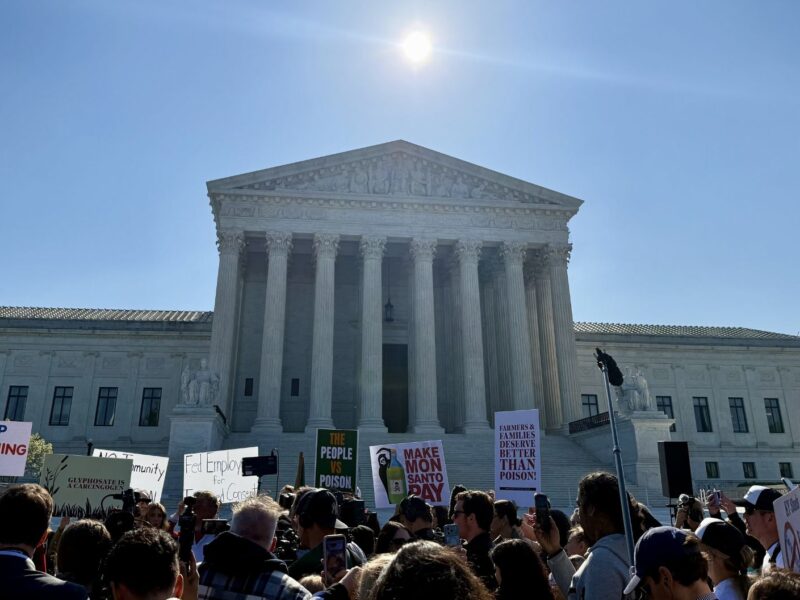
WASHINGTON (CN) — In a win for the White House, the Supreme Court on Thursday greenlit the administration’s push to end temporary protected status for Syrian and Haitian migrants.
Dividing along ideological lines, the conservative majority said the administration’s decisions were not reviewable by the judicial branch.
“A provision of the [temporary protected status] statute provides: ‘There is no judicial review of any determination of the [Secretary of Homeland Security] with respect to the designation, or termination or extension of a designation, of a foreign state under this subsection,’” Justice Samuel Alito, a George W. Bush appointee wrote. “This text is clear, and its plain meaning is very broad.”
The three liberal justices disagreed, saying the consequences of Thursday’s ruling could be exhibit A in the case for why courts should be a check on the secretary’s authority.
“After today, a secretary can announce to the world that she didn’t consult with anyone — more, that she didn’t evaluate country conditions at all — before making, extending, or terminating a TPS designation,” Justice Elena Kagan, a Barack Obama appointee, wrote in dissent. “And the courts will be powerless to intervene, even though Congress loaded up the TPS statute with requirements about the (altogether different) way the secretary is supposed to make her decision.”
Congress authorized the Secretary of Homeland Security to grant country-specific temporary relief to migrants who cannot return home due to armed conflict, natural disasters or other extraordinary conditions. Once designated, eligible nationals already in the United States can apply for temporary protected status, known as TPS, which shields them from deportation and provides work authorization.
Because the designations are temporary, the secretary regularly reviews them and may extend or revoke them based on conditions in each country. The cases before the court asked whether the Trump administration followed proper procedures when it tried to revoke them for Syria and Haiti.
According to the six-justice majority, courts do not have authority to question the administration’s process.
“Each claim concerns a discrete decision made by the secretary — for example, her decision to consult the State Department in a particular manner and her decision that country conditions in Syria and Haiti justified termination of their TPS designations,” Alito wrote. “And all those steps were part of the process that led to her final decision to terminate these countries’ TPS designations.”
Syrian nationals received TPS in 2012 under former President Barack Obama amid a crackdown by then-President Bashar Assad.
The designation was later extended as the bloodshed continued. In 2024, Assad was overthrown and fled to Russia, ending his family’s 53-year rule.
In September, former DHS Secretary Kristi Noem announced the termination of temporary protected status for Syrians. She argued Assad’s ouster and new diplomatic efforts meant Syria no longer qualified. The administration says ongoing conflicts do not pose a serious threat to returning nationals, about 6,100 of whom hold protected status in the United States.
Haitians first received TPS in 2010 following a devastating earthquake. They’ve since had their TPS status extended due to ongoing instability.
In January, the United Nations warned of a worsening crisis marked by escalating gang violence and a severe humanitarian situation. The country’s murder rate rose nearly 20% last year, and 5.7 million Haitians face food insecurity.
More than 350,000 migrants from the Caribbean island nation have TPS status in the U.S. Noem revoked their protections in 2025, based on her determination that there are no extraordinary conditions preventing Haitian nationals from safely returning to their country.
Both Haiti and Syria are categorized under the State Department’s highest risk warning, which advises against any travel. The government says entering either country puts individuals at risk of terrorism, crime and kidnapping. Syria’s advisory includes an additional warning for risks of armed conflict, while Haiti’s advisory lists limited access to health care.
Lower courts blocked the TPS revocations for Haiti and Syria, prompting the Trump administration to file emergency appeals with the Supreme Court. The justices deferred a decision on the administration’s two emergency applications, keeping the migrants’ protected status in place.
Thursday’s decision throws out the lower court orders. And it cast doubt on the Haitians’ claim that the administration’s decision was made with racial animus.
The migrants cited Trump’s comments that Haitians are “eating the dogs …They’re eating the cats. They’re eating the pets,” and that Haitians “probably had AIDS.” Trump also called Haiti a “shithole country” and described Haitian immigration as “poisoning the blood” of our country and “like a death wish.”
Alito said none of the cited statements were overtly racial and all expressed policy views that rest on race-neutral justifications.
“For example, one may oppose TPS and favor tighter restrictions on immigration for economic or other reasons that have nothing to do with race,” Alito wrote. “And a person without racial bias can provide a harshly unfavorable description of living conditions in some of the countries with TPS designations. The criteria for TPS designations guarantee that many, if not most, designated countries have such characteristics.”
Alito said the court would not “capitalize on the statements’ heated language.”
“Political discourse by prominent public figures is increasingly couched in terms that would have scandalized the public just a short time ago,” Alito wrote.
The dissent strongly disagreed. Kagan said the evidence for discrimination by Trump “was so repellent and racially inflected that the majority declines to put them in print.”
“Judges, as we often say, are ‘not required to exhibit a naiveté from which ordinary citizens are free,’” Kagan wrote. “The statements fairly shout, in their racial undertones and overtones alike, that race entered into the president’s resolve to remove Haitians from this country.”
The dissent said the migrants were entitled to relief and should not have been consigned to devastating and life-threatening injuries.
Geoff Pipoly and Andy Tauber, the lead counsel for the Haitians, said the court’s ruling will directly result in thousands of people dying.
“It’s a very sad day, not only for Haitian TPS holders but for anyone who believes, as we do, that immigrants are one of America’s greatest strengths,” Pipoly and Tauber said in a statement. “The responsibility to save these lives is now with Congress — and we urge the Senate to pass the extension of TPS now pending in that chamber.”
 Follow @KelseyReichmann
 Follow @kelseyreichmann.bsky.social
Subscribe to our free newsletters
Our weekly newsletter Closing Arguments offers the latest about ongoing trials, major litigation and rulings in courthouses around the U.S. and the world, while the monthly Under the Lights dishes the legal dirt from Hollywood, sports, Big Tech and the arts.