
 Search Articles


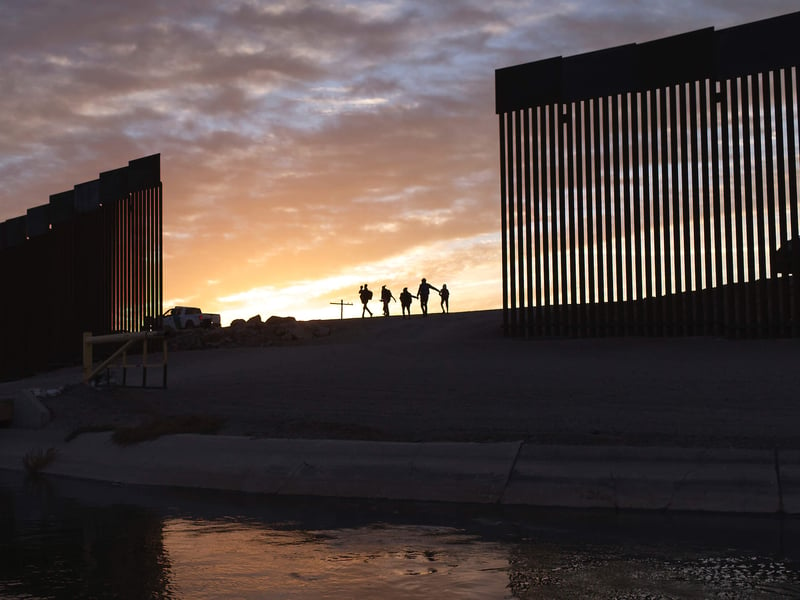
WASHINGTON (CN) — The Supreme Court seemed open on Tuesday to giving President Donald Trump another tool to stymie migrants’ attempts to seek asylum in the U.S.
Under the Immigration and Nationality Act, anyone who is physically present in the United States — whether or not at a designated port of entry — can seek asylum if they have a well-founded fear of persecution in their home country.
During his first term, Trump formalized “metering guidance,” ordering border agents to prevent migrants from seeking asylum by physically blocking them from setting foot over the border. The president hasn’t formally reinstated the turnback policy — which was rescinded during the Biden administration — but he pushed the justices to reverse an appeals court ruling finding it unlawful.
“Administrations of both parties since 2016 have consistently said that this is an important tool in the government’s toolbox for dealing with border surges when they occur,” Vivek Suri, an assistant to the solicitor general at the Justice Department, said. “I can’t predict when the next border surge occurs, but I can say that when it does occur, this is a tool that DHS would want in its toolbox.”
The Supreme Court seemed sympathetic to the government’s case — that migrants can’t “arrive in” the U.S. while on the Mexico side of the border. But the justices spent a significant portion of Tuesday’s argument attempting to decipher the intricacies of when migrants could be considered “in” the U.S.
“If there’s a line, you know, and you’re far back and you hear, ‘no, we can’t cross the border today,’ have they arrived in and been turned away?” Justice Amy Coney Barrett, a Trump appointee, asked. “How could it be something different if you arrive at a port of entry versus if you cross the border or you arrive on the Mexican side of the border, but, say, try to cross into Texas, where there’s not a port of entry?”
A nonprofit immigrant rights organization, Al Otro Lado, and 13 asylum-seekers who sued the government under the now-rescinded policy in 2017 said the line was the threshold of the port of entry.
Fellow Trump appointee Justice Neil Gorsuch asked whether migrants along the Rio Grande or at the border wall qualified.
“At the top of the wall, they’re in, but if they’re at the bottom of the wall, they’re out?” Gorsuch asked.
Justice Sonia Sotomayor, a Barack Obama appointee, seemed more persuaded by the migrants’ arguments.
“If you’re knocking on the door and I’m staring you in the face, you have an obligation to at least listen to my application,” Sotomayor said.
The government’s foot-over-the-line rule, Sotomayor said, was complicating a clear statute.
“I don’t know why the foot is magical,” Sotomayor said. “I could put my hand through or my nose through. I don’t know. Why does a foot count as opposed to a piece of your body count?”
Sotomayor and Justice Ketanji Brown Jackson, a Joe Biden appointee, voiced the strongest opposition to the policy. The former compared it to the U.S. government’s decision to turn away Jewish refugees fleeing Nazi Germany.
“We didn’t consider whether they were being persecuted, and the majority of those people were shipped back or had to go back from where they came and were killed,” Sotomayor said, referring to refugees on the M.S. St. Louis. “That’s what we’re doing here, isn’t it?”
Jackson said the government’s view created a perverse incentive for asylum-seekers, rewarding those who crossed the border illegally instead of individuals who presented themselves to immigration officers at ports of entry.
“Imagine a polite asylum seeker who wants to do everything by the book. He approaches the border but does not cross precisely because the law says you are not supposed to enter the United States without authority,” Jackson said. “Why on earth would Congress have intended for his asylum request to be discarded … but someone who manages to enter the United States unlawfully … gets their application entertained?”
The government responded that the United States didn’t have sole responsibility for taking in the world’s refugees. Congress could have intended to pass some responsibility onto Mexico, Suri said, stating that only once a refugee legally or illegally is in the United States, the government has a greater responsibility.
Jackson accused the government of being unresponsive to her questions. She said it seemed “very peculiar” that the government could tell someone physically standing in Mexico who says they’re being persecuted, “Unless you can figure out a way to illegally cross, we’re not going to entertain that claim.”
Suri jabbed back at the framing of Jackson’s question.
“It seems to me that the premise of the question is that there is something improper about blocking someone from completing the arrival, i.e., into the States,” Suri said.
The back and forth only ended when Chief Justice John Roberts, a George W. Bush appointee, abruptly cut off Jackson’s questioning. Roberts also had concerns about migrants queuing up at the border, asking whether a migrant who was 50th in line had the same claim as the first.
Kelsi Corkran, an attorney at the Institute for Constitutional Advocacy & Protection, said line positioning was irrelevant.
“Under the prior practice, you came through the turnstile, and then you were inspected and processed,” Corkran said. “Now there could have been long waits within the port…but this idea of kind of lines and people piling up on the Mexican side of the border didn’t happen until the turnback policy was put in place, and you’ve got this bottleneck of people waiting on that side.”
Justice Brett Kavanaugh, another Trump appointee, said wherever the definition of “arrives in” landed, the administration would just stop migrants ahead of that line.
“The point, I guess, the ‘arrives in’ thing seems kind of artificial,” Kavanaugh said. “The bigger question, it seems to me, is can the government physically stop people before they get to whatever that line is, no matter how we define it. And that seems like not a statutory question, more of an arbitrary and capricious question.”
Jackson blamed the justices’ handwringing on the lack of a concrete policy from the Trump administration, which would only go so far as to say it wanted to have the option to reinstate the policy should another border surge arise.
“I don’t understand what we are doing other than advising the government in sort of the abstract as to whether or not this kind of thing is lawful,” Jackson said. “We don’t have an actual policy.”
A lower court certified a class for the asylum-seekers who had arrived prior to Trump’s transit rule and issued an injunction reopening claims that had been denied based on the 2019 policy. That class allowed the case to continue after the Biden administration rescinded the metering policy in 2021. The transit rule, which made migrants who traveled through one or more countries on their way to the U.S. ineligible for asylum if they did not previously seek protection in at least one transit country, was later rescinded in 2023.
In 2022, the lower court issued a permanent injunction barring the government from applying the asylum prohibitions to that class and said its members were entitled to seek asylum under prior policy guidance.
To decide whether the remedy should be upheld, the Ninth Circuit reviewed the lawfulness of the metering policy. The panel sided with the asylum-seekers, rejecting the government’s arguments that migrants who were turned away from ports of entry were not unlawfully denied asylum under the metering policy because they were not physically present in the U.S.
 Follow @KelseyReichmann
 Follow @kelseyreichmann.bsky.social
Subscribe to our free newsletters
Our weekly newsletter Closing Arguments offers the latest about ongoing trials, major litigation and rulings in courthouses around the U.S. and the world, while the monthly Under the Lights dishes the legal dirt from Hollywood, sports, Big Tech and the arts.