
 Search Articles


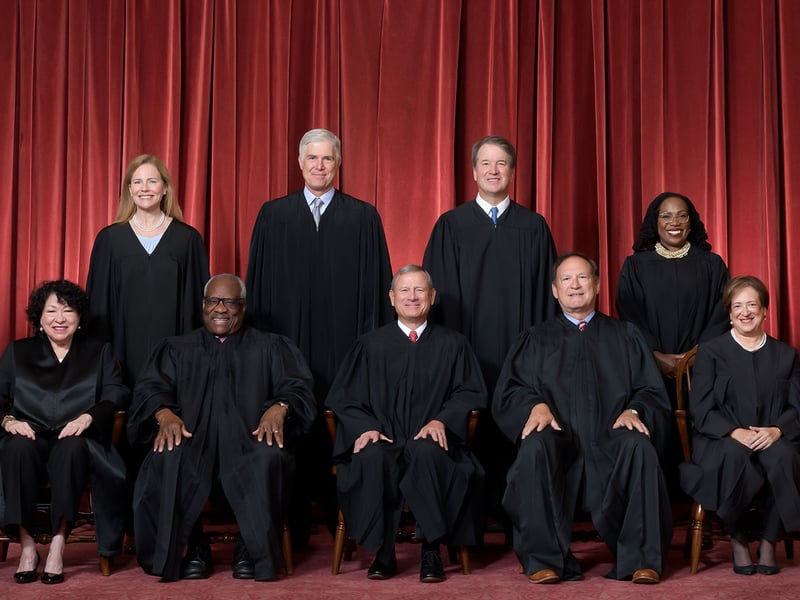
WASHINGTON (CN) — The often ideologically divided Supreme Court found agreement on Thursday to boost lawsuits from two different families searching for accountability for wrongdoing.
In two different unanimous rulings, the justices sided with an Atlanta mother, Trina Martin, whose home was accidentally raided by the FBI, and with Ava, a teenager with epilepsy whose school denied her disability accommodations. The rulings give both plaintiffs another shot at advancing their lawsuits in the lower courts.
Justice Neil Gorsuch, a Donald Trump appointee, authored the court’s ruling that Martin’s case against the government was unlawfully dismissed.
“If federal officers raid the wrong house, causing property damage and assaulting innocent occupants, may the homeowners sue the government for damages?” Gorsuch wrote. “The answer is not as obvious as it might be.”
Martin, her son and her then-boyfriend Toi Cliatt were present in their Georgia residence in 2017 when a SWAT team battered down her door as part of an operation targeting violent gang activity. FBI agents carrying assault rifles swarmed the house, setting off flash-bang grenades.
It was only after agents handcuffed Trina and Toi that the FBI realized officers had raided the wrong house. FBI Special Agent Lawrence Guerra blamed the mix-up on a faulty GPS.
The Martins were left traumatized by the raid, with Trina’s 7-year-old son needing years of therapy. The family sued the FBI, but lower courts dismissed the case, citing that the raid occurred while Guerra was executing federal policy.
The Federal Tort Claims Act allows people to sue the government for harm caused by certain federal officers, but includes a discretionary-function exception, which reinstates sovereign immunity when the claim is based on an officer’s discretion.
In 1974, Congress amended the Federal Tort Claims Act with a law-enforcement proviso — an exception to the exception. The addition came after national outrage about a pair of wrong-house raids similar to the facts of the Martins’ case. Under the proviso, sovereign immunity is waived on claims of assault, battery, false imprisonment, false arrest, abuse of process or malicious prosecution.
Gorsuch said the 11th Circuit erred on multiple fronts. The appeals court incorrectly found that the law enforcement proviso boosted Martin’s case. Gorsuch said there was no reason to treat that exception as somehow above the others.
The appeals court also ruled that the U.S. could defeat the lawsuit under the Supremacy Clause by showing the officer’s actions were tied to federal policy. Though that holding favored the government, it declined to defend it, prompting the court to appoint an amicus.
“In the end, we find the government’s concession commendable and correct: The FTCA does not permit the Eleventh Circuit’s Supremacy Clause defense,” Gorsuch wrote.
Gorsuch said the appeals court wrongly relied on In re Neagle , a case involving a U.S. marshal who killed a man while defending a Supreme Court justice. Though the court found the marshal was protected by the Supremacy Clause, Gorsuch said the case doesn’t apply to Martin’s lawsuit, despite recounting it in detail in his opinion and from the bench.
“The Court’s decision may stand for the proposition that federal law will sometimes preempt a state criminal law when it conflicts with a federal officer’s duties — and do so even in the absence of express federal legislation overriding the state law in question,” Gorsuch wrote.
Martin’s case is different from Neagle’s, Gorsuch said, because here Congress expressly bound the federal government.
The court remanded Martin’s case to the 11th Circuit to decide whether her claims can move forward.
“This is a victory for us but also for everyone who is fighting for accountability and justice,” Trina said in a statement following the ruling. “This isn’t over, but we look forward to continuing the fight. What happened to us was wrong and should never happen to anyone.”
Court eases path for disability suits in schools
In another unanimous ruling, the Supreme Court lowered the standard for schoolchildren with disabilities to bring discrimination suits against schools for failing to provide adequate disability accommodations.
The high court ruled that students no longer had to show that school officials’ conduct rose to the level of “bad faith or gross misjudgment” to succeed under an Americans with Disabilities Act or Rehabilitation Act of 1973 claim.
Chief Justice John Roberts wrote in the court’s opinion that ADA and Rehabilitation Act claims should be subject to the same standards applied in other disability discrimination suits, noting that the heightened standard was not based on either statute’s text.
He added that, while the court’s decision only impacts a narrow evidentiary bar, it has a significant impact for students like the plaintiff in this case, A.J.T., other students with disabilities and their parents.
“Together they face daunting challenges on a daily basis,” Roberts wrote. “We hold today that those challenges do not include having to satisfy a more stringent standard of proof than other plaintiffs to establish discrimination under Title II of the ADA and Section 504 of the Rehabilitation Act.”
A.J.T., the student, has a rare form of epilepsy that causes frequent seizures, which prevented her from attending school before noon, but would subside enough for her to receive at-home instruction in the evenings.
When the family moved to Minnesota in 2015, Osseo Area Public Schools denied their request for at-home instruction, reducing her school day to 4.25 hours instead of the usual 6.5.
Although the family prevailed under the Individuals with Disabilities Education Act, their ADA and Rehabilitation Act suit for damages and a permanent injunction was unsuccessful. A federal judge—and later the Eighth Circuit—ruled for the school, citing the “bad faith or gross misjudgment” standard.
Justice Clarence Thomas, joined by Justice Brett Kavanaugh — a George H.W. Bush appointee and a Trump appointee, respectively — wrote a concurrence to express his support for a future case that would allow the court to address the “no-intent standard,” which does not require an intent to discriminate to establish a violation.
In a separate concurrence by Justice Sonia Sotomayor, joined by Justice Ketanji Brown Jackson — a Barack Obama and Joe Biden appointee, respectively — Sotomayor highlighted the school district’s flawed argument that the heightened standard was appropriate because the relevant statutes require a showing of “animus.”
“Congress was not naive to the insidious nature of disability discrimination when it enacted the ADA and Rehabilitation Act,” Sotomayor said. “It understood full well that discrimination against those with disabilities derives principally from ‘apathetic attitudes rather than affirmative animus.’"
The justices also came to a unanimous decision in favor of a combat veteran fighting for combat pay. A Texas man who was convicted of sexually abusing a child was not so lucky, receiving a unanimous denial of his claims from the high court.
Gorsuch prevented the court from a full unanimous sweep, issuing solo dissents against the court’s decision in a dispute over unpaid taxes and appeal filing deadlines for an inmate who says he was unlawfully held in solitary confinement.
The Trump appointee would have dismissed the inmate’s case since both parties agreed on a solution; however, he would have allowed a woman who was saddled with her husband’s debt to continue her fight.
Despite the slew of unanimous rulings, ideological divides on the court could soon return. The justices have yet to rule in the most controversial cases of the term, including birthright citizenship, transgender health care and LGBTQ book bans.
 Follow @KelseyReichmann
 Follow @kelseyreichmann.bsky.social
Subscribe to our free newsletters
Our weekly newsletter Closing Arguments offers the latest about ongoing trials, major litigation and rulings in courthouses around the U.S. and the world, while the monthly Under the Lights dishes the legal dirt from Hollywood, sports, Big Tech and the arts.