Search Articles


WASHINGTON (CN) — Disagreements over immigration policy spilled over at the Supreme Court on Wednesday as the justices reviewed when the federal government can put green card holders on parole.
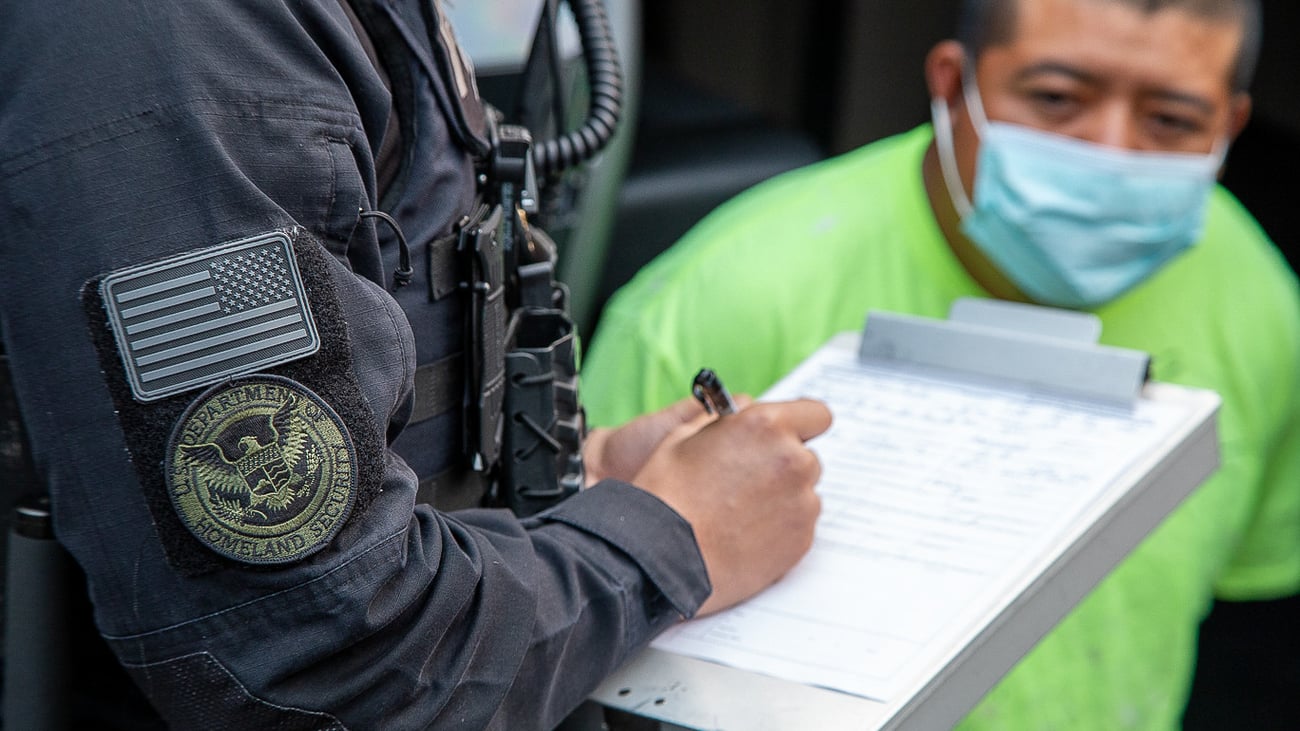
The Trump administration asked the high court to uphold border officers’ authority to limit the rights of lawful permanent residents, as they are formally known, in certain scenarios. Under the immigration authority known as parole, individuals are released into the U.S. on a temporary basis while the government considers their admissions request.
Being paroled into the country versus being admitted — as is typical for green card holders — carries legal significance, including losing access to documents required to live and work in the U.S.
The government’s request to put some green card holders who face criminal charges on parole led to over 90 minutes of contentious back and forth on the bench as the justices spared over the potential breadth and consequences of their forthcoming ruling.
Justice Ketanji Brown Jackson, a Joe Biden appointee, voiced the strongest opposition to the government’s arguments. Endorsing its view, Jackson said, allowed border officers to strip green card holders of the legal protections guaranteed by Congress.
“I don’t understand why border patrol officers suddenly have so much power,” Jackson said.
A key benefit for green card holders is being able to travel freely abroad without the fear of being denied admission back into the United States. Unlike immigrants with temporary status, lawful permanent residents aren’t considered to be seeking admission for the purposes of immigration laws when returning from travel abroad. Therefore, they are not typically paroled into the United States unless they meet a limited set of exceptions.
Wednesday’s argument focused on how and when the government determined whether a green card holder fell into one of those exceptions. Immigrant advocates said the border officers needed clear and convincing evidence — such as a conviction or confession — that a lawful permanent resident fit the criteria at the time they returned to the U.S.
The government applied a looser standard, arguing the border agent only needs a good faith belief the green card holder committed a qualifying offense. An immigration judge would then make a final determination at a later date, potentially using evidence gathered while the immigrant was paroled.
Jackson worried about allowing lawful permanent residents to be put into one of these buckets solely on the suspicion they committed a crime. She saw a world where it would be in the government’s interest to engage in “a bad-faith paroling kind of scenario.”
Lawful permanent residents returning to the U.S. could suddenly find themselves under suspicion or indictment — both under the government’s control — of a crime and be put on parole, Jackson hypothesized, noting such a scenario would result in their green card being confiscated.
“They take this person’s green card, which then makes it much, much harder for this person to actually live and work and continue their life here in the United States, perhaps so much so that this person self-deports because it is really, really difficult without a green card to operate in this country,” Jackson said. “You could imagine that in a world where the government that really is not interested immigration and having immigrants here, living and working, could use this kind of thing to inappropriately parole people rather than admit them so that it depresses immigration.”
The question echoed the administration’s self-deportation push headed by Stephen Miller, the White House deputy chief of staff for policy and homeland security. Miller incentivized this policy by proposing a stipend for migrants who choose to leave.
This year, the Trump administration proposed a rule prohibiting “mixed-status” families from living in public and other subsidized housing. And the administration moved to strip asylum seekers of commercial driver’s licenses.
Shay Dvoretzky, an attorney with Skadden Arps representing the lawful permanent resident at the center of the case, said under the government’s theory border officers could parole green card holders in large numbers.
“Does your argument depend on our acceptance of this conspiracy theory,” Justice Samuel Alito, a George W. Bush appointee, asked Dvoretzky, noting the case before them involves actual criminal charges.
The government wants to remove Muk Choi Lau — who has been a lawful permanent resident since 2007 — under inadmissibility proceedings. While facing pending charges for trademark counterfeiting in 2012, Lau traveled to his home country of China for a short visit. Lau pleaded guilty and was sentenced to probation after returning to the U.S.
Even though he hadn’t yet been convicted at the time, the government says Lau’s reentry into the U.S. exempted him from the privileges of his legal status. According to the government, Lau was paroled into the country for deferred inspection after traveling to China, allowing officials to initiate removal proceedings following his conviction.
But Lau’s lawyers say the government can only use such an exception if it can meet its requirements at the time of reentry. They argued parole isn’t a tool for the government to use while trying to determine whether an immigrant’s circumstances trigger the very authority it already exercised.
The Immigration and Nationality Act includes a two-pronged approach for expelling immigrants with temporary or permanent legal status in the United States. Under the statute, those falling into the latter bucket — lawful permanent residents — are subject to deportation proceedings, whereas immigrants in the first bucket can be removed through inadmissibility proceedings.
While both deportation and inadmissibility removal have the same end point, their proceedings and requirements vary. Immigrants without legal status can be admitted into the United States on parole, granting them temporary permission to enter the country. While physically on U.S. soil, they are still legally considered to be at the border for purposes of immigration laws.
Alito and several of his conservative colleagues worried restricting the government’s parole authority would force border agents to release criminals into the country.
“An [lawful permanent resident] leaves the United States, goes to France, and flies back to the United States,” Alito proposed in his own hypothetical. “While the plane is in the air, the federal government receives an urgent message from the French police. He shot somebody while he was here just before he got on the plane, but he hasn’t been convicted, and in that instance, he hasn’t even been charged.”
Lau’s attorney said the individual probably couldn’t be put on parole under the statute in question, while noting that other laws would permit the offender’s arrest.
Justice Amy Coney Barrett, a Trump appointee, suggested the government’s position is more favorable to green card holders. Without parole, Barrett said, the government would be forced to detain green card holders while considering whether to parole them, setting up adjudicatory hearings at the border.
“Rather than being paroled, they might face detention and immediate removal proceedings,” Barrett said.
The court seemed to be divided along ideological lines, with the conservative majority favoring the government’s arguments. However, Jackson’s questions did seem to give some of her colleagues pause.
Barrett initially seemed receptive to the government’s contention that being paroled had little effect on a green card holder’s legal status. But by the end of the argument, she cited the same amicus brief as Jackson to question the consequences of losing a green card, even if only temporarily.
“In an era where ICE agents are conducting enforcement campaigns, a green card is a much more reliable means of identification if you’re stopped on the street than a temporary stamp, which can be subject to counterfeiting,” Dvoretzky said.
 Follow @KelseyReichmann
 Follow @kelseyreichmann.bsky.social
Subscribe to our free newsletters
Our weekly newsletter Closing Arguments offers the latest about ongoing trials, major litigation and rulings in courthouses around the U.S. and the world, while the monthly Under the Lights dishes the legal dirt from Hollywood, sports, Big Tech and the arts.