
 Search Articles


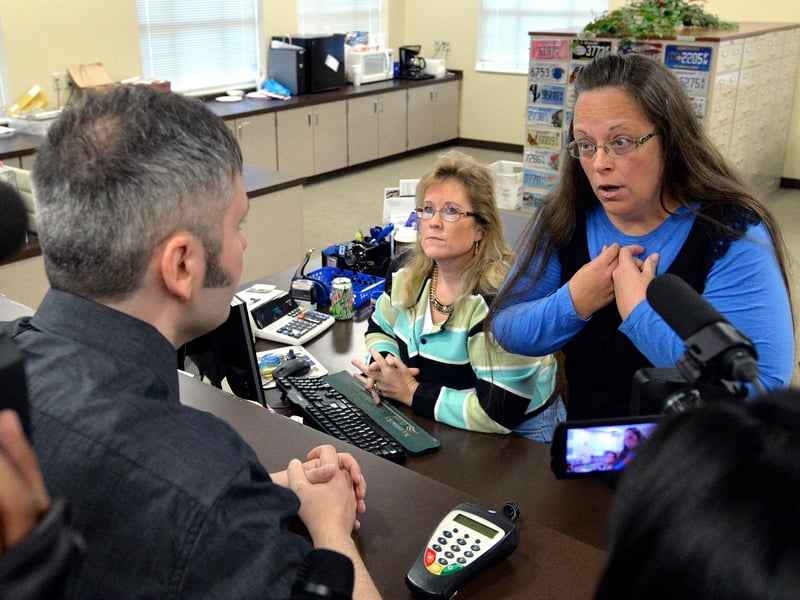
WASHINGTON (CN) — Kim Davis, the onetime Rowan County, Kentucky, clerk who famously refused to issue a marriage license to two men in 2015, still owes the men $360,000 in legal fees. Now, she hopes the Supreme Court will bail her out by overturning its landmark decision to legalize same-sex marriage in Obergefell v. Hodges .
Davis, who claims to be a devout Christian, remains locked in a legal battle that began only a month after Obergefell was decided in June 2015. Encouraged by the conservative supermajority’s ruling overturning Roe v. Wade , Davis asked the Supreme Court to rectify the protracted legal battle by overturning Obergefell , the root cause of her case.
“Obergefell started this mess, and Obergefell is part of the core problem that we have here,” Mat Staver, founder and chairman at the Liberty Counsel, which represents Davis, said in a phone call.
“Under God’s authority”
After the Supreme Court issued Obergefell in June 2015, Davis refused to issue marriage licenses to same-sex couples. In a now-viral video, she was confronted by one couple who was denied a license, stating that she was acting “under God’s authority.”
Davis wouldn’t relent, going so far as to defy a court order that landed her in jail. Upon her release, Davis said that issuing same-sex marriage licenses “would be an act of disobedience to my God.”
One couple to whom Davis denied a license, David Ermold and David Moore, sued her in July 2015. Their case didn’t go to trial until 2023, but their patience was rewarded after a jury awarded each of them $50,000 and $260,000 in legal fees.
The case dragged for the better part of a decade in part because Davis was originally sued in her official position as an officer of the state. Davis claimed that her government job gave her immunity from the lawsuit.
A federal judge ruled that she was not immune from a pair of lawsuits in 2022.
Ermold and Moore’s claim included emotional damages against Davis in her personal capacity. This time, Davis wielded the First Amendment.
In her petition at the Supreme Court, Davis urged the justices to recognize that officials have First Amendment rights even when acting in their official capacity. Staver said officials like Davis shouldn’t have to face bankruptcy for exercising their rights.
“It would send a terrible message that somebody can be an elected official, and then someone can try to strip their immunity for what they said, and then they’d be liable in damages for hundreds of thousands of dollars for exercising their First Amendment right to free exercise of religion,” Staver said.
But while the Roberts court has consistently sided with religious plaintiffs over the last few years, David Cole, a law professor at Georgetown University and the former national legal director at the ACLU, said Davis’ petition would open a can of worms.
“The consequences would be to create a whole new area of constitutional law in which government officials, when sued for violating constitutional rights, could assert their own constitutional rights, even though they don’t have those constitutional rights when they are exercising government power,” Cole said in a phone interview.
When acting as a government official, individuals must follow the law as it applies to everybody, Cole said, without any exceptions that apply when that person is acting as an individual.
“The First Amendment protects private citizens,” Cole said. “It doesn’t protect government officials. It restricts government officials, it doesn’t give rights to government officials, and therefore she doesn’t have the right to interpose a First Amendment defense to a claim that arises from our action as a government employee.”
The way it’s always been
Davis said the origin of the violation of her religious rights originated with the “substantive due process fiction” that created Obergefell . She argued that substantive due process — that backbone of right-recognizing jurisprudence — was reserved for fundamental liberties that are deeply rooted in the nation’s history. The conservative justices offered a similar reasoning when they overturned Roe .
“In Obergefell v. Hodges , the court read a right to same-sex marriage into the 14th Amendment even though that right is found nowhere in the text,’” Davis wrote in her petition before the court. “As was predicted at the time Obergefell was decided, it ‘would threaten the religious liberty of many Americans who believe that marriage is a sacred institution between one man and one woman.’”
Same-sex couples who are currently married would still be protected by the Respect for Marriage Act, refuting any arguments that reliance interests would prevent the court from overturning Obergefell .
“Anybody who already had same sex marriage license, they would be protected, and then each state would then go back to where they were before 2015,” Staver said. “Some states would continue. Other states would revert back to where they were before 2015 but it would go back to the states where it has always been.”
At least nine states have moved to roll back same-sex marriage rights in recent years. Michigan, Montana, Idaho, North Dakota and South Dakota have all suggested that the Supreme Court should revisit Obergefell , and Texas, Missouri, Oklahoma and Tennessee have introduced bills recognizing marriages solely between heterosexual couples, according to the National Center for LGBTQ Rights.
A long shot
Despite some momentum from conservative advocates, legal experts are skeptical that the Supreme Court would be interested in overturning Obergefell . Cole noted Justices Brett Kavanaugh and Samuel Alito said that overturning Roe did not jeopardize other substantive due process privacy cases.
Justice Clarence Thomas is the only justice who has publicly suggested reviewing Obergefell .
“There’s only one justice who has sort of taken the position that it should be overruled, and the other justices expressly said that [Dobbs v. Jackson Women’s Health Organization ] was different and therefore did not justify overruling Obergefell ,” Cole said. “So to the extent the court is on record, it’s very much a long shot.”
Camilla B. Taylor, interim chief legal officer at Lambda Legal, noted that Davis’ appeal had already been rejected by the high court on a previous argument.
“Apparently, Kim Davis can’t take ‘no’ for an answer,” Taylor said in a statement. “She asked the Supreme Court before to review her case, and the court denied the request, with even Justices Alito and Thomas agreeing that her case was unworthy of being heard. It’s no more worthy of attention from the court or anyone else this time than it was the last time.”
The Institute for Constitutional Advocacy and Protection, which represented Ermold and Moore, is confident the justices will deny Davis’ petition.
“Not a single judge on the U.S. Court of Appeals showed any interest in Davis’s rehearing petition, and we are confident the Supreme Court will likewise agree that Davis’ arguments do not merit further attention," William Powell, senior counsel at ICAP, said in a statement.
In March, the Sixth Circuit upheld the awarded damages, stating that Davis couldn’t pursue an “extended game of litigation whack-a-mole.”
 Follow @KelseyReichmann
 Follow @kelseyreichmann.bsky.social
Subscribe to our free newsletters
Our weekly newsletter Closing Arguments offers the latest about ongoing trials, major litigation and rulings in courthouses around the U.S. and the world, while the monthly Under the Lights dishes the legal dirt from Hollywood, sports, Big Tech and the arts.