
 Search Articles


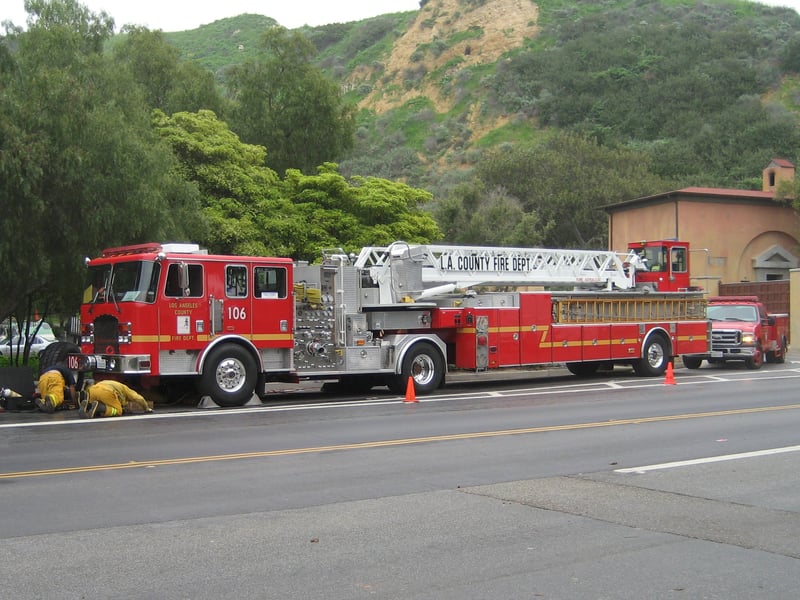
LOS ANGELES (CN) — Los Angeles County on Thursday filed an antitrust lawsuit against two large manufacturers of fire engines and trucks, claiming they have created an unlawful oligopoly by buying up competitors and are driving up prices fire departments have to pay for their equipment.
“Through acquisitions, combinations, and anticompetitive practices, they have created highly concentrated and oligopolistic markets that they control, allowing them to cut supply, raise prices, delay deliveries, or force the use of their proprietary parts to the deep financial detriment of localities across the country,” the county says in its lawsuit, filed in federal court.
The county claims Brookfield, Wisconsin-based REV Group and its private-equity backer American Industrial Partners acquired almost a dozen independent makers of fire apparatuses and chassis over a decade as part of a market consolidation strategy to drive up their profits.
The company also closed historic plants in Pennsylvania and Virginia, which the county says was a deliberate reduction in output that caused backlogs to skyrocket to a record $4.2 billion in undelivered orders by fiscal year 2024.
Meanwhile, REV Group raised its prices by as much as 100%, the county claims, to increase its profit margin.
An REV Group spokesperson said the company believes the lawsuit is meritless and will fight the claims in court.
LA County also accuses Wisconsin-based Oshkosh Corp. and its Pierce Manufacturing subsidiary of not only eliminating competition through both acquisitions and mergers, but also of forcing its parts dealers to refuse to sell compatible replacement parts made by other brands for its equipment.
“In a competitive marketplace, firms could not impose such restraints on customer choice and would expand their productive capacity to increase output and meet increased or pent-up demand, keeping prices at a competitive equilibrium,” the county says in the complaint. “But the markets for fire apparatuses, chassis, and Pierce replacement parts are no longer competitive. They are markets dominated by powerful behemoths”
Fire departments that use Pierce’s custom apparatuses routinely pay two, three, and even four times as much for replacement parts from Pierce as competing manufacturers charge for equivalent parts, according to the county, because of the restrictions on customer choice and access by Pierce and its parts dealers.
Meanwhile, both REV Group and Pierce Manufacturing have been using the supply chain disruptions and shortages that resulted from Covid shutdown as an excuse for long wait times and price increases, the county claims.
“The allegations in this lawsuit are without merit, and we are defending ourselves in court," an Oshkosh spokesperson said. “Oshkosh remains focused on delivering safe, high-quality fire trucks while continuing to reinvest in our U.S. operations to meet record demand.”
This past September, executives of REV Group and Pierce Manufacturing testified before the U.S. Senate Subcommittee for Disaster Management, District Columbia, and Census, at a hearing aptly titled “Sounding the Alarm: America’s Fire Apparatus Crisis.”
Senator Andy Kim, a Democrat from New Jersey, said in his opening statement that they wanted answers as to the reason for delays in getting the necessary equipment, and why are the prices are so high and seemingly volatile.
One fire truck can cost well over a million dollars to purchase, the senator noted, and that doesn’t include the cost of repairs over its lifetime.
Mike Virnig, president of REV Specialty Vehicles Group, told the senators that firefighting vehicles are highly complex and that the production process requires both intensive skilled labor and a large number of parts that manufacturers must source from upstream suppliers.
“Like most products manufactured in the United States, firefighting vehicles have faced significant inflation of input and manufacturing costs over recent years, including increased costs of labor, raw materials and other inputs,” Virnig said.
Dan Meyer, vice president of sales at Pierce Manufacturing, told the subcommittee the company hadn’t acquired any U.S.-based fire truck manufacturers and that it has to compete with dozens of other manufacturers wherever it sells its trucks. They did buy a Canadian manufacturer in 2022, he added, but this company only sells an average of five trucks a year to U.S. customers.
“After the pandemic, the combination of aged fleets, CARES Act funding, and increased property tax revenues for municipalities caused demand for fire trucks to skyrocket,” Meyer testified. “In 2022, the fire truck industry experienced a 45% increase in demand overall compared to pre- pandemic averages, and Pierce itself saw a 64% spike in demand compared to 2019 — the calendar year prior to the pandemic.”
LA County accuses the companies of various violations of the U.S. Clayton Act, the U.S. Sherman Act, as well as the California Cartwright Act. The county seeks unspecified damages, which will be automatically trebled per U.S. antitrust law, and a court order to end the purported anticompetitive concentration of the fire apparatus industry.
The county is represented by attorneys from Simonsen Sussman LLP and from Baron & Budd PC.
 Follow @edpettersson
Subscribe to our free newsletters
Our weekly newsletter Closing Arguments offers the latest about ongoing trials, major litigation and rulings in courthouses around the U.S. and the world, while the monthly Under the Lights dishes the legal dirt from Hollywood, sports, Big Tech and the arts.