
 Search Articles


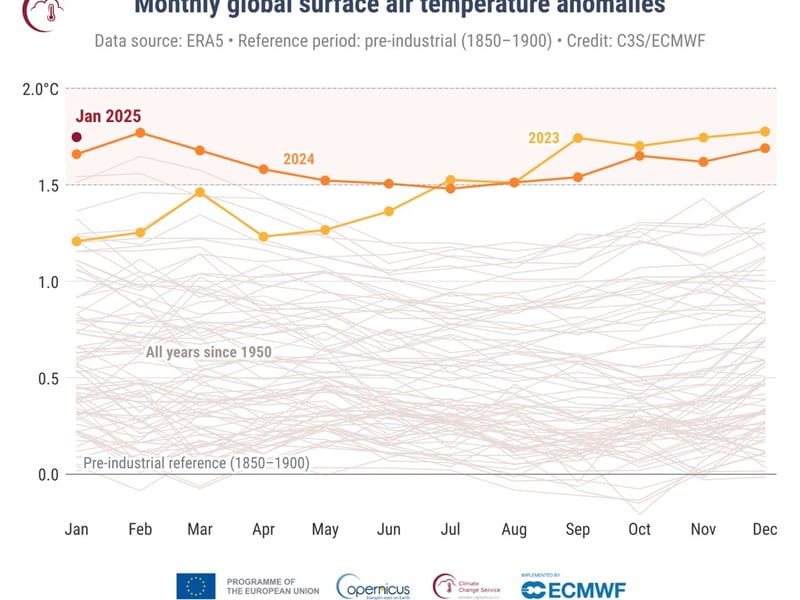
(CN) — An unprecedented global heat spell extended into 2025 after last month became the warmest January ever recorded on the planet, despite the emergence of a La Niña weather pattern, according to the European Union’s climate monitor.
The Copernicus Climate Change Service said it was the warmest January globally with an average surface air temperature of 13.23 degrees Celsius (55.81 degrees Fahrenheit), or 0.79 C (1.42 F) above average.
Samantha Burgess, a lead scientist at Copernicus, called the record January heat surprising because La Niña conditions emerged in the tropical Pacific last month, bringing a “temporary cooling effect on global temperatures.”
When compared to the average temperature before the industrial age and mass burning of fossil fuels, January was 1.75 C (3.15 F) warmer, Copernicus said. January, then, became the 18th month in the last 19 months when the average temperature was more than 1.5 C (2.7 F) above the pre-industrial level. Last year was the hottest on record.
The 1.5 C mark is an important threshold, with scientists warning the planet faces catastrophic consequences if the temperature exceeds that level year after year. Many scientists warn that threshold will be surpassed even with drastic cuts in carbon emissions.
On Jan. 9, the National Oceanic and Atmospheric Administration said La Niña conditions appeared in the tropical Pacific Ocean. La Niñas are typically associated with cooler and more stable weather, but this La Niña is forecast to be brief.
The record-breaking heat spell around the planet was in part fueled by the emergence of an El Niño weather pattern in June 2023. Human-caused global warming, though, is regarded as the main driver behind this long stretch of record heat, and its duration has alarmed scientists.
The most unusually warm parts of the planet in January were Eastern Europe, northeast and northwest Canada, Alaska, and Siberia and over southern South America, Africa, and much of Australia and Antarctica, Copernicus said. Copernicus runs a fleet of specialized satellites that monitor the climate and also bases its reports on weather data from around the world.
Joel Hirschi, a climate scientist at Britain’s National Oceanography Centre, said the continuation of heat into January was similar to what happened after other El Niño patterns in the past decade. In a note, he said “global temperatures remained close to record warm levels even after the onset of La Niña conditions.”
For Richard Allan, a climate scientist at the University of Reading, January’s record heat was further evidence that the accumulation of greenhouse gases in the atmosphere is the chief factor behind rising global temperatures.
“Human-caused warming of the ocean is accelerating and this is dominating to an ever greater extent over the natural year to year fluctuations in climate,” he said in a statement.
“As industrial activity continues to spew greenhouse gases into the air, this growing heating effect is tipping the balance toward record warmth and worsening hot, dry and wet extremes,” he said.
Bill McGuire, a climate scientist at University College London, called the latest data from January “both astonishing and, frankly, terrifying.”
“Having crashed through the 1.5 C limit in 2024, the climate is showing no signs of wanting to dip under it again,” he warned in a note.
Climate scientist Friederike Otto at Imperial College London echoed that sentiment.
“This January is the hottest on record because countries are still burning huge amounts of oil, gas and coal,” she said. “Sure, El Niño and La Niña add or take off a tiny bit of warming, but the reason we’ve broken another record is the continued burning of fossil fuels.
She warned that the catastrophic wildfires that devastated the Los Angeles area in January highlighted the dangers of a warming planet.
Courthouse News reporter Cain Burdeau is based in the European Union.
 Follow @cainburdeau
Subscribe to our free newsletters
Our weekly newsletter Closing Arguments offers the latest about ongoing trials, major litigation and rulings in courthouses around the U.S. and the world, while the monthly Under the Lights dishes the legal dirt from Hollywood, sports, Big Tech and the arts.