
 Search Articles


The House Oversight Committee and Trump’s accounting firm Mazars were supposed to come to an agreement on their own, but disagreed about who should view the records, how they should view the records and which records were on the table.
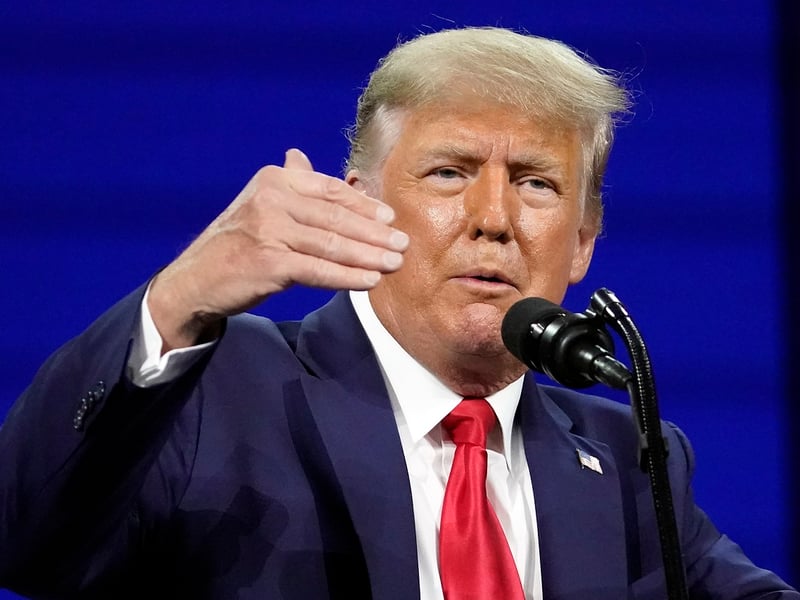
WASHINGTON (CN) — “Should I send you all back to the drawing board?”
A federal judge seemed at a loss for what to do next, years into a lengthy legal battle for Trump’s financial records that has already made its way up to the Supreme Court and back down again.
The House Oversight Committee’s subpoena for Trump’s financial records lapsed with the end of the 116th Congress. In March, the committee reissued an identical subpoena.
“What do I do with any and all of this at this point?” U.S. District Judge Judge Amit Mehta, an Obama appointee, repeatedly asked both parties’ attorneys during oral arguments on Thursday.
At a status conference in June, Mehta had told counsel for Trump and his accounting firm Mazars and counsel for the House Oversight Committee to try to come to an agreement on their own — but the parties reported back that they came to a standstill over disagreements about which documents to disclose.
Cameron Thomas Norris, an attorney representing Trump and Mazars, told Mehta that the firm offered to disclose Trump’s financial statements from 2015-2018 and their corresponding contracts if they remain confidential and only House Committee members look at them — not the public.
If committee members review the records and have questions, Mazars said they are willing to hear a more narrow request regarding the disclosure of any relevant source documents. They will not, however, under any circumstances, give up communications between clients and accountants.
“With all due respect, it is our view that the committee was extremely eager to declare an impasse and cut those negotiations off,” Norris said. “The biggest source of tension was our request of confidentiality.”
But, Douglas Letter, attorney for the House Committee claimed that Trump’s counsel did not offer to produce documents, and brought copies of email records from the negotiations to show the judge.
“They never offered to produce a single document. I want the public to know this,” Letter said. “They offered to produce zero documents, your honor.”
Reading an email from Trump’s team, Letter quoted: “We are willing to permit up to four committee staff — two majority, two minority — and counsel for plaintiffs to have access to the relevant engagement letters and contracts covering its relationship with Mazars during the years 2015-2018.
“We will allow the taking of notes, but not copies or photographs, subject to the committee’s express agreement to not share the information obtained beyond the committee and its staff. We are not prepared at this time to agree in advance to whatever scope of production the committee might demand to review.”
Mehta retorted that perhaps their definitions of “produce” were different. One more permanent, while the other is for a limited number of people.
“We think these are highly complex financial documents with lots of information,” Letter said. “And the notion that no members of Congress would actually be able to look at these is, to be blunt, ridiculous.”
Plus, congressional committees can’t pledge confidentiality, Letter said, and judges can’t order it.
The battle for the financial records, which initially began with a lawsuit in 2019, ultimately led the Supreme Court to issue a new test for when Congress could obtain those records — aptly named the Mazars test. The justices ordered the lower courts to determine whether the subpoenas met the standards.
Letter says the test doesn’t apply to Trump now that he is a private citizen, while Norris says it does.
“This is a basic disagreement of law,” Letter said. “They say Mazars applies, we say it doesn’t.”
It left a skeptical Mehta to push Letter to explain why the House specifically needed Trump’s financial documents for their legislative goals — part of the Mazar test which says that congressional subpoenas must have a valid legislative purpose.
“The committee has not, for example, asked for anyone else’s disclosures or personal information and there are others that have fairly complex financial holdings and are wealthy,” Mehta said. “Why couldn’t you learn what you feel like you need to learn by using somebody else’s financials to determine what additional disclosures are required?
Letter explained that the House needed to specifically address conflicts of interest involving Trump.
“These are things that it seems to me that Congress can turn to experts, can turn to when people have engaged in financial fraud,” Mehta said. “It seems there are other sources to inform the question of what additional disclosures might be required of a president with complex financial holdings.”
“The House doesn’t need decades worth of a single president’s financial disclosures in order to regulate future presidents,” Norris told Mehta.
Mehta has been wary of making a decision, and wanted the parties to negotiate on their own.
“As far as I can tell, there have been limited efforts, and those have only been prompted by my hearing a couple of weeks ago,” Mehta told Letter. “You don’t mean to say that I need to get in the middle of this? Your point is that there has been no agreement and I now have to resolve it?”
No matter which way Mehta rules, the case is almost certain to head back to appellate courts.
Subscribe to our free newsletters
Our weekly newsletter Closing Arguments offers the latest about ongoing trials, major litigation and rulings in courthouses around the U.S. and the world, while the monthly Under the Lights dishes the legal dirt from Hollywood, sports, Big Tech and the arts.