Search Articles


(CN) — Call it an early checkmate in the fast-paced political fortunes of Péter Magyar, Europe’s liberal-minded rising star and vanquisher of Viktor Orbán, Hungary’s long-serving prime minister and iconic far-right leader.
Since the April 12 elections, Hungary has witnessed a remarkable transformation unfold as Magyar’s Tisza party forcefully seizes the reins of power from Orbán’s Fidesz party.
With relentless campaigning across Hungary’s countryside and cities, the 45-year-old Magyar led his newly founded Tisza party to an electoral avalanche that swept Fidesz out of power as a groundswell of resentment against Orbán and corruption crested.
A week ago, Tisza used its supermajority in Parliament to ram through constitutional amendments to rid Fidesz and its tentacles from government. One amendment, the 17th, ordered Fidesz-appointed President Támas Sulyok to resign.
On Saturday, Sulyok did as he was ordered, sealing his fate by signing the 17th amendment into law. He vacated his office.
“Through these decisions, we are restoring something that the Orbán regime tried to take away from the Hungarian people over many long years: the certainty that power can be limited,” Magyar exclaimed after Sulyok resigned.
Fast-forward less than a day. On Sunday, Magyar issued a statement announcing he’d found the right person to represent the country as its next president: Judit Polgár, the 49-year-old Hungarian chess legend.
“Tomorrow I will meet with her and ask whether she is willing to serve our country in this new role until the adoption of the new Constitution,” Magyar announced on social media.
“Judit Polgár’s name has been synonymous with talent and perseverance for decades,” he said. “As the most accomplished female player in chess history, she topped the women’s world rankings uninterrupted for 26 years, while also breaking into the top 10 of the absolute world rankings.”
Along with Magyar’s announcement came statements of support for Polgár from numerous Hungarian celebrities and cultural and sports figures.
“Personally, I would consider it a tremendous honor if she accepts the invitation,” Magyar said. “Our country needs unity, peace, and a president in whom every Hungarian can take pride.”
In Parliament Monday, Polgár’s nomination was approved by the Tisza group, which said she was the best candidate. Her nomination appeared a shoo-in.
Then the furor started.
It wasn’t anger at Polgár — she’s beloved in Hungary. It was directed at Magyar.
“Minutes after Sulyok announced that he would sign, Magyar promised that the successor would not be chosen in ‘smoke-filled rooms,’ inviting parties, civic organizations and citizens to submit names and announcing a consultation process,” the Hungarian Conservative reported. “That promise unraveled in less than 24 hours.”
Amnesty International Hungary came out against the process.
“The problem is not Judit Polgár, but Péter Magyar’s procedure,” it said.
It warned Magyar was trying to bypass public debate, a blunt practice reminiscent of Orbán’s anti-democratic habits. Even inside the ranks of Tisza supporters, Magyar was seen as behaving like a new Orbán.
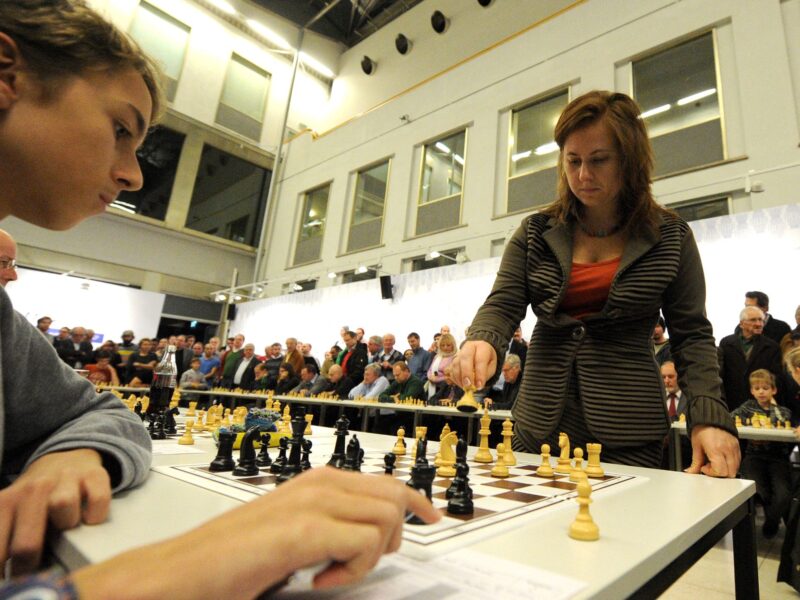
Known as the “Queen of Chess,” Polgár gained worldwide fame as the best female chess player ever and she remains the only woman to beat a reigning grandmaster. She defeated Garry Kasparov in 2002.
Born to a Jewish family in Budapest in 1976, Polgár and her two sisters were forced to master chess by their obsessive father, an autodidact who made it his project in communist-era Hungary to train his daughters to become the best chess players in the world.
Even as very young girls, the Polgár sisters crushed older male competitors and they went on to smash stereotypes about women and chess. Judit Polgár’s life story was the subject of a Netflix documentary called “Queen of Chess.”
By Monday evening, Polgár withdrew her name from consideration for the presidency, even though she said it was an “honor of my life” to be offered the office.
“However, I do not feel strong enough to take on the historical responsibility of uniting a divided nation, so I cannot fully respond to the invitation,” she wrote on social media.
Hungarian presidents, as in many European systems, are elected by Parliament, serving mostly in ceremonial roles while the business of daily governing is left to the national assembly. Still, presidents are granted powers and they can review laws and even veto them. Tisza forced Sulyok out to prevent him from gumming up their agenda to rewrite unconstitutional laws passed under previous Orbán governments.
Magyar’s tone-deaf decision on Polgár, though, fed a perception held by many Hungarians, especially more rural and conservative Fidesz backers, that Magyar is carrying out a revenge campaign rather than truly wanting to clean up the government.
Magyar is a scion of a prominent Budapest legal family and he has shown willingness to implement measures meant to tackle damage caused by Orbán.
Many Hungarians hope he lives up to his promises to respect the rule of law. He has a lot riding on perception considering his family’s long legal reputation in Hungary.
His great-uncle was a former Hungarian president, his mother a judge and his grandfather a celebrity Supreme Court judge who gave legal advice on television during the communist era.
But there are reasons for suspicion, too.
Magyar entered politics as a close ally of Orbán, fitting nicely into Fidesz’s conservative machinery. He turned whistleblower against Fidesz after his marriage to Orbán’s former justice minister, Judit Varga, crumbled amid a presidential pardon scandal that paved the way for Orbán’s eventual downfall.
During relentless campaigning around the Hungarian countryside and in his speeches, Magyar presented himself as the country’s best hope for ending Orbán’s overbearing rule and restoring trust and democracy.
But he’s raised eyebrows with an attempt to nominate his brother-in-law as justice minister.
For now, he’s carrying out a bare-knuckles campaign to go after “stolen money” that Orbán and his Fidesz allies are accused of pilfering. On Tuesday, police raided the Fidesz headquarters.
While in office, Orbán amassed vast wealth for himself and his inner circle. Prosecutors are examining rigged public contracting schemes, nepotism and misuse of public funds. Arrests have been carried out against minor Fidesz figures.
Orbán was one of Europe’s most controversial and powerful figures, growing close with some of the world’s biggest leaders — Vladimir Putin, Donald Trump, Xi Jinping, Benjamin Netanyahu and Narendra Modi among them.
Courthouse News reporter Cain Burdeau is based in the European Union.
 Follow @cainburdeau
Subscribe to our free newsletters
Our weekly newsletter Closing Arguments offers the latest about ongoing trials, major litigation and rulings in courthouses around the U.S. and the world, while the monthly Under the Lights dishes the legal dirt from Hollywood, sports, Big Tech and the arts.