Search Articles


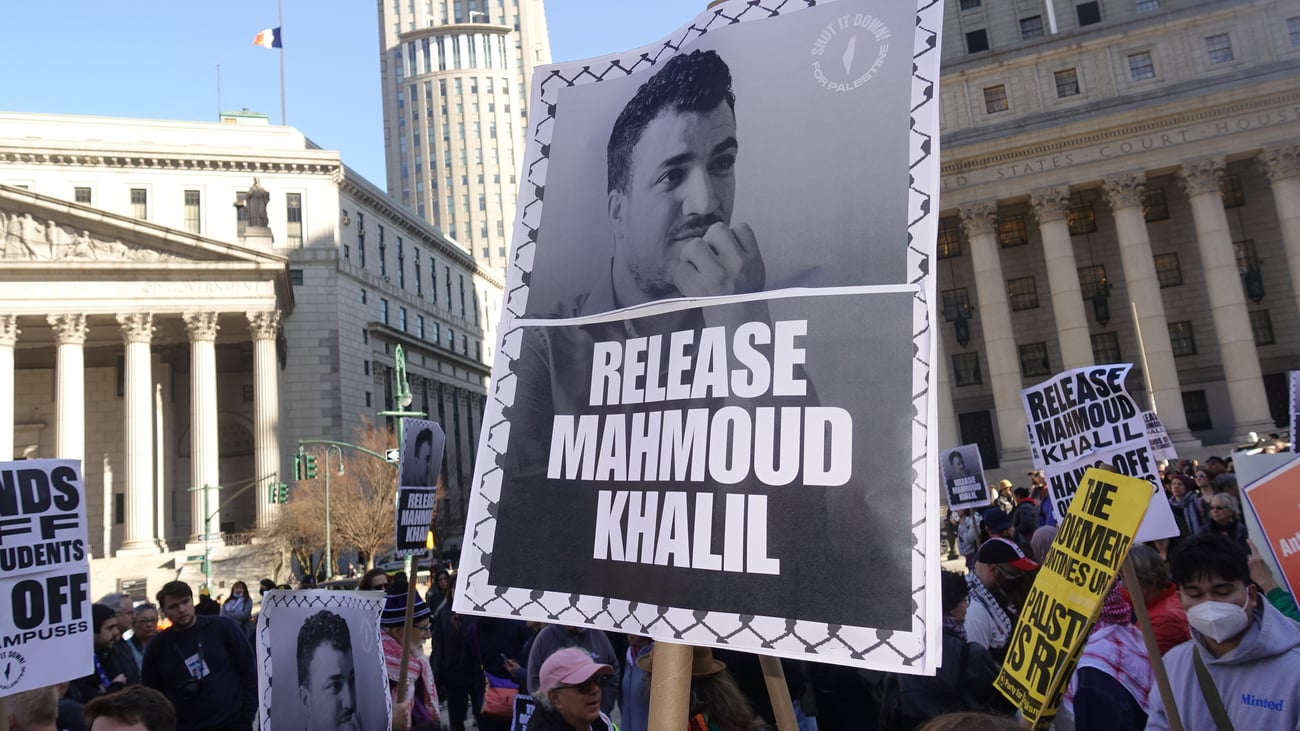
PHILADELPHIA (CN) — As former Columbia University student protester Mahmoud Khalil petitions the Third Circuit for a rehearing en banc to contest his immigration arrest, he wants Emil Bove — the Donald Trump-appointed judge whose contentious rise may have included investigations into student protesters — out of the equation.
While a New Jersey federal judge ruled in June 2025 that the federal government’s monthslong detainment of Khalil amid efforts to deport him was likely unconstitutional, a three-judge Third Circuit panel vacated that ruling in January, finding that the lower court had no authority to weigh his release in the first place. Only an immigration judge, the panel said, could make that determination.
Khalil, a 31-year-old green card holder whose wife and son are U.S. citizens, filed Tuesday in the appeals court a request for a rehearing en banc, calling the case “of extraordinary importance” and worthy of the full court’s attention.
That is, the attention of all but one judge: One day after filing his request, Khalil filed a motion to recuse U.S. Circuit Judge Emil Bove from consideration of his en banc request.
Bove’s inclusion in the consideration process, Khalil posited, would create a conflict of interest due to Bove’s high-ranking roles in the Attorney General’s Office during federal investigations into and litigation against student protestors, including those at Columbia University.
“Judge Bove held high-level leadership and supervisory positions at DOJ from the initiation of Mr. Khalil’s detention and the subsequent filing of his habeas challenge through the filing of the [Trump administration’s] appeal in this case,” Khalil wrote in his motion. “He supervised departments and personnel that the public is likely to believe were responsible for substantive decisions regarding Mr. Khalil’s high-profile case, which raises novel issues of law.”
Additionally, Khalil said, public records — including statements made by Bove himself — suggest Bove actively supervised and guided the Justice Department’s investigation into pro-Palestine protests on Columbia University’s campus. That would include investigations into a student group called Columbia University Apartheid Divestment, a group the government accuses Khalil of leading. Khalil has denied this claim.
“The public reporting on Judge Bove’s involvement in investigating Columbia student protesters makes it difficult to imagine that a member of the public would not perceive that Judge Bove was involved in decision-making around Mr. Khalil’s case, the first and very high-profile government action against a Columbia student protester,” Khalil wrote.
While Khalil noted in his motion that only Bove has the authority to recuse himself, he requested that Bove do so, adding that Bove told Congress during his judicial nomination process he would recuse himself in any cases he had personally been involved in.
Bove’s rise to the Third Circuit, made official in September 2025, raised opposition from more than 75 former state and federal judges and more than 900 former Justice Department attorneys. During Bove’s tenure in the Attorney General’s Office, he oversaw the dismissal of then-New York City Mayor Eric Adams’ corruption charges. Additionally, multiple Justice Department whistleblowers have accused Bove of intentionally violating a federal court order in order to deport migrants to El Salvador.
Khalil was detained in March 2025 by Immigration and Customs Enforcement agents for his pro-Palestinian advocacy. Khalil had served as a lead negotiator for the student protesters, speaking with the university and urging them to divest from Israel.
Invoking the Immigration and Nationality Act of 1952 — a rarely used Cold War-era statute that allows for the removal of lawful permanent residents — the State Department sought to deport Khalil for his protesting, arguing his advocacy negatively impacted U.S. foreign policy.
Khalil was released by U.S. District Judge Michael Farbiarz, a Joe Biden appointee in New Jersey, in June 2025 after more than 100 days in detainment. Farbiarz found that Khalil is neither a flight risk nor a danger to the community and should be freed from detention as legal proceedings continue.
While the Third Circuit panel ruled 2-1 to vacate the lower court’s ruling, they granted Khalil the opportunity for immediate review, meaning he cannot be detained in the meantime.
 Follow @JacksonHeals
Subscribe to our free newsletters
Our weekly newsletter Closing Arguments offers the latest about ongoing trials, major litigation and rulings in courthouses around the U.S. and the world, while the monthly Under the Lights dishes the legal dirt from Hollywood, sports, Big Tech and the arts.