
 Search Articles


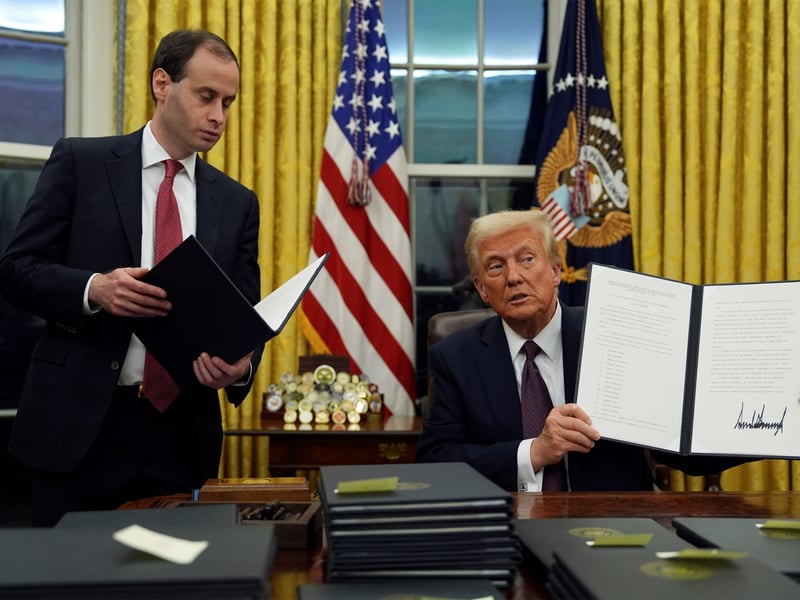
(CN) — A federal judge in Massachusetts on Thursday blocked President Donald Trump’s controversial Day 1 executive order that took aim at birthright citizenship, finding that challengers of the Trump’s narrow redefinition of who is guaranteed citizenship had established irreparable harm.
“The loss of birthright citizenship — even if temporary, and later restored at the conclusion of litigation — has cascading effects that would cut across a young child’s life (and the life of that child’s family), very likely leaving permanent scars,” U.S. District Judge Leo Sorotkin wrote in his opinion granting a preliminary injunction of the executive order — the fourth judge to take such an action following similar rulings in New Hampshire, Maryland, and Washington state.
“The record before the court establishes that children born without a recognized or lawful status face barriers to accessing critical health care, among other services, along with the threat of removal to countries they have never lived in and possible family separation,” the Barack Obama appointee wrote.
“It is difficult to imagine a government or public interest that could outweigh the harms established by the plaintiffs here,” he added. “Perhaps that is why the defendants have identified none. Instead, they point only to the Executive Branch’s discretion in matters of immigration.”
Sorotkin’s ruling came in response to a pair of challenges to the executive order: one lawsuit from a multi-state coalition — led by the attorneys general of New Jersey, Massachusetts and California — who claim that Trump’s executive order was unconstitutional, and another civil complaint from pseudonymous Doe plaintiffs.
New York Attorney General Letitia commended the ruling on Thursday evening.
“The president and his allies made clear long before he was sworn in that they would pursue this illegal action, and our coalition was prepared to challenge it as soon as President Trump fulfilled this unconstitutional campaign promise on Inauguration Day,” she wrote in a statement.
“We immediately stood up for our Constitution, for the rule of law, and for families across the country who would have been deprived of their constitutional rights – and today we delivered for them. This is not yet over, and we will continue to fight every single step of the way until President Trump is permanently prevented from trampling on the Fourteenth Amendment.”
Hours after his inauguration on Jan. 20, Trump signed the “Protecting the Meaning and Value of American Citizenship” order, which narrowed birthright citizenship to people who have one or more parents who are already U.S. citizens.
Trump’s redefinition of birthright citizenship, the coalition claims, flew in the face of decades of legal precedent from multiple branches of government.
“President Trump now seeks to abrogate this well-established and longstanding constitutional principle by executive fiat,” the coalition claims in the lawsuit. “The president has no authority to rewrite or nullify a constitutional amendment or duly enacted statute. Nor is he empowered by any other source of law to limit who receives United States citizenship at birth.”
Other members of the 18-state coalition include Colorado, Connecticut, Delaware, Hawaii, Maine, Maryland, Michigan, Minnesota, Nevada, New Mexico, New York, North Carolina, Rhode Island, Vermont, Wisconsin, the District of Columbia and the city and county of San Francisco.
A separate coalition consisting of attorneys general from Washington, Arizona, Illinois and Oregon, who have their own lawsuit against Trump over the executive order, won a temporary restraining order on Jan. 23 to block its implementation. They claim that, should Trump get his way, the citizenship of hundreds of thousands of people born in the U.S. every year would be threatened.
The judge in that case, Ronald Reagan-appointed U.S. District Judge John Coughenor of the Western District of Washington, panned Trump’s executive order as “blatantly unconstitutional" and has since ruled that he would grant a preliminary injunction to keep it from going into effect.
“I’ve been on the bench for over four decades. I can’t remember another case where the question presented is as clear as this one,” Coughenor remarked from the bench during oral arguments on Jan. 23.
A group of pregnant mothers also won a temporary block in federal court in Maryland after expressing fears that their children would be denied U.S. citizenship under Trump’s order. U.S. District Judge Deborah Boardman, a Joe Biden appointee, ruled that Trump’s redefining of birthright citizenship was likely unconstitutional.
“Citizenship is a most precious right, expressly granted by the 14th Amendment to the Constitution,” Boardman said during a hearing on Feb. 5.
Trump’s executive order challenges the longstanding interpretation of the 14th Amendment of the U.S. Constitution.
Ratified in 1868 after the Civil War, the amendment established citizenship for Black Americans post-slavery by mandating that anyone “born or naturalized in the United States, and subject to the jurisdiction thereof, are citizens of the United States and of the state wherein they reside.”
In his order, Trump proclaimed the 14th Amendment has “never been interpreted to extend citizenship universally to everyone born within the United States.” He claimed that it has “always excluded” people who were not “subject to the jurisdiction” of the country.
Trump’s interpretation of the amendment would not just strip citizenship rights from the children of undocumented immigrants. It could also affect those born to parents who are in the United States legally on a temporary basis, like those on student or H-1B visas.
 Follow @Uebey
 Follow @uebey.bsky.social
Subscribe to our free newsletters
Our weekly newsletter Closing Arguments offers the latest about ongoing trials, major litigation and rulings in courthouses around the U.S. and the world, while the monthly Under the Lights dishes the legal dirt from Hollywood, sports, Big Tech and the arts.