
 Search Articles


(CN) — The Ninth Circuit Court of Appeals on Wednesday affirmed the since-rescinded “metering” policy, under which asylum-seekers were turned away at the U.S.-Mexico border if Custom and Border Protection officials deemed a crossing to be at capacity, is unlawful.
In the split decision, the panel also upheld the trial judge’s ruling that asylum-seekers who were turned away under the metering policy could not be forced, under a subsequent and since blocked Trump administration policy, to first seek asylum in the country they traveled through to reach the U.S. if they were turned away before that “Asylum Transit Rule” went into effect.
The government wrongly argued that a noncitizen stopped on the U.S.’s doorstep is not eligible to apply for asylum unless they have actually stepped across the border, U.S. Circuit Judge Michelle Friedland, a Barack Obama appointee, wrote for the majority.
In that regard, she said, the government misconstrued what it means to “arrive” in the U.S., under the statutory language, in order to seek asylum.
“For a person coming to the United States to seek asylum, the relevant destination is the U.S. border, where she can speak with a border official,” Friedland wrote. “A person who presents herself to an official at the border has therefore reached her destination — she has ‘arrived.’”
Under the government’s interpretation, an asylum-seeker who knows she will be turned away at a port of entry before being allowed to apply for asylum may conclude that she’s better off to surreptitiously cross the border and apply for asylum when she’s on U.S. soil.
“We do not think Congress would have created that incentive,” Friedland wrote.
Representatives of the Justice Department didn’t immediately respond to a request for comment on the ruling.
“It took seven years and untold sums of taxpayer dollars for the U.S. government to learn a legal lesson that should have been apparent from the beginning – that respect for the rule of law and international human rights norms still matters, and that you cannot have a legal process to decide asylum claims while also implementing policies that deny access to that process,” said Nicole Elizabeth Ramos, border rights project director with Al Otro Lado, the organization that brought the lawsuit.
The legal services organization also noted, however, that under the Biden administration the government’s turn-back practices have evolved and expanded and that in 2023, the government unveiled new regulations making most people seeking safety at the southern border categorically ineligible for asylum.
The metering policy was first implemented in 2016 during Obama’s last months in office at the San Ysidro Port of Entry in response to the influx of Haitian immigrants seeking to claim asylum in San Diego.
U.S. District Judge Cynthia Bashant, also an Obama appointee, in 2021 agreed with the immigrant rights groups challenging the policy that border officials violated their mandatory duties to inspect and refer asylum-seekers by turning them back without further ado.
Customs and Border Protection rescinded the policy shortly after Bashant’s ruling.
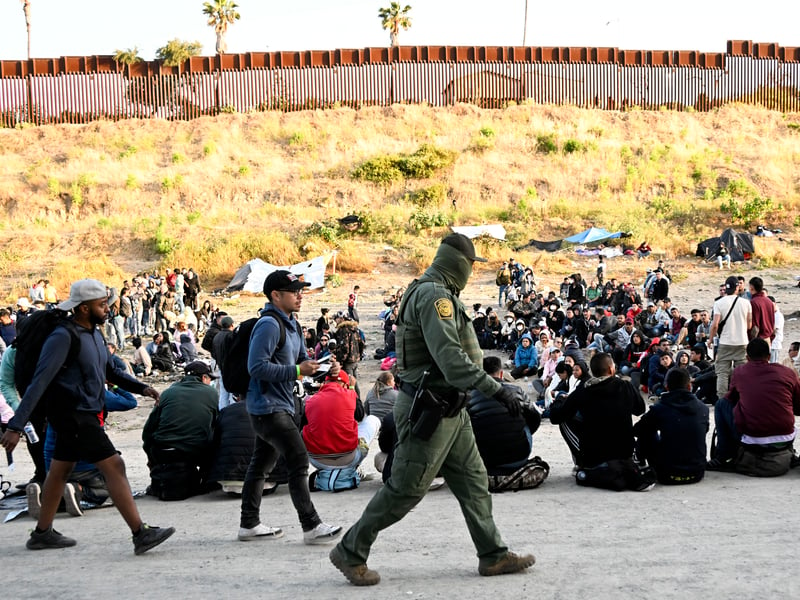
Due to the metering policy, asylum-seekers had begun to accumulate on the Mexico side of the border, Friedland noted in her opinion. Many camped near the bridges at ports of entry and waited for days, weeks, or months, with many of them being subjected to persecution and crime, and lacking adequate food and shelter.
“Some were murdered in Mexico while waiting for an opportunity to be processed by U.S. officials,” Friedland wrote. “Some attempted to reach U.S. soil by other means, such as running down vehicle lanes at ports of entry, so that they could apply for asylum. Others, including young children, tried to swim across the Rio Grande and drowned.”
U.S. Circuit Judge Ryan Nelson, a Donald Trump appointee, wrote in dissent that the majority’s conclusions were “wrong, troubling, and breathtaking.”
The majority’s interpretation of what it means under the law to arrive in the U.S. for the purpose of seeking asylum imposes on the federal government — for the first time — an obligation to interview asylum-seekers who are still in Mexico, Nelson said.
“More than being wrong, the majority’s conclusion is harmful,” Nelson wrote. “Judicial redlining of statutes, as the majority does here, undercuts Congress’ authority, eliminates citizens’ ability to rely on the law, and erodes democracy, allowing unelected judges to revise the decisions of the people’s representatives.”
U.S. Circuit Judge John Owens, also an Obama appointee, rounded out the majority.
 Follow @edpettersson
Subscribe to our free newsletters
Our weekly newsletter Closing Arguments offers the latest about ongoing trials, major litigation and rulings in courthouses around the U.S. and the world, while the monthly Under the Lights dishes the legal dirt from Hollywood, sports, Big Tech and the arts.