
 Search Articles


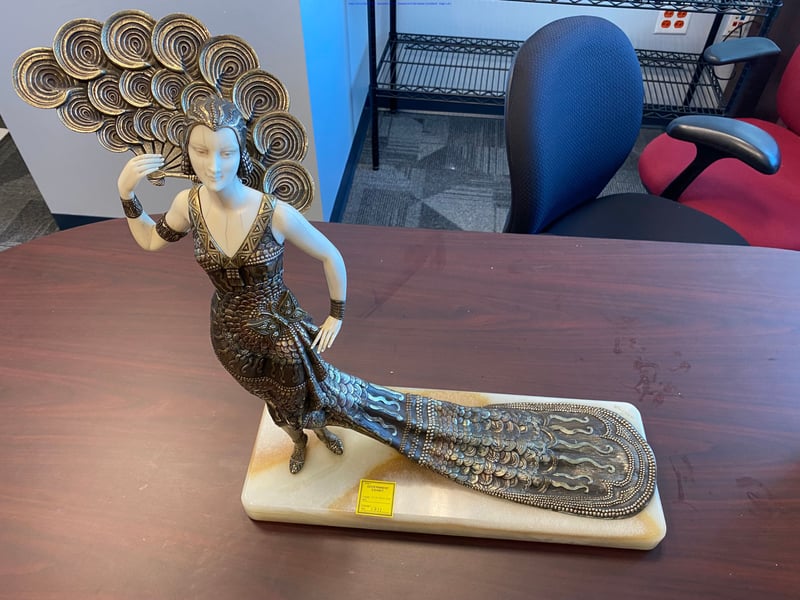
(CN) — A Miami art dealer convicted of smuggling sculptures containing ivory into and out of the United States without declaring them to the feds asked the 11th Circuit on Wednesday to toss his conviction and 51-month prison sentence.
An attorney for Eduardo Ulises Martinez told a three-judge panel that his client’s right to a fair trial was violated when a Florida federal judge “cherry-picked” excepts from an interview with customs officials, omitting from evidence statements showing Martinez honestly believed he was not violating the law. The lower court also wrongly excluded evidence of exceptions to the Endangered Species Act allowing for the importation of ivory that is at least 100 years old or items containing less than 200 grams of ivory, the attorney said.
After an eight-day trial in 2022, Martinez was convicted of nine counts of knowingly smuggling sculptures containing ivory into and out of the United States without properly declaring them or making the ivory available for inspection by the U.S. Fish and Wildlife Service.
Martinez was also convicted of one count of obstruction of justice and ordered to pay a $20,000 fine and serve three years of supervised release after his prison term.
The United States implemented a near-total ban on the commercial trade of African elephant ivory in 2016.
Arguing on Martinez’s behalf, Miami-based attorney Joseph Schuster said jurors were denied the chance to hear complete statements from Martinez’s September 2021 interview with customs officers showing he believed he did not have to declare ivory heads from two statutes found in his luggage at the Miami International Airport because they were antiques.
“He doesn’t say it exactly or as artfully as we would say it here,” Schuster acknowledged. “But he said no less than six times ‘I’m not going to have a problem.’”
Justice Department attorney Robert Stockman countered with arguments that the law does not provide an exception for the declaration requirements Martinez was convicted of violating.
U.S. Circuit Judge Adalberto Jordan appeared to agree, telling Schuster he was confusing the issue.
“[Martinez] may have had every belief in the world he could legally import and export these items,” the Barack Obama appointee said. “But that’s not the same as a belief he did not have to declare them.”
Jordan questioned whether the methods used by Martinez to get the sculptures into and out of the United States belied Schuster’s point.
“He took these things apart. He mailed them in pieces to avoid detection. Why would you take a sculpture apart and send it in pieces if you were not trying to hide what it really meant as a unified whole?” Jordan asked.
Martinez bought sculptures containing ivory from auction houses in Spain, England, Canada and Australia. According to the government, Martinez employed a variety of methods to avoid detection by law enforcement.
Court documents detail Martinez’s efforts to dismantle the sculptures and import them into the United States by shipping the ivory, bronze and marble components in separate boxes. Martinez also shipped the sculptures in pieces to addresses not linked to his business or home.
On some occasions, Martinez had third parties in Spain and England collect sculptures from European auction houses and ship them to the United States.
Martinez reassembled the sculptures and displayed them for sale in his art gallery. A search of Martinez’s home and business uncovered more than 200 artworks containing ivory.
Stockman argued that even if the lower court was wrong in excluding some of Martinez’s statements to the customs officers, there was still “overwhelming evidence” Martinez knew he was “acting contrary to the law.”
“He never lists ivory on his invoices, he never lists ivory in the receipts, he never puts ivory on his websites,” Stockman said. “He arranges for them to be shipped to other people to conceal that it’s coming to him and in multiple conversations he says things like ‘Don’t tell anyone about this object because it’s illegal if you bring it from abroad.’”
Schuster also told the panel his client was unfairly sentenced based on the government’s overestimation of the value of the sculptures.
“These sculptures were valued based on the fame and notoriety of the artist who created them and not the actual contraband. These things were mostly made of bronze and marble with a very small part of ivory,” Schuster said, telling the panel the “inflated” value of the items was the “primary driver” of Martinez’s sentence.
Stockman argued a valuation report provided by Martinez’s expert was unreliable and “massively undervalued” the artwork, citing one instance where the expert valued a sculpture sold by Martinez for $60,000 at just $4,400.
“A smuggler can be held responsible for what he sold his purchases for,” Stockman said.
U.S. Circuit Judge Andrew Brasher, a Donald Trump appointee, and Senior U.S. District Judge Virginia Covington, a George W. Bush appointee sitting by designation from the Middle District of Florida, rounded out the panel.
They did not indicate when they will issue a decision.
 Follow @KaylaGoggin_CNS
Subscribe to our free newsletters
Our weekly newsletter Closing Arguments offers the latest about ongoing trials, major litigation and rulings in courthouses around the U.S. and the world, while the monthly Under the Lights dishes the legal dirt from Hollywood, sports, Big Tech and the arts.