
 Search Articles


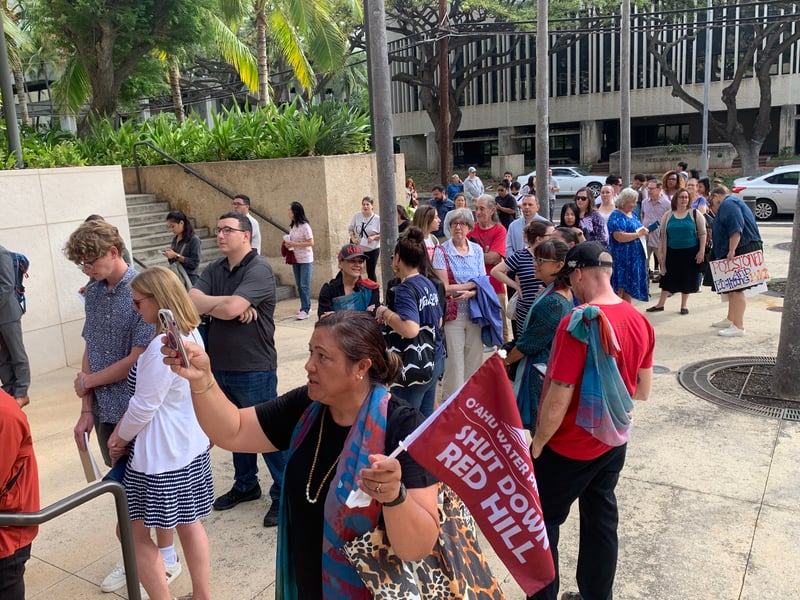
HONOLULU (CN) — Families gave tearful accounts on the second day of a trial over jet-fuel contaminated water at an Oahu Navy base, saying the leak left illness and lingering fears in its wake.
U.S. District Judge Leslie E. Kobayashi heard plaintiffs’ continuing testimony Tuesday in Honolulu federal court.
Patrick Feindt, the husband of Major Amanda Feindt who testified Monday, said the water contamination crisis upended his family.
“I’ve never seen my wife so ill. She’s one of the strongest people in the world, to see her that ill — this was violent and it moved through our family,” he said.
In November 2021, a leak from the World War II-era Red Hill underground fuel storage facility contaminated the water supply for Joint Base Pearl Harbor-Hickam and surrounding areas. The U.S. Navy initially downplayed by the disaster, saying the water was safe to drink. However, many people fell ill and pointed to the contamination as the cause.
As of February 2024, more than 7,500 people had filed lawsuits over water contamination at the Defense Department’s Red Hill Bulk Fuel Storage Facility near Honolulu, Hawaii.
To streamline the massive case, Kobayashi consolidated proceedings and overruled exhibits deemed irrelevant to the “truth of the matter” between each testimony. However, she allowed any evidence pertinent to the plaintiffs’ “emotional distress” claims.
Feindt says he and his family endured immense emotional distress. They are suing the U.S. government for damages for medical negligence, pain and suffering, and loss of life expectancy, among other charges according to the class action brought against the state in August of 2022.
“There was a fuel spill, it got into our drinking water system and then ran through our bodies,” Feindt continued. “I was angry that someone could do that and I was scared for the health of my wife and kids.”
“I didn’t want to believe that someone could do this to you, especially the U.S. government, especially my wife’s employer,” he said, dabbing roughly at his eyes.
Beau Jessup, an 18-year-old high school senior, adjusted his glasses with visibly trembling hands as he spoke from the witness stand. He said that his worsening tremors started a month after he was exposed to the contaminated water and have intensified over the past two and a half years.
Jessup and his younger sister noticed an unusual sheen on their dishes. Initially intrigued by the “cool, and sort of iridescent" appearance of the oily film, the siblings told their parents, inadvertently exposing a larger issue with the water supply.
Beau’s mother, Sheena Jessup, shared a social media post from that time: “This is insane, our water smells like I’m at the gas pump. Pungent fuel odors!” The post began, before going into details about neighbors and animals with similar symptoms like abdominal pains, vomiting, and rashes.
For six months the Jessups boiled water and bathed out of pasta pots — like they were camping in their own home, Beau Jessup said.
For weeks following the incident, the Navy denied any water contamination, which families like the Jessups and Feindts said compounded their distress as they struggled to get clear answers from military officials.
Kristina Baehr and James Baehr of Just Well Law in Austin, Texas, are the leading counsel for the plaintiffs, while the U.S. Navy’s defense is guided by Department of Justice attorney Eric Rey.
The plaintiffs claim the Navy attempted to conceal information and responded inadequately to the unfolding crisis. However, the Navy firmly rejects these assertions, insisting that its response was timely and aligned with proper protocols.
Rey presented an analysis by Paul Rosenfeld, which estimated that no more than 2,024 gallons of fuel contaminated the Red Hill water system, a figure far lower than the 20,000 gallons reported by other sources.
Rey asked Rosenfeld to explain how the chemical tended to stay on the surface of the water and didn’t penetrate the water source.
Gasoline, diesel, and other petroleum products fall under the category of light non-aqueous phase liquids — organic liquids that are less dense than water and incapable of dissolving in it.
Rosenfeld, aiming to break down the science underpinning the Navy’s defense, employed a familiar analogy: “A classic example is olive oil. It floats on the surface of the water,” he said.
Kobayashi requested clarification from Rosenfeld, prompting him to liken the fuel’s behavior to syrup on pancakes. He said JP-5 jet fuel, much like syrup, is an especially sticky substance that would have persisted if introduced into the water system.
The Jessups had their home water systems flushed twice. On the stand, Sheena Jessup said flushing the system made the families symptoms flare up. “If anything, it made things worse,” she said.
The debilitating tremors, nosebleeds, and dizziness Beau has experienced since the fuel spill have crushed his longtime ambition of following his father into military service, his mother said. The lingering symptoms have also left the teen afraid of potential cancer risks.
“I’m worried about every medical condition that we’ve discussed; neurological conditions and cancer are my biggest concerns. I worry about my four children. They’re all I care about, and I believe they were impacted by this leak,” said Jessup at the end of her testimony. “All of this was foreseeable, all of this was preventable.”
Subscribe to our free newsletters
Our weekly newsletter Closing Arguments offers the latest about ongoing trials, major litigation and rulings in courthouses around the U.S. and the world, while the monthly Under the Lights dishes the legal dirt from Hollywood, sports, Big Tech and the arts.