
 Search Articles


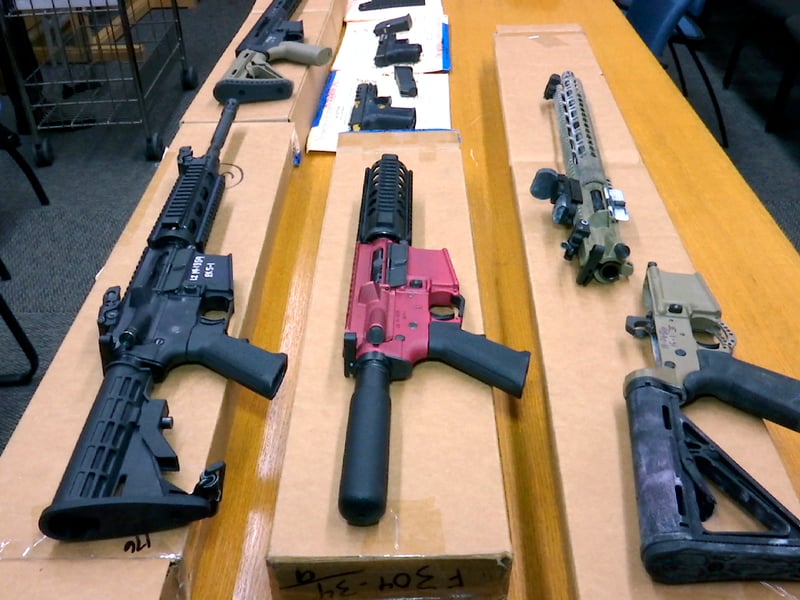
SAINT PAUL, Minn. (CN) — A Minnesota man appealing his conviction for failing to put a serial number on his homemade “ghost” gun argued Wednesday that enforcement of serial-number requirements could have far-reaching implications for thousands of guns that predate midcentury serial-number requirements, too.
The Minnesota Supreme Court heard arguments Wednesday in the case of Logan Vagle, whose attorney warned that if an existing Court of Appeals opinion was allowed to stand, thousands of Minnesotans might suddenly see their firearms declared illegal — with possible Second Amendment implications.
Vagle was caught with a home-assembled handgun when law enforcement responded to a single-vehicle rollover crash on Valentine’s Day of 2022. He admitted on the scene that he did not have a permit to carry the pistol, and was charged with the felony of possessing a firearm without a serial number, and the gross misdemeanor of possessing a pistol without a permit.
The felony charge was dismissed by a district court after Vagle argued that the Minnesota law forbidding possession of guns without serial numbers incorporated federal law, which does not require serial numbers for privately-made firearms (PMFs). The Minnesota Court of Appeals reversedthe dismissal, finding that the statute provides gun owners “a reasonable opportunity to understand what conduct it prohibits,” and that Vagle’s possession of a PMF without a serial number qualified as prohibited conduct.
On appeal to the state Supreme Court, Vagle’s attorney Anders Erickson argued that if Minnesotans were meant to take notice of a total prohibition on ownership of guns without serial numbers, they hadn’t. Thousands of Minnesotans, he pointed out, own guns manufactured before federal law made serial numbers a requirement for all guns in 1968.
“In 1994, I assume it would have been a pretty big deal if the Legislature passed a law that said possession of every one of those firearms became a felony,” he said.
Erickson said gun owners around the state had contacted him following the Court of Appeals decision, asking him “‘what do I do?’ Anecdotally — ‘do I deface this rifle my grandfather gave me with a Sharpie?’”
He also pointed out that “ghost guns” were out and about in Minnesota, serial numbers or not. “Law enforcement is still selling these at auctions around the state,” he said, “Including without serial numbers.”
If the Legislature intended to curb the issues with identifying homemade “ghost guns,” he said, they would have to take specific action on that point. As it was, he said, the law only incorporated federal law, which exempts ghost guns from its serial number requirement.
Arguing for the state, Assistant Anoka County Attorney Kelsey Kelley said that Minnesotans did indeed need to put serial numbers on their guns, regardless of their age or origin, and that federal law had created a process to do so.
“The proper way to go about getting a serial number would be to contact the ATF,” she said, and request a number before drilling the additional hole typically required to make the gun operable.
“If it’s confusing to you, you should not buy one of those firearms,” she continued. “You should go to a retailer and buy a firearm, where that work has already been done for you.”
Minnesota law, Kelley argued, was stricter than federal law by design. She also didn’t contest Erickson’s contention that the law could be applied to pre-1968 guns. Those guns, she said, were illegal, and while prosecutorial discretion meant collectors of antique guns were unlikely to be prosecuted for it, they should be aware of the law.
Justice Anne McKeig, citing her origins in rural Minnesota, expressed some skepticism of that idea.
“I think Minnesotans might not know that,” she said, going on to say that, while prosecutorial discretion was better than no protection, she was wary of depending on it.
Chief Justice Natalie Hudson was similarly wary, but probed Erickson on the limits of his arguments as well.
“There is nothing in the record — in fact, the record is just the opposite — the gun [Vagle] had, was not made before 1968. He put it together himself, sometime in 2021.”
Erickson responded that while that was the case, “privately made firearms, homemade firearms, have never required serial numbers in the history of our country.”
“There is no distinction between a privately made firearm and a rifle manufactured in 1966,” he continued. “There’s no way to make that distinction.”
Hudson also prodded at Vagle’s contention that PMF owners need not get serial numbers before making their guns operable. “Do people have any responsibility whatsoever to look into how they might comply?” she asked. Erickson responded in the negative.
Erickson also noted that Second Amendment concerns weren’t being explicitly raised on appeal, but could be implicated by the court’s decision. That prompted questioning of Kelley from newly-minted Justice Karl Procaccini. What, he asked, did she make of Erickson’s warning?
Kelley pointed to her briefs for the Court of Appeals, where the issue was discussed.
“Even before this country existed, we were putting serial numbers on guns,” she said. Requirements of this kind, therefore, had substantial precedent.
Without the incorporation of federal law, Kelley argued, Vagle had no shot at victory. She was seeking clarity from the court that the reference to the federal law was not incorporation, she said, to give notice to defendants and defense attorneys so that prosecutors around the state didn’t have to spend resources on litigating this issues.
Subscribe to our free newsletters
Our weekly newsletter Closing Arguments offers the latest about ongoing trials, major litigation and rulings in courthouses around the U.S. and the world, while the monthly Under the Lights dishes the legal dirt from Hollywood, sports, Big Tech and the arts.