
 Search Articles


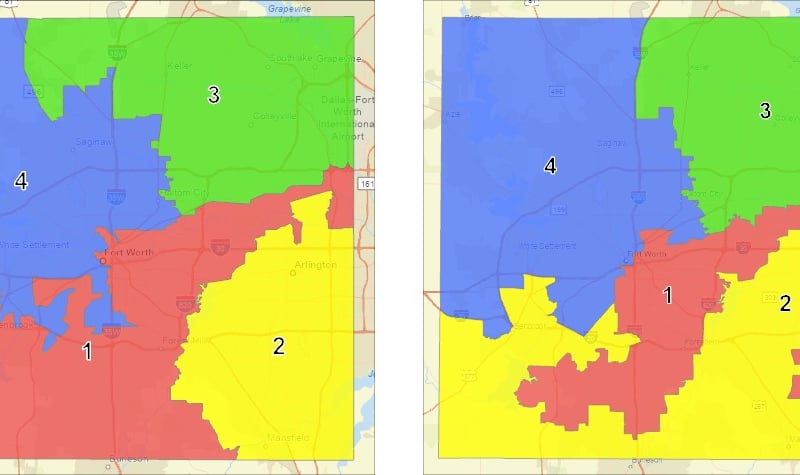
(CN) — A group of Black and Latino voters told a U.S. Fifth Circuit Court of Appeals panel Monday that Texas’ third-most populous county is using redistricting to disenfranchise minority and Democratic voters.
Known as the largest red county in the country, Tarrant County has historically been considered a Republican stronghold, but a major demographic shift in recent decades has made the county increasingly racially diverse and politically competitive, with Joe Biden winning it by 0.22% in 2020.
Despite this, however, Republicans are determined to maintain their grip on the county’s Commissioners Court, the governing body of the county. In an effort to do so, the court’s current 3-2 Republican majority has embarked on a mid-decade redistricting effort, voting along party lines in June to approve a new election map aimed at turning one of the county’s two Democratic precincts red. The court is made up of four commissioners representing precincts, as well as a county judge elected by voters across the county.
In a court filing, the county described this redistricting as “an unambiguous, explicit and unabashed effort to increase Republican power and decrease Democratic power on the Commissioners Court.”
A group of minority voters is suing to block the new map, calling it racially discriminatory. They are currently appealing a federal judge’s denial of their request for a preliminary injunction to prevent the map’s use in next year’s election.
Rather than arguing that the new map dilutes the power of minority voters, as most election map challenges do, the voters instead argue on appeal that the map disproportionately prevents minorities from voting in the upcoming election at all. This is due to Tarrant County’s staggered election cycle — only two of the county’s four precincts will vote for commissioners next year, while the other two won’t until 2028. The plaintiffs argue this means voters who, under the new map, are moved from a precinct set to vote next year to one set to vote in 2028 have effectively been disenfranchised for an election cycle.
While this sort of temporary disenfranchisement will inevitably occur when a county with staggered elections is redistricted, the plaintiffs argue the new map disproportionately disenfranchises Black and Latino voters. In their brief, the plaintiffs say that 1 out of 6 Black adults and 1 out of 8 Latino adults in Tarrant County will have their ability to vote for a commissioner delayed under the new map, compared to only 1 out of 20 non-Latino white adults.
The plaintiffs argue this is the result of intentional racial discrimination. They point to a comment Tarrant County Judge Tim O’Hare, a Republican, made in response to a question from a reporter about accusations that the new map discriminates against minority voters:
“The policies of Democrats continue to fail Black people over and over and over, but many of them keep voting them in. It’s time for people of all races to understand the Democrats are a lost party, they are a radical party, it’s time for them to get on board with us and we’ll welcome them with open arms.”
The plaintiffs argue this shows O’Hare intended to discriminate against Black people because he doesn’t like the way they vote.
In denying the plaintiffs’ request for a preliminary injunction, U.S. District Judge Reed O’Connor, the chief judge of the Northern District of Texas, found they were unlikely to succeed on this claim, saying they hadn’t shown the redistricting was motivated by race rather than partisanship.
“Because of the strong correlation between race and politics, and because defendants assert in defense that they were motivated by partisan goals, it would be wrong to allow plaintiffs to escape the heavy burden associated with racial gerrymandering claims just by concocting a novel harm theory,” the George W. Bush appointee wrote.
But the plaintiffs argue that even if that is the case, the redistricting would still be unconstitutional, as it would constitute viewpoint-based discrimination in violation of the First Amendment.
At a virtual panel hearing Monday, U.S Circuit Judge Kyle Duncan asked Danielle Lang, an attorney for the plaintiffs, why this viewpoint discrimination claim wouldn’t be foreclosed by the U.S. Supreme Court’s 2019 ruling in Rucho v. Common Cause . In that case, the Supreme Court said the issue of partisan gerrymandering is a political question beyond the reach of federal courts.
Lang responded that Rucho prevents claims based on partisan vote dilution, while the plaintiffs’ claim voters are being temporarily denied the ability to vote at all based on political affiliation.
Courts need to intervene, she said, “when legislators have said it’s open season on voters.”
But attorney Christian Adams, representing Tarrant County, told the panel that the plaintiffs are attempting to use a “novel theory” to try to get around Rucho and sue over partisan gerrymandering.
“Rucho would be gutted if this cause of action were allowed to go forward,” he said.
Senior U.S. Circuit Judge Rhesa Barksdale, a George H. W. Bush appointee, and U.S. Circuit Judge Don Willett, a Donald Trump appointee, joined Duncan, also a Trump appointee, on the panel.
Tarrant County has been a hotbed of Republican redistricting efforts at both the local and state levels. After a highly publicized fight that involved Democrats in the Texas legislature fleeing the state to prevent a quorum, the Republican-controlled state in August approved a controversial mid-decade redrawing of the state’s congressional districts that is expected to give Republicans five more seats in the U.S. House of Representatives.
Tarrant County is one of the areas impacted by the redistricting. U.S. Representative Marc Veasey, a Democrat from Fort Worth, the county seat of Tarrant County, saw his district (TX-33) redrawn to exclude Tarrant County entirely, with it instead confined to Dallas County. Under the new map, Tarrant County is largely split among several Republican districts that stretch into rural areas.
This congressional redistricting is also facing legal challenges, with civil rights groups, elected officials and voters arguing the new map is racially discriminatory.
Subscribe to our free newsletters
Our weekly newsletter Closing Arguments offers the latest about ongoing trials, major litigation and rulings in courthouses around the U.S. and the world, while the monthly Under the Lights dishes the legal dirt from Hollywood, sports, Big Tech and the arts.