Search Articles


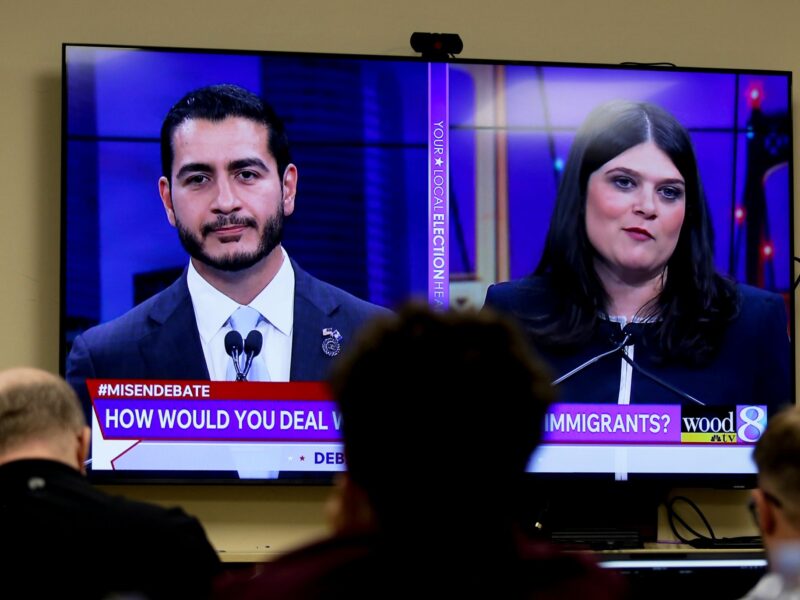
(CN) — Legislative experience is pitted against antiestablishment progressivism as Democrats in Michigan take to the polls Aug. 4 to select a U.S. Senate candidate in the state’s primary election.
U.S. Representative Haley Stevens and former public health official Abdul El-Sayed will force Democrats to choose between an established, party-backed candidate and one who seeks to disrupt the status quo.
Former U.S. Representative Mike Rogers — who served in the U.S. Army and worked as a special agent for the FBI — is the presumptive Republican candidate.
The two Democratic candidates squared off in a contentious debate on July 6, with Stevens accusing El-Sayed of angling to be a “celebrity senator.”
Stevens also criticized El-Sayed for being a “millionaire … trying to sell a book or a podcast,” but the epidemiologist hit back with pointed remarks about his opponent’s fundraising.
“If Congresswoman Stevens makes it or Mike Rogers wins, either way, Israel will win. AIPAC is perfectly fine with either of my two opponents, because they know that they will have a comfortable, reliable vote in the USA,” he said.
Stevens is endorsed by retiring Senator Gary Peters.
Anthony Jesuale, a professor from the Political Science and Public Administrator Department at Western Michigan University, said the race could help shape this year’s election cycle.
“I think Michigan is stacking up to be a testing ground of progressive strength in 2026 in a primary,” he said. “If they can pull their supporters, which tend to be a little bit younger, I think we’ll see something similar across the country where more progressives vote.”
A Quantus Insights poll from the end of June, prior to State Representative Mallory McMorrow’s withdrawal over Independence Day weekend, showed El-Sayed with a narrow 5-point lead over Stevens.
Jesuale said he doesn’t envision McMorrow voters having a decisive impact.
“I don’t see her supporters tipping it to either side, given they were only maybe 9% of the vote, but I think they’ll still vote,” he said.
The poll also showed nearly 16% of likely Democratic voters remain undecided.
El-Sayed — backed by U.S. Senator Bernie Sanders, U.S. Representative Alexandria Ocasio-Cortez and other progressive voices — is hoping recent wins by politicians like New York City Mayor Zohran Mamdani are the start of a sea change in the Democratic Party.
“We’ve got to build a movement of people to get money out of politics, put money in your pocket and pass Medicare for all,” he said during the debate.
While the progressive El-Sayed would seem to present a large target for Rogers in the November election, Jesuale was hesitant to say it’s the matchup Republicans want.
“As we saw in 2024 and in 2016 in Michigan when Trump won, part of the reason was because a number of progressives and left-leaning supporters stayed home,” he said. “That did not entirely cause Trump to win the state, but it did help in that cause. If we get into the general election, El-Sayed is probably going to run a little bit stronger because he’s going to activate younger voters.”
The lack of a primary competitor for Rogers has allowed him to amass an impressive war chest, with over $4.2 million in cash on hand, according to FEC data for the period ending March 31.
Rogers stands firmly with President Donald Trump and has based his platform on ousting “two-faced” politicians and a housing plan that seeks to make homebuying more affordable.
Trump’s endorsement for governor
The race for Michigan’s next governor is one of 36 gubernatorial elections set to be held in November, as candidates battle to replace term-limited Democrat Gretchen Whitmer.
Current Michigan Attorney General Jocelyn Benson is the frontrunner on the Democratic side of the ballot, while three Republican candidates are locked in a tight race for their party’s nomination.
Former Michigan Attorney General Mike Cox and U.S. Representative John James are the leading candidates, while 2022 gubernatorial candidate Perry Johnson is also vying to put his name on the ballot for the general election in November.
James, who served in the Army as a helicopter pilot, is endorsed by Trump and has consistently polled at or near the top of the three-man race.
The candidates faced off in a spirited debate on July 8, and it was not surprising that Cox and Johnson went after James.
Cox urged Republican voters to nominate a “winner,” and emphasized James was endorsed by Trump during unsuccessful Senate runs in both 2018 and 2020.
“The last two times he had the president’s endorsement, he squandered it and lost,” Cox said.
James was defeated by veteran Democrat Debbie Stabenow in 2018 and lost a tight Senate race to Peters in 2020, but that hasn’t kept him from remaining at the forefront of the Michigan GOP.
“I don’t think it’s been too exciting for the Republican Party that James is carrying the banner, especially after the Trump endorsement, which I’m sure really irritated Mike Cox, because he was a relative early supporter of the president. But I don’t think his previous losses are going to have too negative of an outcome,” Jesuale said.
James might have Trump’s backing, but that doesn’t make him invincible.
Jesuale cited criticisms about James’ father, as well as a historical hesitancy by some Michigan Republicans to back a Black candidate, as potential weaknesses in November.
“Both Johnson and Cox went after James for his dad’s business, and who has been a long-time supporter and funder of Democrats,” Jesuale said. “And you saw them trying to put this around his neck, and they’re doing that to try and be a signal to Republican voters that this person is going to be weaker in the general election.”
The CMU professor also said he was not surprised by the combative nature of each party’s recent debates.
“Primaries tend to try and play nice, but especially during debates, the candidates are going to want to separate themselves,” Jesuale said.
Funding for the general election
Fundraising has already become divisive in the Democratic primary, and once the candidates are locked in for the general election, money from outside the state is sure to pour in.
“Michigan is going to act, as it often does, as a bellwether and as a test to see how much voters are ready to either turn back to the Democrats or continue embracing Trump’s agenda, and outside money is going to be essential,” Jesuale said. “Republicans should anticipate being in a weaker position, as has typically been the norm in off-year elections. So if they are hoping to get their candidates across the finish line, it’s going to take a lot of outside money.”
El-Sayed’s criticism of AIPAC and others funding Stevens’ campaign could put him in an awkward position if he wins the nomination, but he won’t be able to stop contributions from outside groups to the Democratic Party as a whole.
“The Democratic establishment, so to speak, might not be enthused to have El-Sayed on the ticket over Stevens, but they’ll surely be much happier to have him in the Senate than they will Mike Rogers,” Jesuale said.
 Follow @kkoeninger44
Subscribe to our free newsletters
Our weekly newsletter Closing Arguments offers the latest about ongoing trials, major litigation and rulings in courthouses around the U.S. and the world, while the monthly Under the Lights dishes the legal dirt from Hollywood, sports, Big Tech and the arts.