
 Search Articles


(CN) — Round one goes to the musicians over the machines.
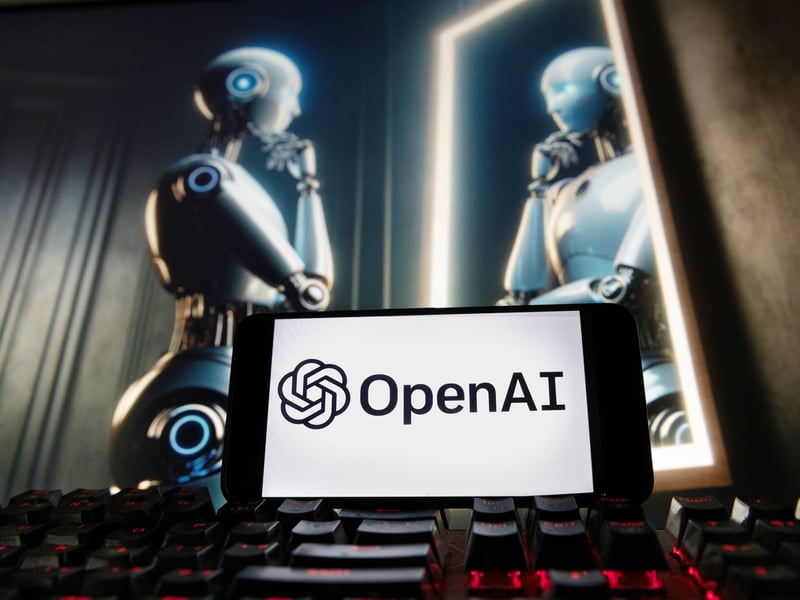
On Tuesday, a Munich court sided with a group of popular German musicians who sued OpenAI, the U.S. tech giant, for violating their copyrights by using their song lyrics to train its AI models and reproducing those same lyrics, when prompted, in their outputs.
The ruling from the Munich Regional Court favoring the musicians’ case was largely expected, but it will hardly be the last word on the contentious issues surrounding the arrival of increasingly dominant AI models that can produce everything from movie scripts to pop songs in a matter of seconds.
Tuesday’s ruling was seen as the first of what promises to be a lengthy legal battle in Europe over copyright infringement, plagiarism and artistic values in the realm of burgeoning AI tools. Similar lawsuits are wending their way through courts around the globe.
“The decision marks the beginning of a longer legal process,” said Philipp Hacker, a legal expert at the European New School of Digital Studies at the European University Viadrina in Frankfurt, in an email.
He said the ruling’s wider repercussions would be felt immediately as copyrights holders are emboldened to sue and AI companies come under increased pressure to pay for the use of copyrighted content.
The German ruling was issued by a Munich court specializing in copyright law and signaled European courts are ready to take a hard line against AI models.
But the ruling may be appealed to higher courts, including to the European Union’s highest legal chambers. The EU’s Luxembourg-based courts likely will end up settling many of the disputes swirling around so-called generative artificial intelligence, a fast-evolving technology based on gathering nearly everything that hits the internet and then using that information to provide complex predictions to answer most questions.
OpenAI was sued in November 2024 by GEMA, a German association founded with the aim of combating AI copyright violations. In its class action, GEMA accused OpenAI and its wildly popular ChatGPT tool of using copyrighted musical works without compensating artists or obtaining a license to use their works.
“The internet is not a self-service store, and human creative work is not a free template,” said Tobias Holzmüller, the head of GEMA, in a statement.
He said the case “set a precedent that protects and clarifies the rights of copyright holders” and that “even operators of AI tools like ChatGPT must comply with copyright law.”
He said a company like OpenAI, with a worth valued at around a half trillion dollars, must ensure it compensates artists when it uses their works in its AI models.
During the trial, OpenAI did not dispute that ChatGPT used artists’ lyrics for training purposes, according to JUVE Patent, an online news site that specializes in the European patent market.
The plaintiffs argued OpenAI’s use of musicians’ lyrics led to unlawful reproduction of their works. OpenAI countered that simply training its computers on works created by humans does not mean it is unlawfully reproducing their works for profit.
But Munich Judge Elke Schwager agreed with the musicians, saying they were entitled to compensation and damages because OpenAI failed to acquire permission for training its AI models on their lyrics.
“Both the memorization of the lyrics in the language models and the reproduction of the lyrics in the chatbot’s outputs constitute infringements of copyright exploitation rights,” the court said in a statement.
“For the first time in Europe, the use of copyrighted works by generative AI systems has been legally assessed and decided in favor of the creators,” GEMA said.
OpenAI said the ruling was flawed, arguing its AI systems “do not store or contain training data” and therefore are not in possession of “copies of lyrics or other texts.”
The company, a pioneer in the development of AI models that scrape enormous volumes of digital information, said its models “learn patterns and generate new outputs based on those patterns.”
Schwager disagreed and found the plaintiffs proved the company’s models contained copies of the original works because they were easily displayed in response to simple prompts from users.
OpenAI said the rationale behind the ruling reflected a misunderstanding of how the technology works. It added the ruling was limited to a “set of lyrics” and would have no effect on “the millions of people, businesses, and developers in Germany that use our technology everyday.”
“We respect the rights of creators and content owners and are having productive conversations with many organizations around the world, so that they can also benefit from the opportunities of this technology,” OpenAI said in a statement.
GEMA is seeking to force AI companies to pay a licensing fee to use works by musicians it represents. It sees its licensing model “as a solution for the industry” at a time when musicians are under immense financial pressure due to AI and other digital tools that are rewriting the way people listen to music and now create it with a few keystrokes.
GEMA also has sued Suno Inc., a U.S.-based AI company that offers users the ability to create new songs within seconds. That suit is pending at the Munich Regional Court too with a hearing set for Jan. 26, 2026.
The Munich ruling comes amid an escalating wave of copyright litigation against AI companies worldwide. About 50 copyright lawsuits have been filed against AI companies in the United States alone, targeting not only OpenAI but also Google, Microsoft, Anthropic, Midjourney, Stability AI and others.
The New York Times filed suit against OpenAI and Microsoft in December 2023, claiming unauthorized use of its articles to train AI models.
Meanwhile, the Authors Guild, along with prominent authors including John Grisham and George R.R. Martin, filed a class action in September 2023 against OpenAI.
Faced with mounting legal pressure, AI companies have pursued two parallel strategies: defending certain lawsuits on fair use grounds while proactively negotiating licensing agreements to secure legal access to content.
In September, Anthropic agreed to pay $1.5 billion to settle a copyright infringement suit and agreed to compensate authors around $3,000 for each of an estimated 500,000 books.
Hacker, the legal expert, said AI models that rely on large-scale scraping can only be controlled “through strict legal and technical constraints.”
He said AI companies need to open up their training data to scrutiny, compelled to enter into compensation agreements with entities like GEMA and undergo external audits.
“Without these, control remains limited,” he wrote.
He added that courts in Europe and the United States are largely in agreement about ensuring technological progress is aligned “with fundamental rights and established legal positions, such as copyrights.”
Musicians are among those most threatened by the arrival of AI models, in part because they are so good at generating songs.
For example, a survey released Wednesday by the polling firm Ipsos found people find it extremely difficult, if not impossible, to tell the difference between music generated by artificial intelligence and that created by humans. Ipsos asked 9,000 people to listen to two clips of AI-generated music and one of human-made music in a survey conducted for France-based streaming platform Deezer.
“Ninety-seven percent could not distinguish between music entirely generated by AI and human-created music,” Deezer said, as reported by AFP, the French news agency.
Courthouse News reporter Cain Burdeau is based in the European Union.
 Follow @cainburdeau
Subscribe to our free newsletters
Our weekly newsletter Closing Arguments offers the latest about ongoing trials, major litigation and rulings in courthouses around the U.S. and the world, while the monthly Under the Lights dishes the legal dirt from Hollywood, sports, Big Tech and the arts.