
 Search Articles


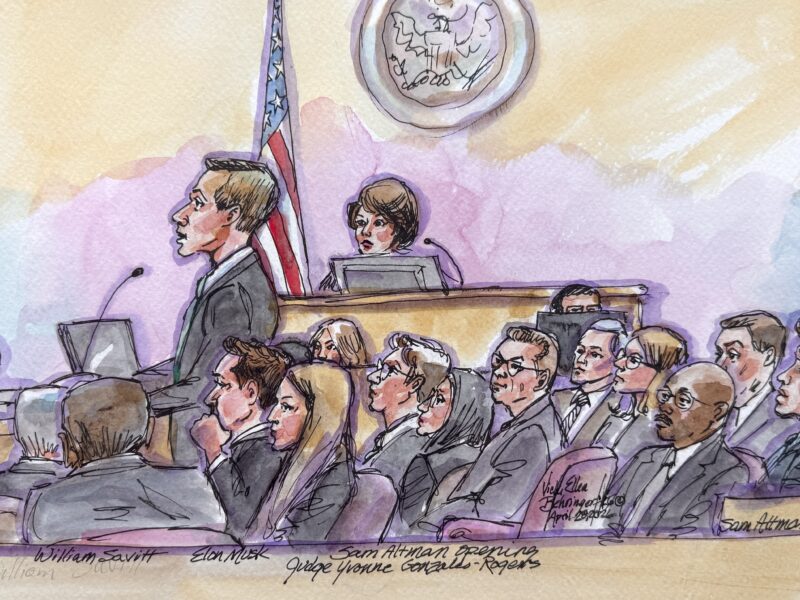
OAKLAND, Calif. (CN) — Two tech billionaires faced off in federal court Tuesday on the first day of a jury trial to determine if one of the wealthiest artificial intelligence companies in the world violated its original mission as a nonprofit to develop AI for the benefit of humanity.
Attorneys for both parties made opening statements to the jury in the lawsuit brought by Elon Musk against ChatGPT creator and OpenAI co-founder Sam Altman.
Steve Molo, of the law firm MoloLamken, starting his opening by quoting OpenAI’s original mission statement: “For the benefit of all mankind as a whole, unconstrained by the need for a financial return."
Both Musk and Altman were in the courtroom Tuesday to hear opening statements. Greg Brockman, the president of OpenAI and a co-defendant in the case, was also present. Ari Emmanuel, the celebrity agent and CEO of Endeavor, an entertainment company and talent agency, sat front row near Musk.
Around noon, Musk was called as the first witness by his own counsel. He talked about his four current companies, SpaceX, Tesla, Neuralink and The Boring Company. When explaining the mission of SpaceX, the court reporter responsible for making a transcript of the proceedings asked Musk to repeat the phrase “to make life interplanetary.”
“Life insurance for life as we know it,” Musk said. “There are things that people need to be excited about, that make life worth living. It can’t just be about solving one miserable problem after another.”
Altman was not present in the courtroom during Musk’s testimony.
In a packed courtroom with about 15 news reporters, several dozen attorneys and a personal security detail for Musk, U.S. District Judge Yvonne Gonzalez Rogers started the day by soothing the jury’s nerves given the amount of media attention on the case.
“You are now the most important people in this room,” the Barack Obama appointee told the six women and three men selected as jurors Monday.
Altman and Brockman’s defense attorney, William Savitt from Wachtell Lipton Rosen, told the jury that Musk exceeded the statute of limitations to bring the suit when he decided to wait until his own AI for-profit company xAI was a competitor with OpenAI. Savitt also said Musk knew about OpenAI’s trajectory to have a for-profit arm during the early years of company, calling the flip-flop “a tale of two Elons.”
Savitt said that in 2022 when OpenAI started its public benefit corporation and “ChatGPT became a household name, Mr. Musk didn’t like that one bit.”
During testimony, Musk was monotone and didn’t show any obvious emotion when questioned by Molo, or during the few objections by Savitt. He became most animated when recounting his conversations with Google founder Larry Page about AI. Musk said OpenAI wouldn’t have existed if Page didn’t call him a “speciesist,” or someone who prefers humans over digital life-forms such as AI and other nonhumans, causing Musk to become concerned about Google’s advantage in the AI world.
“I was like, ‘This is nuts,” Musk said about Page’s comment. Musk said at the time AI could “go to a good place liking curing diseases and making everyone prosperous, but it could also kill us all,” referring to a vision of an AI future like the “Terminator” movies.
Emails between Musk and Altman shown to the jury discussed the early days of OpenAI as a nonprofit with a mission for open-sourced AI. In the beginning of the company, Altman sent an email envisioning the executive team, which included himself, Musk, Bill Gates, Pierre Omidyar, the former chairman of eBay, and Dustin Moskovitz, a co-founder of Facebook. When asked by Molo who Moskovitz was, Musk responded, “I think he was Zuckerberg’s roommate,” which got a few laughs from the audience and at least one smile from a juror.
In 2024, Musk, the world’s richest person, sued Altman, the co-founder of OpenAI, and its for-profit enterprise that started after Musk acrimoniously left the startup in February 2018. Musk, Altman and Brockman co-founded OpenAI together in 2015.
Musk claims Altman deceived him after bringing in technical talent and bankrolling the project with millions of dollars, while Altman made deals with other investors to ultimately make the nonprofit into a for-profit company behind his back.
Musk brings breach of charitable trust and unjust enrichment claims, seeking $150 billion in compensatory and punitive damages from OpenAI and Microsoft. In 2019, Altman partnered with Microsoft after the software company agreed to invest $1 billion and later made another $10 billion investment. Musk claims OpenAI has diverted from its original mission and would like the company to revert to a nonprofit. Microsoft is a co-defendant in the case over a claim of aiding and abetting the breach of charitable trust, with Musk claiming the company benefited from his early donations.
In Microsoft’s opening statement, attorney Russell Cohen, with Dechert law firm, said that it wasn’t possible for Microsoft “to substantially assist in something it wasn’t even involved in.”
Musk sought a court order in 2024 to prevent OpenAI from going through with for-profit restructuring. He claimed the move violated OpenAI’s nonprofit mission and breached the terms of his previous donations to the company worth about $38 million.
The court denied Musk’s bid for an order that would have blocked OpenAI’s conversion from a nonprofit in March 2025. It also further thinned Musk’s claims against OpenAI in May 2025.
In counterclaims upheld by the court in August 2025, OpenAI accused Musk of unlawfully disrupting the ChatGPT developer’s business relationships during the lawsuit by orchestrating a “sham bid” to buy the company for about $97.4 billion in February 2025.
Jared Birchall, Musk’s personal business manager and the CEO of Neuralink, will be called as a witness after cross-examination of Musk on Wednesday.
Subscribe to our free newsletters
Our weekly newsletter Closing Arguments offers the latest about ongoing trials, major litigation and rulings in courthouses around the U.S. and the world, while the monthly Under the Lights dishes the legal dirt from Hollywood, sports, Big Tech and the arts.
Additional Reads


 EU suspends funds for Serbia over law reforms May 1, 2026