
 Search Articles


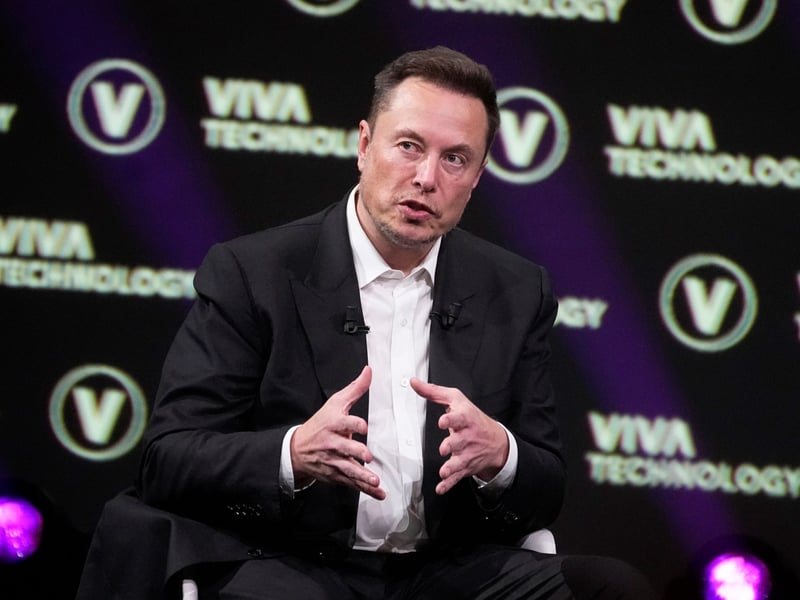
MARSEILLE, France (CN) — Elon Musk has European leaders seeing red.
This week alone, U.K. Prime Minister Keir Starmer called out Musk for spreading “lies and misinformation” over Starmer’s handling of a pedophilia gang in the mid-2000s.
Jonas Gahr Store, the prime minister of Norway, said he found it worrying that a man with considerable access to social networks and significant economic resources is directly involved in the affairs of other countries.
Italy’s premier Giorgia Meloni tried to quash an outcry by opposition parties, saying Thursday that her government is in talks with several private companies, including Musk’s SpaceX, over a telecoms security system, but denying any private discussion with Musk on the issue.
And French President Emmanuel Macron weighed in on Musk’s latest provocation.
“Ten years ago, if we had been told that the owner of one of the largest social networks in the world would support a new international reactionary movement and intervene directly in the elections, including in Germany, who would have imagined it?” Macron said in a news conference.
Macron was alluding to Musk’s interview Thursday with Alice Weidel, the leader of the extreme-right party Alternative for Germany, known as AfD.
Musk blasted the conversation with Weidel across his platform X, formerly known as Twitter. The AfD is anti-immigration, Euroskeptic and has been classified as a “suspected extremist” organization by Germany’s domestic intelligence agency — but it is increasingly popular. During the conversation, Weidel reassured listeners that the AfD bears little similarity to Adolf Hitler’s former party.
The two agreed that Germany’s taxes are too high, there is too much immigration, and that it was a mistake to shut down nuclear power plants.
Musk said he hoped the conversation showed people that Weidel is reasonable. “Nothing outrageous has been proposed, just common sense,” Musk said. “People really need to get behind the AfD, otherwise things are going to get very, very much worse in Germany.”
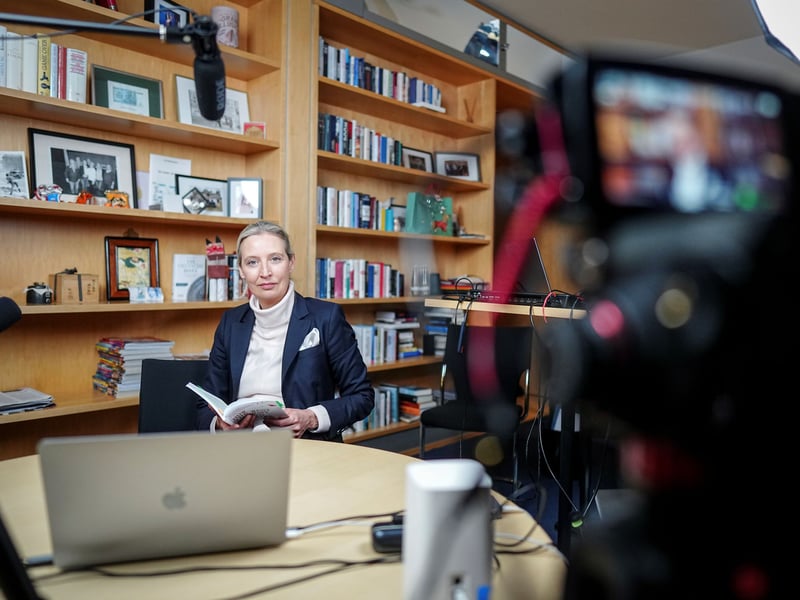
Germany will hold snap general elections Feb. 23 after Chancellor Olaf Scholz’s coalition government collapsed late last year. The AfD is polling second at 20%, after the center-right CDU/CSU, which has about 31% of voters’ support. Friedrich Merz, leader of the Christian Democratic Union of Germany and the Christian Social Union in Bavaria, is widely expected to become the next chancellor. Scholz’s SPD trails with 16%.
The interview gave Weidel a megaphone to spread the party’s views and help reshape its image as mainstream. Musk is openly supporting the AfD’s campaign, and controversially tweeted that “Only AfD can save Germany.”
Etienne Soula, a research analyst at the German Marshall Fund of the United States, told Courthouse News: “So AfD is kind of a uniquely problematic political force in Europe, even among the constellation of far-right parties that exist here. Even the far right in France, for instance, has kind of refused to work with AfD as they deem them too extreme and overtly problematic.”
Investigators will analyze whether the stream breached EU laws by giving the AfD an unfair advantage over other parties.
German Green parliamentarian Damian Boeselager wrote a letter to Henna Virkkunen, EU commissioner for Tech Sovereignty, Security and Democracy, asking if algorithms used on Musk’s platform meet transparency requirements under the European Union’s Digital Services Act.
“There are indications that Musk hard-coded a multiplier into the code of X. This would mean undermining the neutrality of the algorithm for the benefit of his own reach,” Boeselager wrote.
The new legislation, which entered into force in February 2024, aims to prevent any single platform from gaining too much control over the online landscape. The step has widely been viewed as a new chapter in the bloc’s attempts to tame the internet and take on Big Tech.
The EU is already investigating X. The new European Commission has inherited its predecessor’s ongoing investigation of X, which began in December 2023 with no confirmed end date, over stopping the spread of illegal content and information manipulation on the platform.
Following on the heels of a July 2024 ruling that X breached the DSA with its paid “blue checks,” former European Commissioner Thierry Breton, then the EU’s top digital enforcer, also sent Musk a strongly worded letter in August about X’s obligations before a live-streamed interview with Donald Trump.
The digital platform was also accused of not being transparent about how actors purchased online advertising, and not providing access to its data — both of which would violate the EU legislation.
X said it disagreed with the compliance assessment; Musk threatened litigation.
The company has been asked to respond to the EU charges before a final decision is made, which Brussels insiders say would most likely be in early 2025.
Valérie Peugeot, a researcher and professor at Sciences Po Paris and former commissioner at the National Commission on Informatics and Liberty, told Courthouse News: “The fact that he’s interacting with the extreme right in Germany, the fact that he’s been criticizing the English prime minister and other positions that he’s taken in the public space, is to get European society even more polarized. And that can serve him both on the economic side and on the political side.”
In Peugeot’s view, Musk can exploit a polarized society for economic gain through clicks. Violence and controversy bring more ad revenue. From an ideological standpoint, he’s trying to reshape the world to align with his views, she said.
“I think that in large, Elon Musk is taking interest in politics whether they’re in Europe or the U.S., and Europe is just a new playground for him,” Peugeot said. “So the kind of anti-democratic and extremely capitalistic society that he’s trying to promote — that’s his project, basically.”
“We need to promote discourse that shows that technology is not neutral, technology is deeply political and social,” she continued.
Europe as a whole generally doesn’t operate within Musk’s belief systems, though he has supported a number of right-leaning leaders.
He has been increasingly using his platform to weigh in on EU politics. He called the newly approved European Commission “undemocratic" in December, when members of the European Parliament greenlighted the new EU leadership.
In the same month, the leader of the right-wing populist Reform party in the U.K., Nigel Farage, said the party was in “open negotiations” with Musk over a donation, although he played down speculation that it could be as much as $100 million. Farage later distanced himself from Musk after the billionaire called for the release from prison of a far-right activist who goes by the name of Tommy Robinson.
Musk is libertarian, while Europe is riddled with complex regulatory frameworks; Musk is hyper-capitalistic and Europe is largely socialist. Now that he will officially be a part of the Trump administration, he arguably wields a higher level of power.
“I think his support for Donald Trump has now positioned him as one of the key advisers in the incoming administration, and he is likely looking to replicate that political success in other parts of the Western world,” Soula said. “In addition, I’d say that the fact that he’s supporting far-right groupings is kind of consistent with the broader orientation of his own ideology, and of the way he has been moderating, or not moderating, X, formerly known as Twitter, since he acquired it.”
Soula argues that Musk’s involvement in extreme-right groups could backfire in multiple ways.
Under the German Marshall Fund of the United States, Soula works for a program called the Alliance for Securing Democracy that researches foreign authoritarian interference in democracies, namely Russia and China.
AfD has ties to both.
“The parties that Elon Musk has chosen to support have been kind of the most problematic in Europe over the past year in particular, and are the ones that have been proven to be most susceptible to influence from authoritarian regimes in Moscow and Beijing,” Soula said. “Even if you put yourself as ‘America first,’ defending the U.S.’s national interests in a very aggressive manner, I find it very counterproductive to be supporting those forces if you’re an American citizen.”
Then, it’s not certain that these extremist parties will embrace Musk with open arms. The AfD and similar parties are generally nationalist and populist, and won’t necessarily be ecstatic about having the support of an American billionaire.
“I think there is even a case to be made that Elon Musk’s very strong and overt support might backfire for these nationalist parties, because I’m not sure that voters for some of these far-right parties will be thrilled to have a U.S. voice defending or supporting their parties,” Soula said.
 Follow @lilyradz
Subscribe to our free newsletters
Our weekly newsletter Closing Arguments offers the latest about ongoing trials, major litigation and rulings in courthouses around the U.S. and the world, while the monthly Under the Lights dishes the legal dirt from Hollywood, sports, Big Tech and the arts.