
 Search Articles


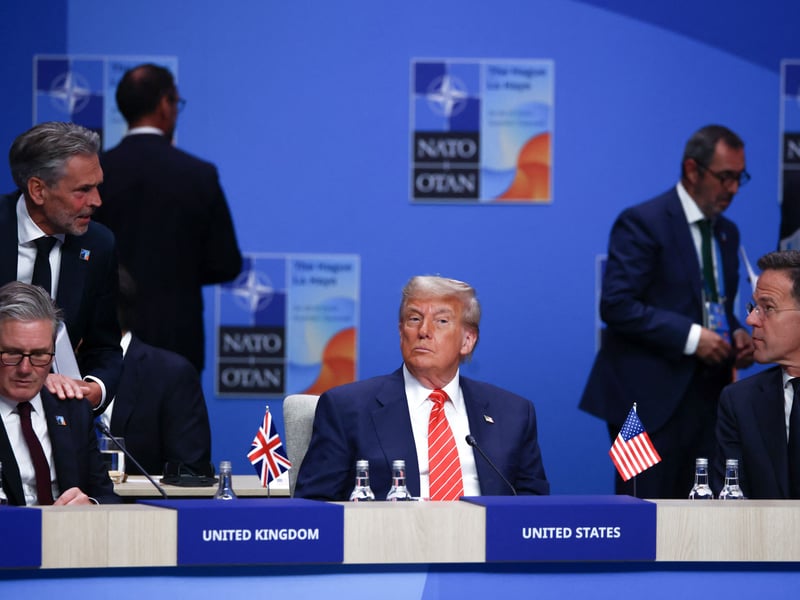
BRUSSELS (CN) — NATO allies agreed Wednesday to spend 5% of their national budgets on defense by 2035, with U.S. Secretary of State Marco Rubio calling the gathering “the Trump summit” as European leaders offered extraordinary praise to secure continued U.S. commitment to the alliance.
“I’ve been asking them to go up to 5% for a number of years, and they’re going up to 5%,” President Donald Trump said Wednesday. “That’s a big jump from 2% and a lot of people didn’t even pay the 2% so I think that’s going to be very big news.”
Trump claimed personal credit for the unprecedented increase, saying leaders told him they had tried “to get it up to 3% for 20 years” without success. He said the commitment would add “more than $1 trillion a year” to collective defense and called it “a monumental win for the United States.”
“I would call this the Trump summit,” Rubio said Wednesday in an interview with Politico on the margins of the gathering, acknowledging how the proceedings centered around managing Trump’s expectations.
NATO Secretary-General Mark Rutte lavished praise on Trump. “President Trump, dear Donald, you made this change possible,” Rutte said. “Your leadership has already produced $1 trillion in extra spending from European allies since 2016 and the decisions today will produce trillions more.”
When questioned about his praise for Trump, Rutte called him “a good friend” and argued the president deserved credit for forcing alliance action. The extent of Rutte’s accommodation became evident when Trump made crude comments about Iran and Israel, saying they “have been fighting so long and so hard that they don’t know what the fuck they’re doing” and comparing them to “two kids in a schoolyard.”
Rather than criticizing such language, Rutte endorsed Trump’s approach, saying “Daddy has to sometimes use strong language to get it stopped.”
The alliance formalized the commitment in its official declaration, requiring members to spend at least 3.5% of GDP on core defense needs like weapons and troops, plus up to 1.5% on security infrastructure including cybersecurity and military transport.
Following the NATO Council meeting, Rutte declared that allies had “laid the foundations for a stronger, fairer, and more lethal NATO.” He called the spending agreement “The Hague Defense Investment Plan” that “will fuel a quantum leap in our collective defense.”
Trump hedges on Article 5 despite European accommodation
The summit declaration reaffirmed NATO’s “ironclad commitment to collective defense” under Article 5, which states that an attack on one member is an attack on all. This contrasted with Trump’s ambiguous stance on the mutual defense clause.
When asked Tuesday about his commitment to Article 5, Trump said: “Depends on your definition. There are numerous definitions of Article 5.” Pressed to clarify, he said: “I’m committed to saving lives” and promised to provide “an exact definition when I get there.”
When questioned Wednesday about whether Article 5 is subject to interpretation, Rutte said “Article 5 is absolutely clear” while acknowledging NATO avoids details about “when exactly Article 5 will be triggered” to avoid making “adversaries any wiser.”
Trump described how NATO meetings had changed his perspective on Article 5. “When I came here, I came here because it’s something I’m supposed to be doing, but I left here differently,” he said, recounting what he claimed leaders told him: “Almost every one of them said, thank God for the United States, without the United States we couldn’t have NATO.”
Despite securing increased European defense spending, Trump maintained the U.S. should be exempt from the new requirements. “I don’t think we should pay what everyone else [does],” he said, arguing that infrastructure spending benefits European roads rather than American assets.
Rutte provided justification for Trump’s exemption, saying “I think we can safely assume that the U.S. is more or less at that 5% already,” effectively allowing Trump to demand standards from allies that America wouldn’t meet itself.
Spain emerged as the sole holdout among NATO’s 32 members, with Prime Minister Pedro Sánchez saying his country would meet military capability targets while keeping defense spending at 2% of GDP. He called it “sufficient, realistic and compatible with the welfare state.”
Earlier Wednesday, Rubio said Spain’s position was “a problem,” prompting Sánchez to respond that Spain is “never a problem, always a solution.”
Trump threatened economic retaliation against Spain during his news conference, saying he would make the country “pay twice as much” in trade negotiations to compensate for defense spending shortfalls. “You’re the only country that is not paying. I don’t know what the problem is,” he said.
The Spanish leader’s isolation was visible during the summit’s group photograph, where he appeared to distance himself from other leaders.
Other allies showed mixed reactions to the spending commitment. Belgian Prime Minister Bart De Wever criticized Spain for seeking exemptions but then requested “maximum flexibility” for Belgium. Slovakia also balked, with Prime Minister Robert Fico saying his country “has other priorities in the coming years than armament.”
Polish President Andrzej Duda strongly supported the increases, warning that Russia remains “a real risk” despite appearing “exhausted” by Ukraine. Danish Prime Minister Mette Frederiksen criticized exemptions as unfair to countries closer to Russia.
German Chancellor Friedrich Merz said the spending hikes reflect genuine threat assessments and confirmed he lobbied Trump privately for additional Russia sanctions.
Victory lap on Iran strikes
Trump used the summit to defend his Iran strikes against media skepticism. At his news conference, he described recent attacks on Iranian nuclear facilities as “a massive precision strike” that was “very, very successful,” responding to media reports questioning the effectiveness of the operation.
He called the Iran-Israel conflict “the 12 day war,” saying he personally prevented further escalation by stopping an Israeli retaliation. Israel had “52” planes ready to strike after Iran violated the ceasefire, he said, but he told Israeli leaders “you got to get them back” and “they brought them back.”
Trump also revealed plans to meet with Iranian officials next week for possible negotiations. “We may sign an agreement. I don’t know. To me, I don’t think it’s that necessary,” he said, claiming Iran’s nuclear capabilities were destroyed.
On Ukraine, Trump described his meeting with President Volodymyr Zelenskyy as positive but acknowledged frustrations. “Vladimir Putin has been more difficult, frankly. I had some problems with Zelenskyy,” he said. “And it’s been more difficult than other wars.”
Rubio signaled Trump would resist European pressure for additional Russia sanctions. “If we did what everybody here wants us to do, and that is come in and crush them with more sanctions, we probably lose our ability to talk to them about the ceasefire,” Rubio said.
British Prime Minister Keir Starmer called on Putin to engage in negotiations, stating “now is the time for Putin, who’s been dragging his heels to come to the [negotiating] table.”
The gathering in The Hague marked the first NATO summit hosted by the Netherlands since 1949, with about 9,000 people attending. NATO announced its next summit will be held in Turkey in 2026, followed by Albania.
Subscribe to our free newsletters
Our weekly newsletter Closing Arguments offers the latest about ongoing trials, major litigation and rulings in courthouses around the U.S. and the world, while the monthly Under the Lights dishes the legal dirt from Hollywood, sports, Big Tech and the arts.