
 Search Articles


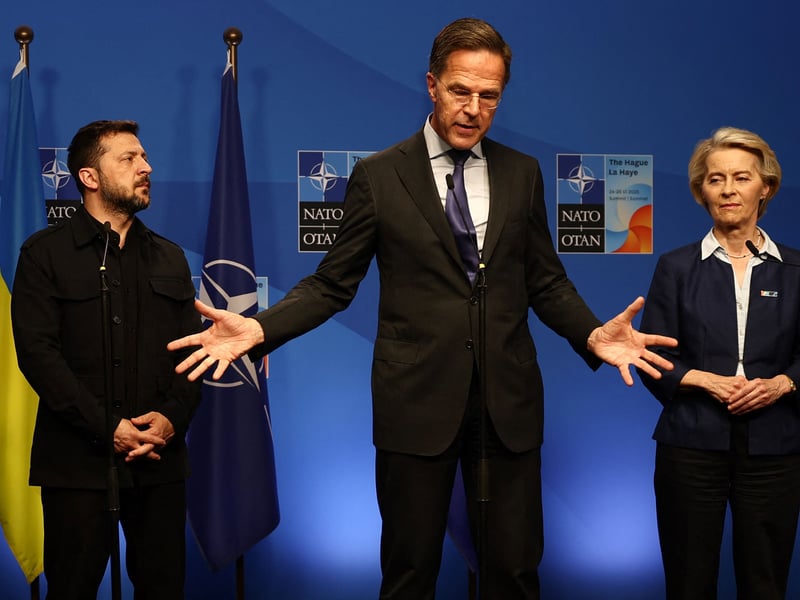
BRUSSELS (CN) — NATO leaders converged on the stately Dutch city of The Hague Tuesday for a tightly choreographed summit designed to secure a historic defense spending pledge while managing the unpredictable dynamics of U.S. President Donald Trump’s return to the alliance.
More than 40 government leaders will gather for dinner at the royal palace in the evening, with most delegations having arrived over the past two days.
Trump departed Washington Tuesday aboard Air Force One, with arrival expected at Amsterdam’s Schiphol Airport in the early evening.
During the flight, the president posted a screenshot on Truth Social, his social media platform, showing a message from NATO Secretary General Mark Rutte that congratulated the president on “decisive action in Iran” after Trump said Israel and Iran agreed to a ceasefire, and stated “we got them all at five percent,” suggesting spending negotiations were already concluded.
The two-day gathering at the World Forum brings together heads of state and government from all 32 NATO members, with the primary goal of finalizing an agreement to boost defense spending to 5% of gross domestic product — more than double the current 2% target.
“We have to win this new production war,” Rutte said Tuesday at the Defense Industry Forum. “It is simply unthinkable that Russia with an economy 25 times smaller than NATO can surpass us.”
The president will proceed directly to the royal dinner at Huis ten Bosch Palace, where he will also stay overnight as a guest of the Dutch monarchy. Trump will be the sole foreign leader staying at the royal residence, a distinctive honor that underscores the alliance’s careful approach to managing relations with its largest contributor during the critical negotiations.
The main event will be the North Atlantic Council meeting Wednesday morning, where all heads of state and government will formally discuss defense spending commitments and other pressing security issues. The leaders’ session represents the alliance’s principal decision-making body at its highest level.
The day will conclude with a meeting between NATO leadership, Ukrainian President Volodymyr Zelenskyy and the leaders of Europe’s five largest powers — France, Germany, Italy, Poland and the United Kingdom.
The summit will be the largest security operation in Dutch National Police history, with 27,000 personnel deployed — nearly half the force’s total workforce, according to Dutch authorities.
Dual-use compromise still faces hurdles
While Trump’s Truth Social post suggested full agreement on 5% spending, key allies are already challenging the specifics of their commitments.
Spain contends it can fulfill NATO capability requirements with just 2.1% of GDP spending, far short of the proposed 3.5% target for core defense. Rutte dismissed that position Tuesday.
“Spain thinks they can achieve those targets with 2.1% spending. NATO is absolutely convinced that Spain will have to spend 3.5% to get there,” Rutte said.
The secretary general emphasized that the alliance would not accept special arrangements. “NATO has no opt-out and NATO doesn’t know side deals,” he said.
Other members are pursuing “maximum flexibility” mechanisms, with Belgian Foreign Minister Maxime Prévot warning that aggressive spending increases could create domestic political instability.
“If we make choices that divide public opinion too deeply, Putin will ultimately have won without fighting a battle, by creating a boulevard for the far right,” Prévot said Tuesday in an interview with local broadcaster RTBF.
Belgium currently spends around 2% of GDP on defense and acknowledges it cannot reach 3.5% without major budget restructuring. Belgian Prime Minister Bart De Wever described the spending target as a “bitter pill to swallow.”
NATO’s solution involves expanding what counts as defense spending. The 5% target splits into 3.5% for traditional military capabilities and 1.5% for broader security investments including cybersecurity and infrastructure.
Countries can now count civilian technologies that serve military purposes — artificial intelligence, satellites, cloud services — toward their defense commitments.
“Many critical components of 21st-century defense are dual-use,” European Commission President Ursula von der Leyen said Tuesday, announcing that defense projects would gain access to new AI facilities.
The broader definition aims to make the targets more achievable, but implementation challenges remain. NATO will review progress in 2029, with countries required to report regularly on classified capability targets.
U.S. Secretary of State Marco Rubio said last month that all NATO nations “will have agreed on a goal” of reaching the 5% target over the next decade.
The EU has already set up financial mechanisms to boost European defense capabilities. This includes mobilizing 650 billion euros over four years through the ReArm Europe Plan and providing 150 billion euros in loans for joint defense purchases through the SAFE program.
Ukraine seeks defense partnership while facing reduced summit role
Zelenskyy addressed the Defense Industry Forum Tuesday, emphasizing Ukraine’s role as a key partner in European defense manufacturing while warning of broader Russian threats to NATO territory.
“All the weapons we produce will become part of a new, stronger European defense,” Zelenskyy said, positioning Ukraine’s wartime manufacturing experience as an asset for the broader alliance while delivering stark warnings about Russian intentions.
“Our intelligence confirms that Russia is planning new operations on NATO territory,” Zelenskyy said. “That means in your countries. Putin only thinks about war. As long as he kills, he lives.”
Despite this prominent role at the industry forum, Ukraine’s overall presence at the summit appears diminished compared to previous gatherings since Russia’s 2022 invasion. Ukraine has been invited to the summit, but Zelenskyy will not participate in Wednesday’s main leaders’ session, according to diplomatic sources.
Zelenskyy will address the Dutch parliament Tuesday afternoon and attend the royal dinner, but the reduced access to core alliance decision-making reflects broader questions about NATO’s approach to the war as Trump has signaled reluctance to expand U.S. military commitments in Europe.
US burden-sharing pressures persist
All NATO allies are expected to meet the current 2% GDP defense spending target this year for the first time, but wide disparities remain. Poland leads at 4.7% of GDP while Spain spends just 1.28%.
Trump has repeatedly criticized allies for insufficient burden-sharing, with U.S. defense spending comprising nearly 69% of NATO’s total in 2023, according to alliance data. He has said the U.S. should be exempt from the 5% target.
U.S. Ambassador to NATO Matthew Whitaker sought to reassure allies at the NATO Public Forum, saying “The U.S. is not going anywhere” and describing withdrawal concerns as press speculation.
However, Whitaker indicated last month that Washington would begin discussions with European allies regarding potential U.S. troop reductions in Europe, describing such talks as working through “practical consequences.”
And Trump on Tuesday seemed reluctant to commit to the mutual defense guarantees that underpin the NATO treaty.
“Depends on your definition,” Trump told reporters on his way to The Hague. “There’s numerous definitions of Article Five, you know that, right? But I’m committed to being their friends.” Asked later to clarify, Trump said he is “committed to saving lives” and “committed to life and safety” but did not expand further, saying he didn’t want to elaborate on a plane.
If all allies reached the 5% target, NATO’s combined defense spending would total 2.4 trillion dollars annually, according to numbers from The Washington Post.
Broader implications for European unity
Beyond defense spending, the summit reflects deeper tensions within the Western alliance. Hungarian Prime Minister Viktor Orban’s lunch meeting with Dutch far-right leader Geert Wilders Tuesday underscored the political divisions complicating European unity.
Brussels acknowledges its diminished global influence amid mounting pressures.
“The EU has absolutely no leverage whatsoever because it is irrelevant when it comes to the Middle East,” said Jean-Louis de Brouwer, director of the European Affairs program of the Egmont Institute in Brussels, in conversation with Courthouse News.
“The EU summit in Brussels will be deeply influenced by the outcome of The Hague NATO summit,” the expert said. “EU member states will have to digest and swallow what will come out of NATO.”
He emphasized that Europe’s strength lies in focusing on trade negotiations, enlargement processes and industrial policy rather than military intervention.
European Union leaders will meet in Brussels on Thursday and Friday following the NATO summit to assess, among other topics, the implications of defense spending commitments reached in The Hague.
The timing is crucial as the European executive prepares its upcoming budget coordination process, where member states submit their national spending plans and economic reforms for EU review. This annual cycle, along with longer-term EU budget planning, will need to account for how NATO’s spending requirements affect what countries can spend on other priorities like infrastructure, education, and social programs.
The 5% framework may also align with the EU’s broader resilience and preparedness strategy. EU officials suggest that the 1.5% portion for “broader security investments” could include civil defense and resilience measures that serve both military and civilian purposes, potentially helping member states justify the spending increases to domestic audiences.
Subscribe to our free newsletters
Our weekly newsletter Closing Arguments offers the latest about ongoing trials, major litigation and rulings in courthouses around the U.S. and the world, while the monthly Under the Lights dishes the legal dirt from Hollywood, sports, Big Tech and the arts.