
 Search Articles


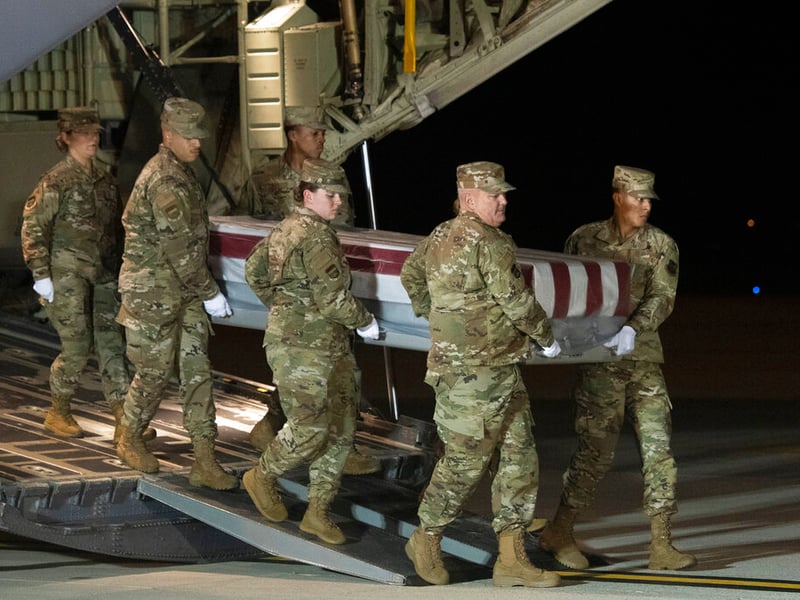
JACKSONVILLE, Fla. (CN) — The shooting victims and families of three service members killed at a Florida military base by a Royal Saudi Air Force cadet asked an 11th Circuit Court of Appeals panel Tuesday to revive their lawsuit against the Kingdom of Saudi Arabia.
Mohammed Saeed Alshamrani, a Saudi air force cadet training with the U.S. military at Pensacola Naval Air Station, shot and killed three sailors while also wounding eight others in the December 2019 attack. Alshamrani was killed by police during the incident. The FBI managed to hack into Alshamrani’s phones, which revealed his contacts with several al-Qaida members as far back as 2015.
The victims and their families brought a federal lawsuit against Saudi Arabia in 2021, accusing the kingdom of knowing about Alshamrani’s connections to al-Qaida, his public social media posts showing his growing radicalization and its failure to monitor him as he trained on the naval base.
Last year, U.S. District Judge M. Casey Rodgers dismissed the lawsuit, citing the Foreign Sovereign Immunities Act, which protects foreign governments from certain civil lawsuits.
During Tuesday’s oral arguments, Stephen Vladeck, representing the victims and families, told the three-judge panel that the goal of the Justice Against Sponsors of Terrorism Act of 2016 (JASTA) was to “provide litigants with the broadest possible basis to seek relief against foreign countries that provide material support to terrorist organizations or persons that engage in terrorist activities against the United States.”
That legislation should override foreign sovereign immunity, Vladeck contended.
“It is difficult to imagine how any JASTA case can survive if this one can’t,” he said.
The judges focused on if Alshamrani was acting in the scope of his employment, a crucial part of invoking the act.
“I understand he was wearing his uniform, but under Florida law it takes more than that,” said U.S. Circuit Judge Britt Grant, a Donald Trump appointee.
“Alshamrani, his presence in the United States, his participation in the program, his access to the building, the ability to store a gun and ammunition on a U.S. military base were all things that were only available to him by his Saudi employment,” Vladek said. “The kingdom was not just a negligent bystander, but it was actively involved in facilitating Alshamrani’s behavior in the United States.”
U.S. Circuit Judge Stanley Marcus said the best argument against Saudi Arabia is the failure of a country liaison officer to keep tabs on Alshamrani, including conducting searches of the Saudi cadets’ barracks.
“The Saudis sent the CLO over, he was missing in action, he did not do his job,” the Ronald Reagan appointee said. “That struck me as the best claim that you have.”
However, Marcus noted there is not much information in the complaint about who was responsible for ensuring the country liaison officer was doing his job.
“I think the complaint is quite detailed with the information we have at this stage on what the kingdom knew and when,” Vladek answered, but conceded that his clients wanted more discovery, something that the district court denied.
Gregory Rapawy, representing Saudi Arabia, contended that Alshamrani acted alone.
“The core of this case is the accusation of wrongful failure to prevent a terrorist attack,” Rapawy said, while noting the Foregin Sovereign Immunity Act protects the country from negligence claims.
“They do not allege that Saudi Arabia knew he was planning to commit a terrorist attack or he was associated with al-Queda,” he continued. “And that is what they have to show.”
“How could they show that at the pleading stage?” Pryor countered.
As far as Alshamrani’s connections to al-Qaida, Rapawy argued that Saudi Arabia could not have known about them.
“They leave out that those communications were made using encryption to avoid discovery,” he said. “So to the extent that you are considering the plausibility that Saudi Arabia would have been aware of those communications, I think you should consider the fact that they were encrypted.”
Marcus then circled back to whether there were regulations or manuals that mandated regular searches of cadets’ barracks.
“There are certainly allegations that they were not inspected at all,” Rapawy answered.
“That’s obvious,” Marcus interrupted.
U.S. Circuit Judge Jill A. Pryor, a Barack Obama appointee, also sat on the panel.
The judges did not indicate when they will reach a decision in the case.
 Follow @alexbpickett
Subscribe to our free newsletters
Our weekly newsletter Closing Arguments offers the latest about ongoing trials, major litigation and rulings in courthouses around the U.S. and the world, while the monthly Under the Lights dishes the legal dirt from Hollywood, sports, Big Tech and the arts.