
 Search Articles


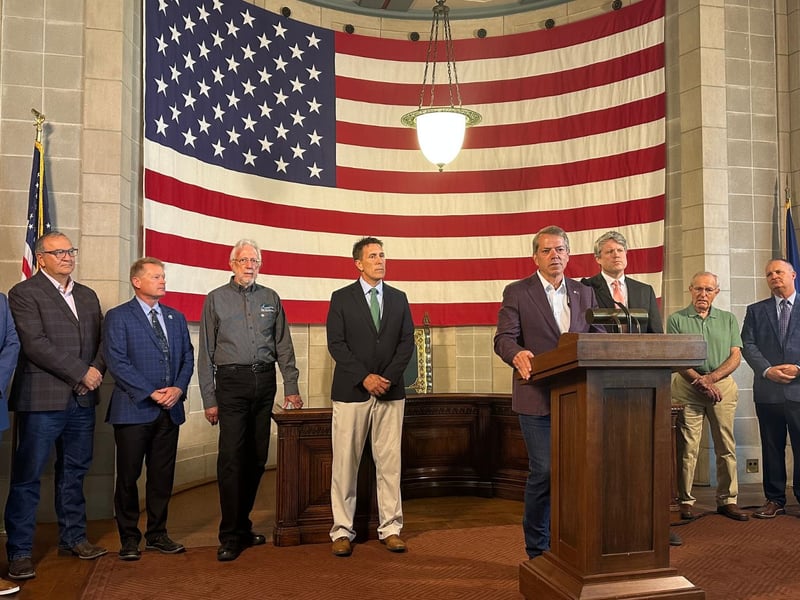
WASHINGTON (CN) — Nebraska escalated an increasingly contentious fight with Colorado over an interstate river on Wednesday, asking the Supreme Court to prohibit the Centennial State from siphoning water owed to the Cornhusker State.
“It’s really, really simple,” Nebraska Governor Jim Pillen said. “We’re here to put our gloves on. We’re going to fight like heck. We’re going to get every drop of water.”
Water from the South Platte River is shared between Nebraska and Colorado by terms laid out in a 1926 compact. A century later, Nebraska finally wants to exercise one of its rights under the compact: the construction of a canal. However, the early 20th century agreement didn’t account for technological advances in groundwater pumping.
Under the compact, Colorado must shut down water access to its users when Nebraska isn’t receiving 120 cubic feet per second of water flow during the summer irrigation season. Nebraska accused Colorado of not abiding by the deal by allowing “junior” users to violate Nebraska’s “senior” rights.
Colorado has allowed the pumping of hydrologically connected groundwater on its side of the border, resulting in reduced flow on Nebraska’s banks. The South Platte River Compact, like others of the time, doesn’t explicitly mention groundwater, leaving the states at loggerheads over the resource.
Robin Kundis Craig, a University of Kansas law professor, said such conflicts are growing considerably among states as modern problems meet antiquated rules.
“At the time the compacts were negotiated, groundwater wasn’t really an issue because, unless you had a relatively shallow artesian well, it wasn’t economically viable to try and go after the groundwater,” Craig said.
Compacts instead addressed the surface water of the river itself. Groundwater pumping technology evolved soon after the agreements were negotiated and approved by Congress, but the conflict has continued to plague interstate water relations.
“You just had an expansion of groundwater pumping in a lot of Western states that nobody even really contemplated when the compact was being negotiated, but a lot of that groundwater is hydrologically connected to various rivers, and so as you expand the groundwater pumping, you’re actually reducing the flow of the river,” Craig said.
“Canal to nowhere”
Nebraska stated that constructing a canal is the only way it can ensure the water access it is entitled to under the compact.
“Colorado was aggressively pursuing water from the South Platte River in ways that we knew were harming Nebraska, and would absolutely harm Nebraska going forward,” Nebraska Attorney General Mike Hilgers said. “We would lose not the entitlement to the water, but we would lose the water to which we’re entitled if Colorado’s growth was unchecked and we didn’t assert our rights.”
Nebraska says Colorado’s upstream growth is leaving Nebraska’s farmers, ranchers, industries and residents short on water.
Pillen unveiled plans for the Perkins County Canal in 2022, but three years later, the states remain at odds. Nebraska accuses Colorado of stonewalling and now sees drastic action as needed.
“We’ve been losing to Colorado on this issue for too long,” Pillen said, explaining his reasoning for petitioning the Supreme Court. “It’s time we win.”
Colorado said Nebraska’s “failure to look for reasonable solutions” was “predictable given the misguided effort driving the proposed canal. The state dismissed the canal as a boondoggle, and a spokesperson previously called the project a “canal to nowhere.”
“Nebraska has now set in motion what is likely to be decades of litigation,” Colorado Attorney General Phil Weiser said in a statement. “And if, after decades of litigation, the court allows Nebraska to move forward with its wasteful project, Nebraska’s actions will force Colorado water users to build additional new projects to lessen the impact of the proposed Perkins County Canal.”
Craig said the project was coined by some as the “canal to nowhere” because it doesn’t seem to have an immediate user.
“There’s a legitimate concern on Colorado’s part that we don’t want this precious water just kind of diverted, and then it evaporates in Nebraska, is not doing anybody good,” Craig said.
The second most important resource in Nebraska
The Cornhusker State irrigates 11 million acres of land for agriculture that supplies food to people worldwide. Every drop counts, Hilgers said, stating that securing water access was of critical importance.
“This may be the most consequential lawsuit that this office will be a part of in my generation,” Hilgers said. “It is almost impossible to overstate the importance of the South Platte River to the future of the state of Nebraska.”
Nebraska says it faces ongoing uncertainty without Supreme Court intervention. Water from the river supports farmers, cities, industries and federally protected species that could be harmed by shortages.
No end in sight
Colorado faulted Nebraska for starting what would likely be an expensive and time consuming litigation.
“When the dust finally settles, likely over a billion dollars will have been spent — tens of millions of that on litigation alone — and no one in Nebraska or Colorado will be better off,” Weiser said.
Nebraska’s lawsuit is among the rare cases that fall under the Supreme Court’s original jurisdiction, meaning that the case comes to the justices without any review from the lower courts. Disputes between states always fall in this category.
If the court accepts Nebraska’s request to file its complaint, the justices will likely appoint a special master to act as a trial court judge in the dispute. Sometimes, the special master can negotiate a settlement between the parties; if not, they gather information and build a case for the high court to review.
“It’s going to the Supreme Court as a blank slate, and so the special master…develops the factual record and takes the initial evidence and has a whole bunch of hearings, hears a lot of testimony, gets a lot of documents, and then the special master will write up a usually pretty hefty report with recommendations to the court proper,” Craig said.
The process usually takes a minimum of six years but often as long as 15, Craig said.
“There’s almost no field of anything where you could have a contract that’s 100 years old and not have thought you would have needed to renegotiate it a couple of times along the way,” Craig said. “So it’s just unfortunate that more states didn’t build in adjustment periods into their compacts, but that’s where we are.”
 Follow @KelseyReichmann
 Follow @kelseyreichmann.bsky.social
Subscribe to our free newsletters
Our weekly newsletter Closing Arguments offers the latest about ongoing trials, major litigation and rulings in courthouses around the U.S. and the world, while the monthly Under the Lights dishes the legal dirt from Hollywood, sports, Big Tech and the arts.