
 Search Articles


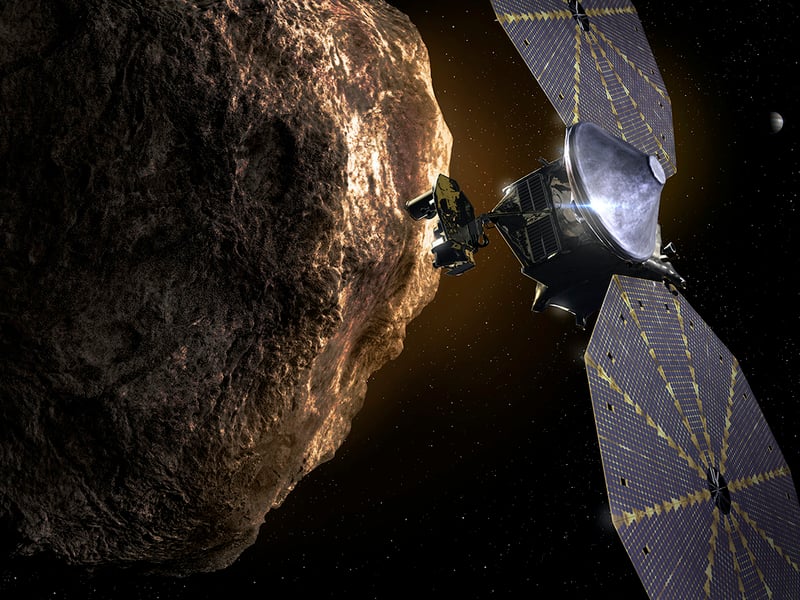
(CN) — Researchers from NASA’s Lucy spacecraft have made a new discovery that could change how we understand the formation of asteroids and other celestial bodies.
During a flyby of the asteroid Dinkinesh, also known as “Dinky,” in November 2023, the spacecraft found that Dinky was accompanied by a satellite asteroid named Selam, which turned out to be a contact binary — two asteroids, or moons, melded together.
The Lucy spacecraft team, including University of Maryland Astronomy and Geology Professor Jessica Sunshine, detailed their findings in a paper published in the journal Nature Wednesday.
The researchers noted that the contact binary challenges existing theories about how asteroids and other celestial bodies formed over time.
“There’s a lot more complexity in these small bodies than we originally thought,” Sunshine said in a statement. “With the additional observations taken by the spacecraft, we were able to better analyze features such as Dinkinesh’s rotation speed and Selam’s orbit pattern. We also have a better understanding of what materials they’re possibly made of, bringing us a step closer to learning just how terrestrial bodies are created.”
When Lucy passed by Dinky, images revealed a trough where about a quarter of the asteroid had broken off, a ridge from its structural failure, and the contact binary Selam.
Named after the child counterpart of the Lucy hominin fossil discovered in 1974, Selam’s formation challenges existing theories about asteroid development.
The team theorized that Dinky’s rapid spinning, influenced by the uneven reflection of sunlight, caused it to shed rocky debris into orbit. Some debris likely formed Selam, while other fragments fell back onto Dinky, creating the ridges observed by Lucy.
“One of the things that’s critical to understanding how planets like Earth got here is understanding how objects behave when they hit each other, and to understand that we need to understand their strength,” said lead scientist Hal Levison, principal investigator for the Lucy mission, in a statement. “Basically, the planets formed when smaller objects like asteroids orbiting the Sun ran into each other. Whether objects break apart when they hit or stick together has a lot to do with their strength and internal structure.”
The team believes that Dinky’s internal strength allowed it to retain most of its form despite the structural failure that led to Selam’s creation.
Although the exact process remains a mystery, Sunshine noted that these findings pave the way for comparative studies with similar bodies.
“I’m personally very excited to compare the Didymos binary system with this one, especially as they appear to share many similarities such as size, general shape, and possibly composition despite being in totally different parts of the solar system,” Sunshine said in a statement.
Sunshine also worked on NASA’s DART mission, which successfully deflected Dimorphos, the small moon of Didymos.
According to Sunshine, the Didymos binary system is located in a near-Earth environment while the Dinkinesh system is located much farther away from Earth in the main asteroid belt.
“They have very different features, but we think they may have undergone similar processes to become what we know of them today,” Sunshine said in a statement.
Dinkinesh and its satellite are the first of 11 asteroids Lucy plans to explore over its 12-year mission.
After skimming the inner edge of the main asteroid belt, Lucy will return to Earth for a gravity assist in December 2024. This maneuver will propel the spacecraft back through the asteroid belt to observe asteroid Donaldjohanson in April 2025 and then move on to the Trojan asteroids in 2027.
“Our ultimate goal is to understand the formation of celestial bodies,” Sunshine said in a statement. “How do planets form? How was Earth formed? With Dinky and the other asteroids we’re flying by, we’re laying the groundwork for understanding how planets are made.”
Subscribe to our free newsletters
Our weekly newsletter Closing Arguments offers the latest about ongoing trials, major litigation and rulings in courthouses around the U.S. and the world, while the monthly Under the Lights dishes the legal dirt from Hollywood, sports, Big Tech and the arts.