Search Articles


WILMINGTON, Del. (CN) — U.S. Representative LaMonica McIver faced off against the Justice Department at the Third Circuit on Wednesday, as the Trump administration accuses the Democratic lawmaker of attacking federal officers outside an immigrant detention facility.
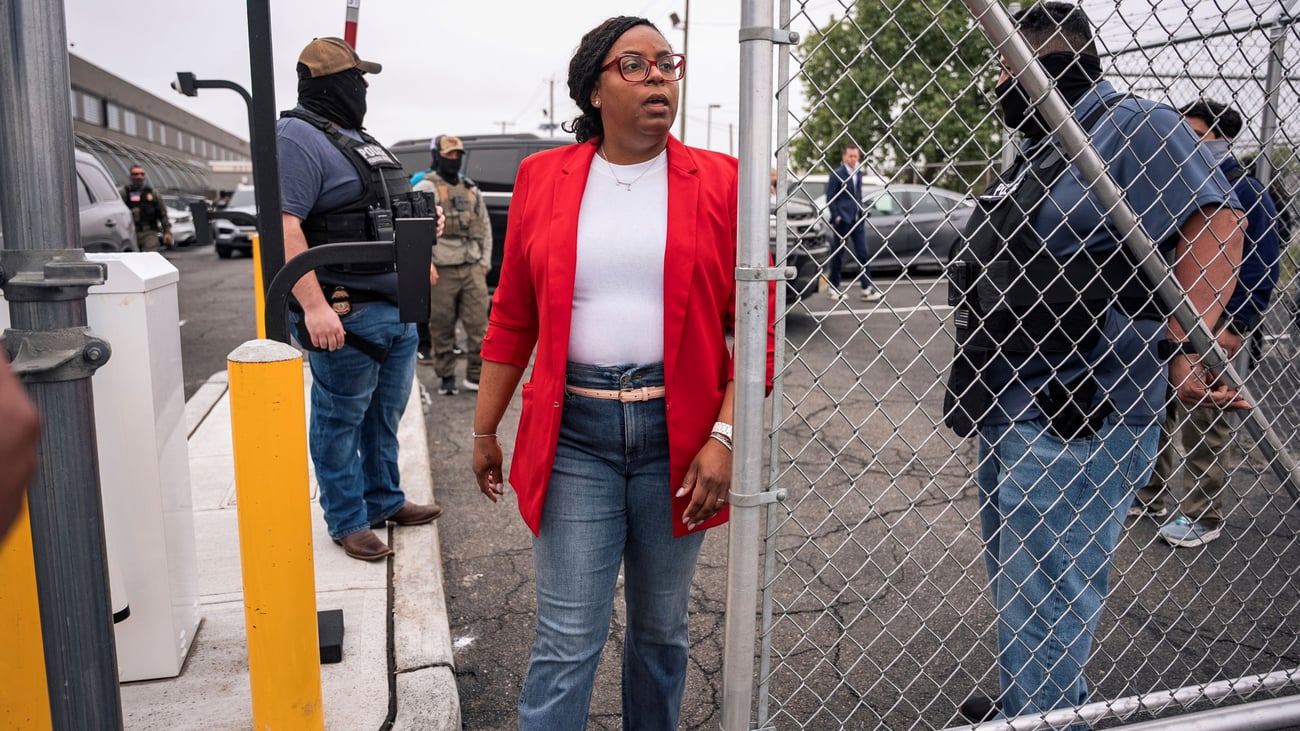
McIver faces three counts of assaulting, resisting, impeding and interfering with a federal officer during a May 2025 incident just outside the Delaney Hall immigration facility in Newark, New Jersey.
McIver — who was at Delaney Hall for an oversight inspection of the facility alongside two other Congress members — ended up in a scuffle with U.S. Immigration and Customs Enforcement and Homeland Security officers who sought to arrest Newark Mayor Ras Baraka on trespassing charges.
Forming a circle around Baraka with the other lawmakers, aides and protesters, McIver and the federal officers repeatedly made physical contact before the mayor was pulled from the crowd and arrested.
While Baraka’s charges were eventually dropped, McIver ended up with three federal charges of her own and could face 17 years in prison.
McIver has pleaded not guilty, calling the case a “brazen attempt at political intimidation” and filing two separate motions to dismiss.
In one motion, McIver asserted legislative immunity protects her from litigation under the speech or debate clause — a constitutional clause providing Congress members immunity from criminal prosecution for actions occurring within the legislative sphere. Because she was conducting a legislative act by inspecting Delaney Hall, McIver argued, she could not be held criminally liable for the scrum.
In the other motion, McIver asserted the Justice Department had selectively enforced the law and vindictively prosecuted her, asserting she had been targeted by the Trump administration on politicized grounds.
A New Jersey federal judge denied both motions — in part in November 2025 and in full in January 2026. McIver promptly appealed.
Defending McIver’s scuffle in front of the panel, attorney Paul J. Fishman asserted the congresswoman’s conduct was not extraordinary enough to render the speech and debate clause inapplicable.
However, U.S. Circuit Judge Thomas L. Ambro hesitated to agree that all of McIver’s actions around Delaney Hall could be considered legislative acts.
“At some point there’s an attempt — arms around the mayor, etc. — to do something that the government contends is attempting to interfere with the arrest, how is that supplemental oversight of Delaney Hall and what goes on there?” the Bill Clinton appointee asked.
“We’re not saying that assault is a legislative act,” Fishman replied, adding he denies McIver ever committed an assault. “It’s the person who does it, and it’s the context in which it occurs.”
Focusing on the charges surrounding McIver’s scuffle just outside the Delaney Hall facility, U.S. Circuit Judge Stephanos Bibas suggested such activity could not be considered as part of a facility oversight operation.
“She’s not even inside the Delaney facility,” the Donald Trump appointee said. “She leaves the Delaney facility and, the government’s contention is, gets involved in the fracas.”
In response, Fishman placed the onus on ICE: By both refusing to allow the lawmakers to immediately enter Delaney Hall and arresting Barak without probable cause, he argued, the federal officers “undermine[d] the entire purpose of the speech or debate clause.”
“If that’s possible for ICE to do two illegal things … and three members of Congress engaged in lawful, constitutionally and statutorily authorize oversight, and something happens in front of them, the speech or debate clause requires that they be given that latitude,” said Fishman, a former federal prosecutor in New Jersey who is now a partner at Arnold Porter.
“I’m not sure the presumption is in her favor,” replied Bibas, noting assault still is not typically considered an integral part of a legislator’s duties.
Representing the Justice Department, Assistant U.S. Attorney Mark E. Coyne could not finish the first sentence of his argument before Ambro interjected, noting the uncommon nature of this case.
In particular, Ambro emphasized the oddity of charging McIver for attempting to push her way back into Delaney Hall to conduct the oversight visit.
“I struggle finding anywhere where someone has been indicted for that type of conduct,” Ambro told Coyne. “I can’t imagine that a congressperson would be indicted for assault for using, not sharp elbows, but just plowing through — that doesn’t seem like assault.”
“Your honor, on whether it’s an assault, whether she’s acting with the intent of assault, that’s a quintessential factual issue for trial,” Coyne replied. “In order for her to meet her burden under the speech or debate clause, it’s on Representative McIver to demonstrate that that was a legislative act.”
Still, Coyne conceded this “is not a typical case,” while still arguing McIver violated the law.
Later, Ambro questioned Coyne as to why McIver’s conduct could not be deemed legislative, prompting a stern reply from the attorney:
“Use of force is never — never — covered by the speech or debate clause,” Coyne said. “That’s our position.”
Shortly after returning in front of the panel for rebuttal, Fishman again faced questioning over whether McIver’s use of force could be protected by legislative immunity.
In response, Fishman again suggested McIver’s conduct during the scrum was not at issue, focusing instead on the context in which the scrum occurred.
“If any member of Congress walks into a bar, sees an ICE agent and decks him, it’s not covered,” Fishman told the panel. “That’s not what the law is. If the member is in the middle of doing an inherently manifested or even ambiguously legislative act, it’s covered.”
Shifting focus to McIver’s claims of selective enforcement and vindictive prosecution, Fishman noted body camera footage from the incident shows one federal officer telling another that then-Deputy Attorney General Todd Blanche — not a local officer — demanded Baraka’s arrest.
“These calls on cases involving members of Congress — we can’t be naive about this — they are not made in Newark,” Fishman said. “The problem in this case is — and I can’t emphasize this too strongly — from the moment [the Congress members] got there, the goal of ICE was to thwart. There was no other inference to be drawn.
“If you put all of those things together, it gives the DOJ and the DHS the ability to interfere, impede, obstruct, thwart members of Congress who are doing exactly what they are allowed to do by law,” Fishman added. “And when something happens, they can say, ‘Oh my goodness, this is an assault! She threw a sandwich, she threw an umbrella, she threw an elbow!’ Where are we, judge, in 2026, that that’s the government’s defense to this patently awful prosecution of a sitting federal congressperson?”
U.S. Circuit Judge Cindy K. Chung, a Joe Biden appointee, rounded out the appeals panel.
 Follow @JacksonHeals
Subscribe to our free newsletters
Our weekly newsletter Closing Arguments offers the latest about ongoing trials, major litigation and rulings in courthouses around the U.S. and the world, while the monthly Under the Lights dishes the legal dirt from Hollywood, sports, Big Tech and the arts.