
 Search Articles


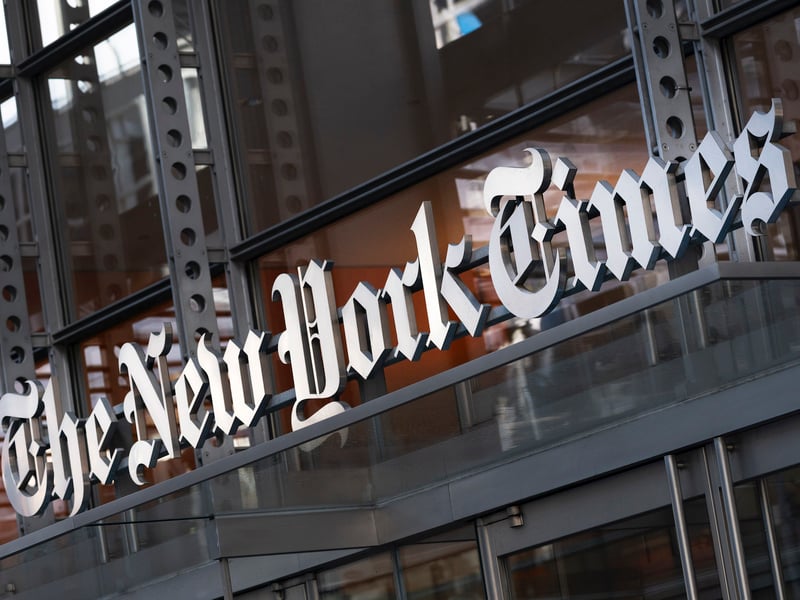
WASHINGTON (CN) — The New York Times sued the Defense Department Thursday over its new press policy that bars journalists from obtaining any information not explicitly approved for release by Pentagon officials, warning it deprives the public of information on the military’s activities.
The media outlet brought the lawsuit in U.S. District Court for the District of Columbia, arguing the Oct. 6 rule violates its First Amendment rights, its Fifth Amendment due process rights and binding D.C. Circuit precedent by suddenly revoking its Pentagon Facility Alternate Credentials, or PFACs.
“The policy, in violation of the First Amendment, seeks to restrict journalists’ ability to do what journalists have always done — ask questions of government employees and gather information to report stories that take the public beyond official pronouncements,” the Times wrote in the 41-page lawsuit.
“If and when they do and then publish anything that has not been approved by Pentagon officials, the policy permits those officials to, at any time and without any standards to guide their decisions, immediately suspend and ultimately revoke those journalists’ PFACs in violation of the First Amendment, the due process clause and binding D.C. Circuit precedent,” the Times continued.
The Times is requesting Senior U.S. District Judge Paul Friedman, a Bill Clinton appointee, declare the Pentagon policy unlawful and enjoin the Defense Department from enforcing it.
Under the Pentagon’s new press restrictions, journalists could be deemed a “security risk” if they disclose classified or even unclassified information without the Pentagon’s authorization. In response, dozens of media outlets rejected the rules rather than sign on by the Oct. 17 deadline, with nearly 50 journalists turning in their access badges and walking out of the Pentagon as the deadline approached.
Since their exodus, veteran journalists have been replaced by individuals and media outlets who closely align with the Trump administration and espouse viewpoints the Department favors, the Times said.
They include Mike Lindell, chief executive of MyPillow and a close ally of President Donald Trump; Laura Loomer, the influential pro-Trump activist; former Florida representative and brief attorney general candidate Matt Gaetz, now a host for One America News Network; and Raheem Kassam, editor-in-chief of the National Pulse who describes his site as “an industry mag/site for MAGA world.”
“These developments place the purpose and effect of the policy in stark relief: to fundamentally restrict coverage of the Pentagon by independent journalists and news organizations, either by limiting what kind of information they can obtain and publish without incurring punishment, or by driving them out of the Pentagon with an unconstitutional policy,” the Times said.
The Times pointed to the Supreme Court’s 1980 decision in Richmond Newspapers Inc. v. Virginia*, *in which the high court ruled 7-1 that the First Amendment guarantees a “right to gather information,” because otherwise the “freedom of the press could be eviscerated.”
Further, the D.C. Circuit’s 1977 decision in Sherrill v. Knight*, *where the appellate court ruled that the White House could not arbitrarily deny a press pass to a journalist, makes clear that such passes cannot be denied without due process, the Times argues.
“This binding precedent applies with full force here,” the Times said. “There is no legitimate, let alone compelling, justification for the provisions of the policy targeting lawful news gathering and reporting — purposely vague and over broad provisions designed to give Department officials free rein to grant or deny Pentagon access to journalists and media outlets on the basis of view point and that are wholly untethered to any interest in the ‘safe, efficient and secure operation of the Pentagon Reservation.’"
Thursday’s lawsuit comes as Secretary of Defense Pete Hegseth has come under increased scrutiny over his military strikes on supposed drug smuggling boats in the Caribbean, which have thus far killed 83 people.
An initial strike on Sept. 2 — which required a second strike under Hegseth’s verbal “kill everybody” order — has raised concerns that the Pentagon has engaged in war crimes with another 20 similar attacks through Nov. 15.
The Trump administration has argued that it has the legal authority to carry out the strikes because the U.S. is in a “non-international armed conflict” with drug cartels it has designated as terrorist organizations, who it holds responsible for the thousands of Americans who die from drug overdoses each year.
Senate Democrats have demanded the Justice Department declassify an Office of Legal Counsel opinion purportedly justifying the attacks, which has thus far only been shared with Republican senators.
Theodore Boutrous, of Gibson Dunn, is representing the Times in the suit.
The Pentagon did not respond to a request for comment.
 Follow @Ryan_Knappy
Subscribe to our free newsletters
Our weekly newsletter Closing Arguments offers the latest about ongoing trials, major litigation and rulings in courthouses around the U.S. and the world, while the monthly Under the Lights dishes the legal dirt from Hollywood, sports, Big Tech and the arts.