
 Search Articles


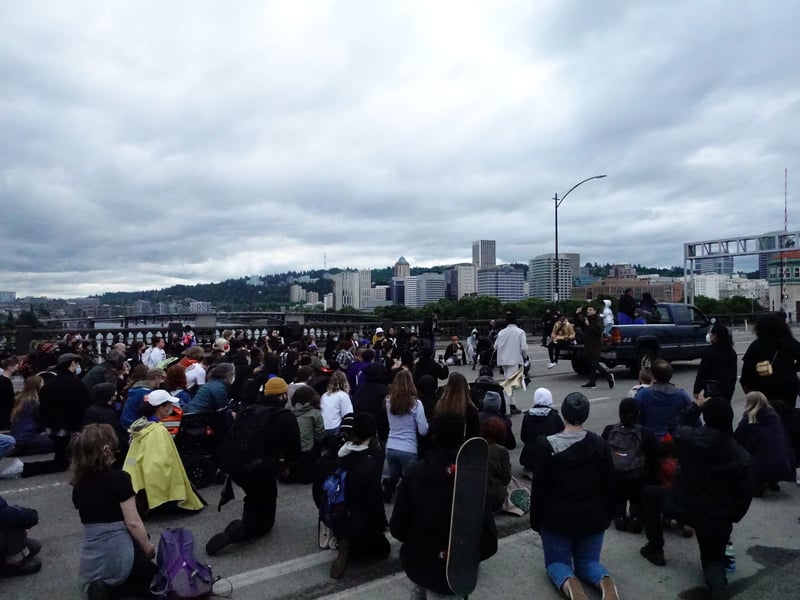
PORTLAND (CN) — The question of whether Oregon city leaders retaliated against protesters by issuing and enforcing a citywide curfew after several days of protests in response to the 2020 murder of George Floyd is before a three-member panel of the Ninth Circuit Court of Appeals after attorneys for both sides argued over the limitations of retaliation and qualified immunity Tuesday morning.
The protesters argue that the city manager for Eugene, Oregon, and the police chief lacked a legal right to enact the curfew in the first place and that the police chief retaliated against the group by enforcing the curfew and arresting protesters as they dispersed.
The city defendants argue that they are entitled to qualified immunity because the protesters “did not and could not” cite the law that proved that temporarily extending a nighttime curfew to the entire city violated their right to protest.
“This is the quintessential case where qualified immunity should apply,” argued Matthew Kalmanson, an attorney with the Portland-based Hart Wagner firm representing the city defendants.
In late May 2020, following the fatal police shooting of Floyd in Minneapolis, Eugene’s city manager pro tem implemented a curfew covering the downtown area of the city from 9 p.m. to 6 a.m. The order was then expanded citywide to begin at 11 p.m.
Three protesters who were arrested following the expanded curfew, and two who were at home and subject to the curfew, sued the city, its manager, and the chief of police for violating their First, Fourth, and 14th Amendment rights.
In March of 2024, U.S. District Judge Ann Aiken, a Bill Clinton appointee, denied the city defendants’ motion for summary judgment on the grounds of qualified immunity and granted partial summary judgment in favor of the protesters.
Before the Ninth Circuit on Tuesday, Marianne Dugan, an attorney with the Civil Liberties Defense Center representing the protesters, argued that the lower court had gotten it right and that the curfew was issued and enforced with a retaliatory motive.
“The enforcement was bizarre,” Dugan said, explaining that protesters had voluntarily moved from the downtown core to a grocery store parking lot and kneeled in respect for Floyd.
The protesters began dispersing once they were informed there were three minutes until the curfew went citywide but were arrested as they were getting to their cars, Dugan said.
”The enforcement was clearly, to me, obviously not to the world, retaliatory to take peaceful protesters who were trying to disperse and start arresting them for violation of curfew, where they could just let people go to their cars,” Dugan said.
U.S. Circuit Judge Lucy Koh noted that before the extended curfew, there had been people “intending to engage in riot behavior” who were striking light poles and police vehicles with hammers, shooting paintballs at police, and blocking routes to the hospital.
“Based on these facts, what is the clearly established law here?” the Joe Biden appointee asked.
Dugan pointed to Collins v. Jordan, a case where the Ninth Circuit held that San Francisco officials were not justified in banning all demonstrations in the county because there had been previous violence and disorder the day before.
The city defendants, however, disagree with the protesters’ application of the case law, arguing that the facts are too different to compare, plus the city’s actions were comparable to those taken by cities across the country during that time.
“ We saw the same type of act imposed by other cities, which were temporary nighttime curfews that were designed to preserve public order,” Kalmanson said.
Further, he argued that the city defendants are protected by qualified immunity.
“ The doctrine is meant to protect public officials who make difficult decisions in events as they are unfolding,” Kalmanson said. “They operate under less than perfect information in an environment where the legal rules are complicated and difficult to apply.”
U.S. Circuit Judge Jennifer Sung, a Biden appointee, questioned why the defendants hadn’t argued for qualified immunity on the retaliation claim.
“ I’m having trouble with essentially the argument that qualified immunity applies,” Sung said. “I understand that the plaintiffs bear some burden, but it is an affirmative defense and there was essentially no development of that argument.”
Kalmanson explained that if the court determines the individual city defendants are entitled to that defense for imposing the curfew itself, that finding would flow to the retaliation claim. But Sung countered that determining if the curfew was lawful wouldn’t necessarily extend to the enforcement of the curfew, which is at issue in the retaliation claim.
“ To take the claim and turn it into an enforcement claim against the city manager, who is a landscape architect, and the chief of police, who was not on the ground arresting people, how could there be a retaliation claim against them?” Kalmanson asked the panel.
He also argued that the protesters failed to clearly establish the retaliation claim and didn’t individualize it enough.
“ My clients are being faulted for not raising the correct qualified immunity against a claim that none of us seem to be able to state with any specificity,” Kalmanson said.
The Ninth Circuit panel, which also included George W. Bush appointee Carlos Bea, did not indicate when it would rule.
Subscribe to our free newsletters
Our weekly newsletter Closing Arguments offers the latest about ongoing trials, major litigation and rulings in courthouses around the U.S. and the world, while the monthly Under the Lights dishes the legal dirt from Hollywood, sports, Big Tech and the arts.