Search Articles


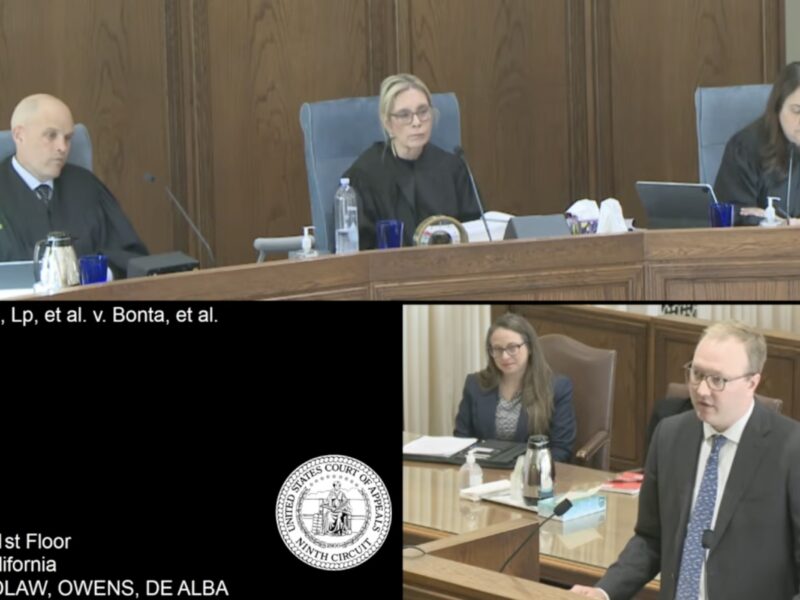
PASADENA, Calif. (CN) — A Second Amendment argument over the sale of long guns to young adults in the Ninth Circuit on Tuesday revolved around the customs and practices of firearm sales to young militia men during the country’s founding.
Invoking the images of young men taking up arms during the American Revolution, attorney William Bergstrom argued on behalf of two gun retailers that California’s prohibition on the sale of semiautomatic centerfire rifles to 18- to 20-year-olds and its prohibition of long gun sales to 18- to 20-year-olds without a hunting license violate the Second Amendment.
Bergstrom, representing plaintiffs Poway Weapons and Gear and North County Shooting Center, said young people are among those who are entitled to the Second Amendment and California’s laws are unconstitutional.
The plaintiffs say a federal court erred when it ruled California’s restrictions are merely a commercial regulation and do not otherwise impair Californians under the age of 21 from otherwise accessing firearms.
“At the founding, 18- to 20-year-olds were armed,” Bergstrom told the panel. “Today, they are trying to justify a law that boxes 18- to 20-year-olds out of the market, which is the most common way to get firearms. There is no way to square that circle.”
Citing the Militia Act of 1792, Bergstrom told three-judge panel there is no historical precedent for preventing adults under 21 years of age from purchasing long guns, particularly when all able-bodied men aged 18 to 45 were required by law to enroll in their state militia.
“The question is whether having a hunting license is an acceptable predicate to the right to keep and bear arms,” Bergstrom said. “Here, I don’t understand the state to be arguing that being a licensed hunter is a prerequisite to exercising your right. It’s just a special restriction they placed on 18- to 20-year-olds because of their age.”
Bergstrom argued the state may as well require long gun owners to also become organ donors.
U.S. Circuit Judge Kim Wardlaw, a Bill Clinton appointee, noted the topic was totally unrelated.
“But that’s my point, your honor,” Bergstrom said. “Hunting is totally unrelated to the use of firearms for self-defense. There are law-abiding people who exercised their right to keep and bear arms who are hunters and there are law-abiding people who exercised their right to keep and bear arms who are not hunters.”
The state’s ban on centerfire rifles, which includes AR-15-style rifles, for 18- to 20-year-olds is also illegal because it restricts the sale of a common type of firearm that the U.S. Supreme Court recognized as protected in its District of Columbia v. Heller decision, the plaintiffs say.
Bergstrom also pointed to the Supreme Court’s recent unanimous decision in favor of a man who habitually used marijuana and who federal investigators found to be in possession of a handgun. The federal government relied on historical drunkard laws to argue its case.
“The same argument is being made here, your honor,” he said. “The state is saying that because 18- to 20-years-olds at the time of founding were minors and were not responsible with money, we can say that they’re not responsible with guns either."
But Wardlaw didn’t appear convinced the hunting license requirement was especially burdensome. Similarly, U.S. Circuit Judge John Owens, a Barack Obama appointee, and U.S. Circuit Judge Ana de Alba, a Joe Biden appointee, also questioned whether the law violated the plain text of the Constitution.
“When I was a kid spending my summers in the Central Valley, my family had firearms," Owens said. “I had access to firearms and I shot them, but as a 12-year-old I didn’t think I had the right to go buy one — I mean I knew I couldn’t do that.”
Young people during the American Revolution could have been provided with firearms by their family, but Bergstrom said it’s reasonable to assume they would have also been required to purchase them too.
However, California Deputy Attorney General Jane Reilley contested many of Bergstrom’s arguments.
The hunting license includes long gun safety practices and is issued promptly after completing the course, she said. The law is not used abusively or to prevent people from exercising their Second Amendment rights, she said.
Additionally, Reilley argued the Militia Act of 1792 was enacted under much different circumstances.
“The militia laws are a national service requirement,” she argued. “It was a policy decision based on national security needs. It’s not reflective of a standalone constitutional right. We know that because states had the discretion to set the age of militia service higher than 18 and several chose to do so.”
Reilley also argued people under 21 would not have been expected to purchase firearms, because their parents were in control of their wages.
She also disputed Bergstrom’s argument this is the only constitutional right 18- to 20-year-olds are restricted from enjoying completely, citing Mississippi’s 21-year minimum age requirement to marry.
Tuesday’s oral arguments date back to a 2019 lawsuit challenging the state’s firearm restrictions. The Ninth Circuit previously ruled against the state in 2022 after it banned the sale of semiautomatic rifles to people under age 21. However, the case was vacated following the U.S. Supreme Court’s New York State Rifle & Pistol Association, Inc. v. Bruen decision later that year.
Subscribe to our free newsletters
Our weekly newsletter Closing Arguments offers the latest about ongoing trials, major litigation and rulings in courthouses around the U.S. and the world, while the monthly Under the Lights dishes the legal dirt from Hollywood, sports, Big Tech and the arts.