
 Search Articles


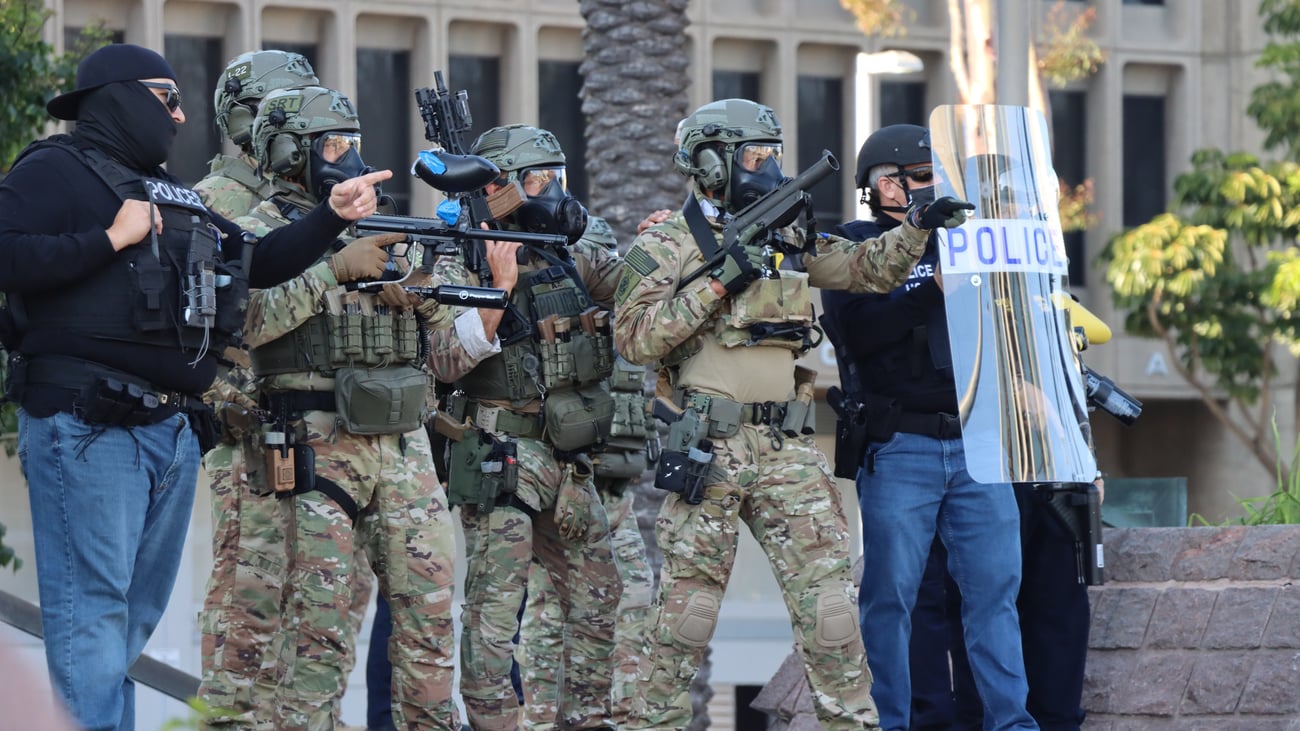
(CN) — A Ninth Circuit panel on Wednesday found the preliminary injunction a Los Angeles judge issued last year prohibiting U.S. Department of Homeland Security agents’ use of excessive and indiscriminate forces against journalists covering immigration-enforcement protests was too broad.
The three-judge panel agreed that the press organizations, individual journalists and legal observers were entitled to an injunction. However, they vacated the injunction by U.S. District Judge Hernán Vera nonetheless, because some of its provisions applied to people beyond the individuals and organizations who brought the lawsuit — a practice that’s been frowned upon in recent years by the U.S. Supreme Court.
“Peaceful protests and a free press sit at the core of our democracy,” U.S. Circuit Judge Ronald Gould, a Bill Clinton appointee, wrote in the unanimous order. “In light of the First Amendment to our Constitution, the government cannot properly silence the people or the press simply because the government disagrees with public protests, demonstrations, press reporting, orother speech criticizing the government.”
The panel said the journalists were likely to succeed on the merits of their claim that U.S. Immigration and Customs Enforcement and other DHS agents’ use of force against them amounted to retaliation for their coverage of the protests that erupted in Southern California in the wake of the Trump administration’s crackdown on immigrants that are suspected of living in the U.S. without legal permission.
“Because direct evidence of officers’ subjective motives is rarely available, plaintiffs may rely on circumstantial evidence to establish retaliatory intent,” Gould said. “And here, the district court cited an ‘avalanche’ of circumstantial evidence to conclude that plaintiffs’ First Amendment activity was a ‘substantial motivating factor’ for defendant’s actions.”
There was extensive evidence, the judge said, that federal agents repeatedly targeted journalists and peaceful legal observers who stood far from any protesters or bad actors, as well as evidence that DHS agents deployed crowd control weapons even when crowds were already dispersing or attempting to comply with orders to disperse.
Still, the panel said Vera had to redo the preliminary injunction as it applied beyond the plaintiffs in the case. For one, Gould wrote, the injunction prohibits Homeland Security from firing tear gas canisters or flash-bang grenades aimed at striking “any person.”
In addition, the panel found, insofar as the injunction exempts plaintiffs, as well as non-party journalists and legal observers, from lawful, non-retaliatory dispersal orders, it was broader than necessary to remedy the news organizations’ First Amendment claims.
The appellate panel also said that a provision of Vera’s preliminary injunction that required federal agents to give two separate audible warnings before deploying crowd control weapons wasn’t appropriate because the “necessarily subjective requirement for audibility of warnings invites strategic or near-frivolous contempt proceedings against the government’s responsible law enforcement agents.”
The other two judges on the panel were U.S. Circuit Judge Jacqueline Nguyen, a Barack Obama appointee, and U.S. Circuit Judge Mark Bennett, a Donald Trump appointee.
Representatives of the Justice Department, which represents DHS in the litigation, had no immediate comment on the decision.
“The Ninth Circuit’s opinion affirmed the critical role that protest and reporting have played in shaping our nation and upheld Judge Vera’s detailed findings that the government has been systematically retaliating against people for exercising their First Amendment rights,” Matthew Borden, of Braun Hagey & Borden, representing the plaintiffs, said in an email. “We intend to seek class certification in district court, which will enable broader relief down the road.”
In December of last year, the same panel had refused the administration’s bid to stay the preliminary injunction pending appeal.
Vera, a Joe Biden appointee, said last year journalists may be reluctant to cover protests from up close as a result of the excessive force used by federal officers and that this chilling of their exercise of First Amendment rights was in itself a constitutionally sufficient injury for the purpose of legal standing.
Moreover, he said in a decision last October, since the journalists who brought the lawsuit intend to continue attending and covering the very protests where federal officers have targeted or fired indiscriminately upon peaceful protesters, legal observers and reporters, they would be at risk absent an injunction.
“And plaintiffs cannot simply, as defendants suggest, attend protests and observe from a distance where they are out of range of crowd control devices, because defendants have fired on plaintiffs even when they were far from the center of protest activity,” Vera wrote.
 Follow @edpettersson
Subscribe to our free newsletters
Our weekly newsletter Closing Arguments offers the latest about ongoing trials, major litigation and rulings in courthouses around the U.S. and the world, while the monthly Under the Lights dishes the legal dirt from Hollywood, sports, Big Tech and the arts.
Additional Reads
 Judge greenlights suit over USS Bonhomme Richard fire April 1, 2026
 Man gets 4 years for cross-burning political hoax April 1, 2026