
 Search Articles


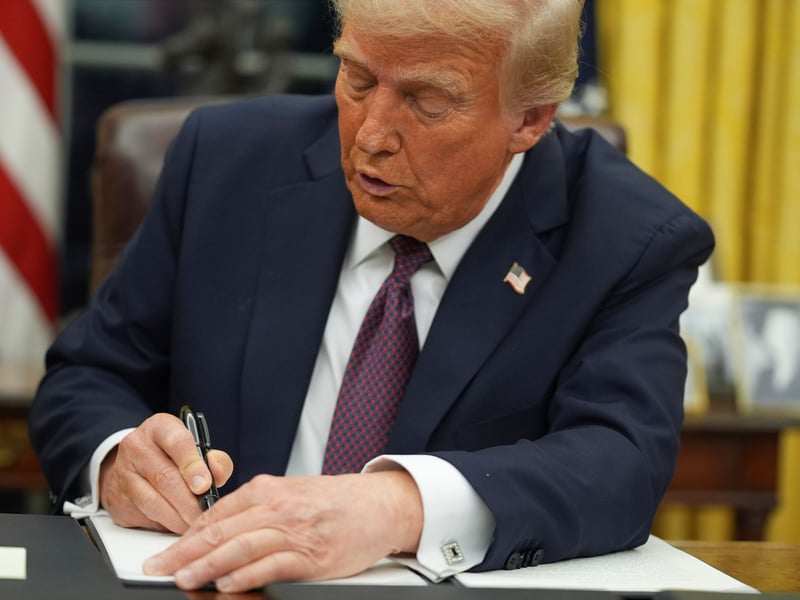
(CN) — A Ninth Circuit panel on Wednesday upheld a federal judge’s nationwide preliminary injunction of President Donald Trump’s Day 1 executive order that denied citizenship to children who are born in the U.S. but whose parents are unlawfully or only temporarily in the country.
In a split decision, the panel found the four states that brought the lawsuit — Washington, Arizona, Illinois and Oregon — had standing to challenge the executive order and that a nationwide injunction isn’t barred by a recent U.S. Supreme Court ruling, which without deciding the constitutionality of Trump’s limitation of birthright citizenship, found that lower courts couldn’t issue universal injunctions of the president’s order.
“The president has the power to issue executive orders if they stem either from an act of Congress or from the Constitution itself on matters that fall within that scope established by Article II,” U.S. Circuit Judge Ronald M. Gould, a Bill Clinton appointee, wrote for the majority. “But one power that the president was not granted, by Article II or by any other source, is the power to modify or change any clause of the United States Constitution.”
Senior U.S. Circuit Judge Michael Daly Hawkins, also a Clinton appointee, joined Gould in upholding the injunction.
They agreed in the first place that the four states suing the Trump administration had standing, because they claim the executive order would cause them economic injury by defunding and requiring substantial changes to existing public programs such as Medicaid and the Children’s Health Insurance Program among others.
The states provided evidence that more than 1100 infants born each month in their jurisdictions would be subject to the executive order, and, if those infants are denied citizenship, they will be ineligible for these federally backed state-run programs.
“States generally do not receive federal reimbursements based on services to individuals who do not have a lawful, qualifying immigration status,” Gould wrote. “The states accordingly allege that they will lose millions of dollars of contracted reimbursements that they would otherwise receive.”
The majority dismissed the claims brought by individual pregnant women as part of the lawsuit, because there is already a nationwide class action on their behalf pending in federal court in New Hampshire.
With respect to the recent Supreme Court opinion curtailing nationwide injunctions, the majority noted that that decision didn’t necessarily preclude injunctions that provide “complete relief” between parties involved in a lawsuit.
And in this particular case, the majority agreed that the trial judge hadn’t abuse their digression by granting a universal injunction, because the purported harm to the states isn’t restricted to the denial of citizenship to children born in their jurisdictions.
A state’s resident may give birth in a state that isn’t subject to a more limited injunction, and individuals subject to the executive order in such states will inevitably move to states where the executive order is preliminary enjoined, the majority reasoned. In order to account for this, the states would need to overhaul their eligibility-verification systems for Medicaid, the Children’s Health Insurance Program, and other federally funded programs.
“For that reason, the states would suffer the same irreparable harms under a geographically-limited injunction as they would without an injunction,” Gould said.
U.S. Circuit Judge Patrick Bumatay, a Donald Trump appointee, wrote in dissent that the four states purported pecuniary injuries were too speculative and contingent to give them standing to bring the lawsuit.
“State plaintiffs’ allegations of pecuniary injuries are riddled with contingencies and speculation,” Bumatay said. “Their theory of standing requires us to swallow two big pills — (1) state standing based on speculative assumptions about the indirect, downstream costs of federal government action; and (2) state standing based on predictions about how a federal policy might be implemented. Together, these concerns doom jurisdiction.”
The case before the Ninth Circuit is one of several in which judges have issued injunctions against Trump’s controversial limitation of birthright citizenship.
After the Civil War, lawmakers enshrined the 14th Amendment, which declares that “all persons born or naturalized in the United States and subject to the jurisdiction thereof, are citizens of the United States and of the state wherein they reside.”
Trump claims that people in the country illegally or temporarily are not “subject to the jurisdiction” of the U.S. and therefore are not necessarily citizens.
Judges in Washington state, Maryland and Massachusetts found that Trump’s executive order is likely unconstitutional, blocking its enforcement nationwide. Instead of challenging the merits of those rulings — whether limits on birthright citizenship are lawful — Trump asked the Supreme Court to review whether judges could freeze his policies nationwide.
“The Ninth Circuit affirms our nationwide injunction in birthright citizenship," Washington Attorney General Nick Brown said in a statement. “The court agrees that the president cannot redefine what it means to be American with the stroke of a pen. He cannot strip away the rights, liberties, and protections of children born in our country.”
Representative of the U.S. Justice Department did not immediately respond to a request for comment.
 Follow @edpettersson
Subscribe to our free newsletters
Our weekly newsletter Closing Arguments offers the latest about ongoing trials, major litigation and rulings in courthouses around the U.S. and the world, while the monthly Under the Lights dishes the legal dirt from Hollywood, sports, Big Tech and the arts.