Search Articles


RALEIGH, N.C. (CN) — The North Carolina Supreme Court struck down a decades-long landmark education case Thursday, claiming a lower court lacked jurisdiction to handle the case.
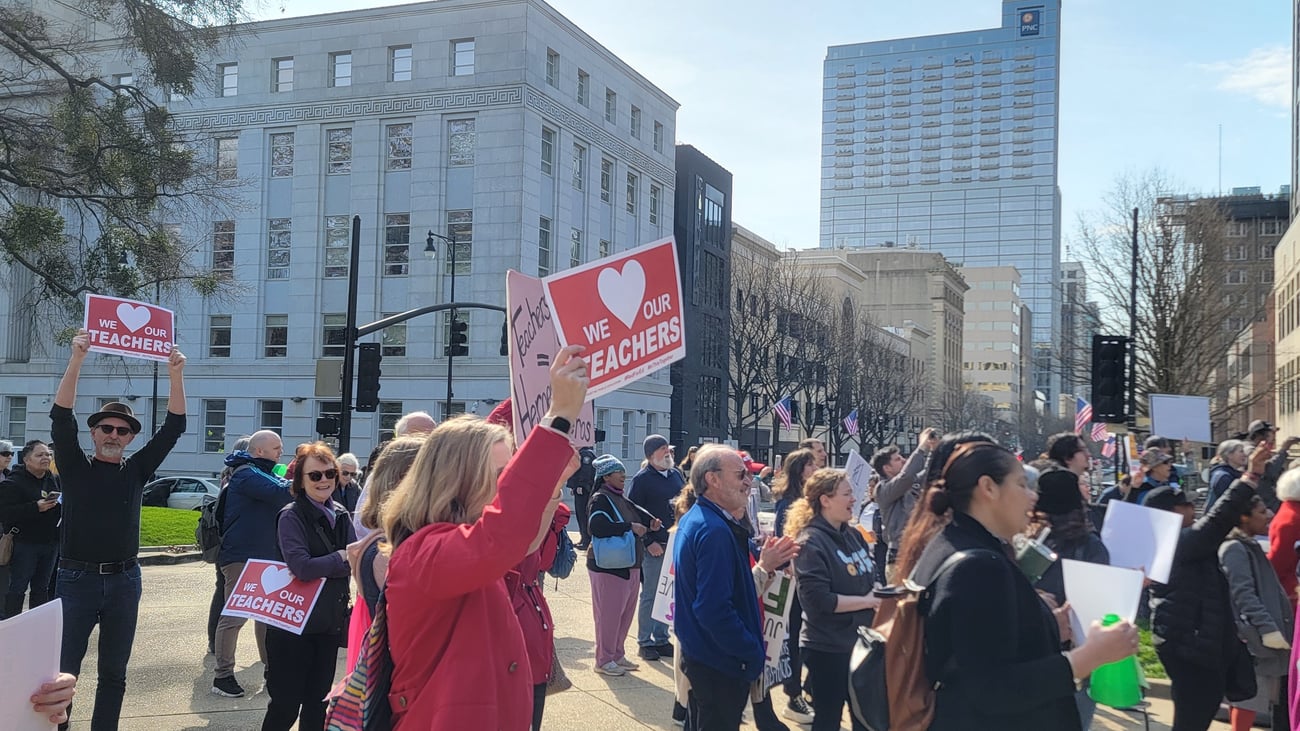
The 32-year-old case, which is often called the “Leandro” case after the last name of a middle-school plaintiff, concerns securing additional funding for K-12 public schools. Five school districts and families of their students filed suit against the state in 1994, arguing their districts weren’t getting enough funding to provide students with an equal education. The state’s highest court heard arguments in the case in February 2024.
The case has been heard five times before the state Supreme Court, which has ruled twice — once in 1997 and again in 2004 — that students have a right to a “sound basic education” under the North Carolina Constitution. The court decided in 2022 that the legislature must provide funding for a remedial plan to resolve funding inequality and resolve educational issues.
After the court’s political majority flipped from Democrat to a Republican-controlled 5-2 in November 2022, the justices voted to rehear the case. Funds had been caught in political limbo after a Superior Court judge told legislators in April 2023 that they owed over $677 million to address lacking education during recent school years.
Chief Justice Paul Newby vacated the lower court’s decision in the Thursday order, dismissing the case with prejudice and preventing it from being refiled. The decision was 4-3, with Republican Associate Justice Richard Dietz dissenting alongside the two Democratic justices.
“In our constitution, the people established a tripartite system of government,” Newby wrote in his opinion. “In doing so, the people did not vest the judicial branch with the power to resolve policy disputes between the other branches of government or to set education policy.”
“Judges are not experts on education policy,” he added. “We cannot account for the various policy alternatives or public opinion. Our consideration of cases is limited to the facts and evidence in the record and the dispassionate application of the law. In short, the judicial branch is not the venue in which to seek education policy reform.”
The case is fundamentally different from the one that was first filed in 1994, Newby said, holding that all court decisions filed in the case after July 2017 are void for lack of subject-matter jurisdiction. The lower court at that time worked with the parties to rework the educational system, he said.
The original plaintiffs’ claims focused on implementation of the education system in their respective districts, Newby said, and didn’t make a facial challenge, in which the plaintiff argues a law is always constitutional, instead of only unconstitutional in certain contexts.
“Since at least 2017, the trial court and remaining participants have openly sought a systemic overhaul of the public education system,” Newby said. “By the trial court and remaining participants’ own admission, the litigation no longer seeks redress for students just in the school districts named in the complaints; rather, they now purport to vindicate the rights of all students across the state.”
The court’s two Democratic justices dissented, with Associate Justice Anita Earls claiming the majority dismissed the case “on a hyper-technicality” that no parties argued. The state still isn’t meeting its educational obligations, she said.
“Today’s decision represents a sad day amongst the many days our state judicial system has allowed our children to languish in uncertainty and without the resources they need to start their lives as productive members of our society,” Associate Justice Allison Riggs, a Democrat, added in her dissent.
Attorney General Jeff Jackson said the state is still reviewing the order to determine what it means for public schools.
“We continue to believe our state constitution guarantees every child a sound, basic education,” he said in a statement. “We’ll keep pushing for the funding that public schools need to keep teachers in classrooms and students on track.”
Melanie Black Dubis, attorney for Hoke County plaintiffs, called the decision disappointing.
“The majority opinion rewrites the court’s past rulings and dismisses the case — leaving the state’s children with no remedy — because the ‘perfect’ procedural posture proved elusive,” she said. “The decision does not abrogate the constitutional right of every North Carolina child to the opportunity to a sound basic education. Nor does it reverse the finding in 2004 that the state of North Carolina violated the rights of certain North Carolina children. The majority opinion, however, abdicates the court’s role in enforcing the state constitution and defers to the ‘other branches of government’ to figure out how to do so.
“It is an extraordinarily disappointing and troubling decision,” she added. “The children of North Carolina deserve better.”
The office of Republican House Speaker Destin Hall, whose predecessor was an intervenor-defendant, asserted success in the case.
“Today’s decision rightly recognizes the constitutional role of the North Carolina General Assembly, since the state constitution entrusts sole appropriations authority to the legislature,” said Demi Dowdy, spokesperson for Hall. “House Republicans remain committed to investing in public education.”
“For decades, liberal education special interests have improperly tried to hijack North Carolina’s constitutional funding process in order to impose their policy preferences via judicial fiat,” added Senate President Pro Tempore Phil Berger, one of the intervenor-defendants in the case. “Today’s decision confirms that the proper pathway for policymaking is the legislative process.”
 Follow @SKHaulenbeek
 Follow @shaulenbeek.bsky.social
Subscribe to our free newsletters
Our weekly newsletter Closing Arguments offers the latest about ongoing trials, major litigation and rulings in courthouses around the U.S. and the world, while the monthly Under the Lights dishes the legal dirt from Hollywood, sports, Big Tech and the arts.