
 Search Articles


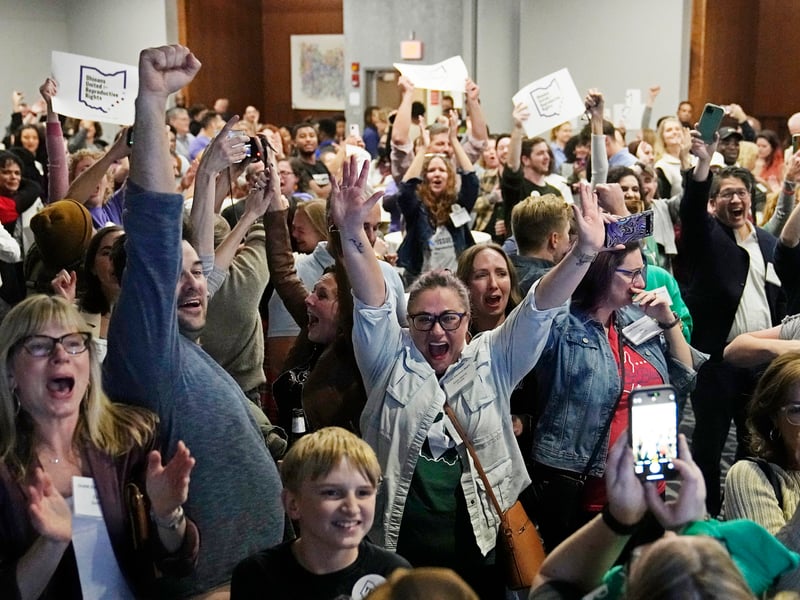
CINCINNATI (CN) — An Ohio court will have to reconsider the viability of several provisions in the state’s “heartbeat” abortion law after an appeals panel overturned parts of an injunction granted to abortion providers.
Preterm-Cleveland and several others won their legal battle against Ohio Attorney General Dave Yost in October 2024, nearly a year after voters enshrined the right to an abortion in the state Constitution by passing Issue 1 in 2023.
The abortion providers’ sued in response to the Ohio Legislature’s 2019 passage of Senate Bill 23, which outlawed abortion in the state after the detection of a fetal heartbeat.
Yost conceded the heartbeat provision of the law was unconstitutional after Issue 1’s success, but argued before Hamilton County Common Pleas Court Judge Christian Jenkins the remainder of the law was still enforceable.
Jenkins disagreed and struck down the law in its entirety when he issued the permanent injunction in 2024, a decision challenged by Yost before Ohio’s First District Court of Appeals.
Judge Candace Crouse wrote Wednesday’s opinion, the first issued by the district in 2026, granting Yost a remand to the Hamilton County court.
Crouse determined Jenkins erred during his severability analysis when he improperly considered the constitutionality of several provisions of Senate Bill 23 that Preterm-Cleveland hadn’t challenged.
These provisions include documentation requirements for doctors for abortion services they perform, and civil and criminal enforcement mechanisms.
Severability refers to a court’s ability to separate and strike down unconstitutional provisions of a law while leaving other parts intact.
Jenkins’s constitutional analysis was unnecessary and violated procedural rules, according to Crouse.
“Statutory provisions whose constitutionality have not been challenged — like the disputed provisions here — are presumptively constitutional, and should continue to be presumed so for purposes of a severability analysis,” she wrote. “A court’s power of constitutional review comes into play only as an incident of the need to resolve a dispute between parties.”
Crouse warned against courts morphing into “roving seekers of constitutional error, whether challenged or not,” and reminded Jenkins he was permitted only to examine whether the unchallenged provisions could operate in the absence of the unconstitutional heartbeat provision.
Preterm-Cleveland sought to have the appeals court conduct any additional severability analysis, but Crouse and the other judges on the panel opted to send the case back to Jenkins.
Crouse emphasized the court’s decision did not affect the injunction as it relates to the heartbeat provision, which Yost did not challenge in his appeal.
Attorney Jessie Hill, director of the Reproductive Rights Law Initiative at Case Western Reserve University and counsel for Preterm-Cleveland, told Courthouse News the decision would not affect abortion rights in Ohio.
“We’re pleased that the appeals court correctly kept the injunction in place as to the six-week ban, which the state agrees is unconstitutional under the Reproductive Freedom Amendment. Abortion remains legal in Ohio, and we will continue to fight to ensure that it remains legal and accessible and that the promise of the Reproductive Freedom Amendment is fulfilled,” she said.
Bethany McCorkle, spokesperson for the Ohio Attorney General’s Office, applauded the appeals court for enforcing procedural norms.
“We are pleased to see the appeals court agree with what we said all along — it is important for courts and parties to follow procedural rules. Here, proper procedure was not followed, so the appeals court ordered a do-over in the trial court,” she said.
Appeals Court judges Jennifer Kinsley and Ginger Bock also sat on the panel and concurred with Crouse’s opinion.
 Follow @kkoeninger44
Subscribe to our free newsletters
Our weekly newsletter Closing Arguments offers the latest about ongoing trials, major litigation and rulings in courthouses around the U.S. and the world, while the monthly Under the Lights dishes the legal dirt from Hollywood, sports, Big Tech and the arts.